

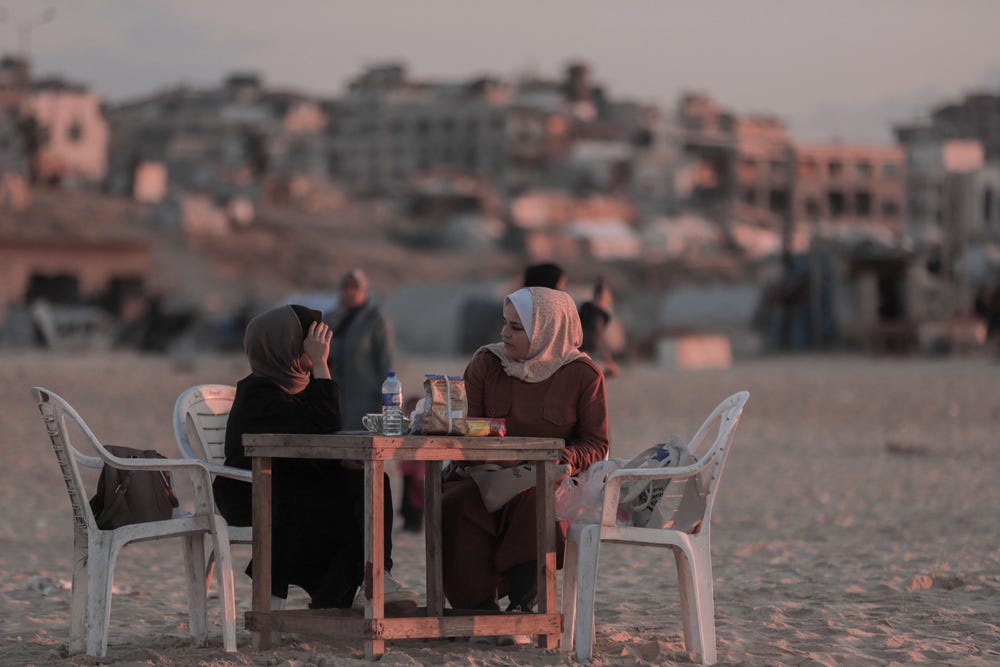
There has been substantial comparative analysis of the Ukraine and Gaza wars and criticism of the Western media’s portrayal of Ukrainians compared with Palestinians (Al-Najjar and Zaid, 2025; Ghani, 2025; Protect Journalists, 2023). However, there is limited gender analysis which places Palestinian women’s media representation in direct comparison with that of Ukrainian and Israeli women. The following research begins to close this gap by examining how the Western media’s coverage of contemporary war is not only shaped by gender but also by its intersection with race and ethnicity. This essay argues that Palestinian women are more likely to be undifferentiated, dehumanised, or completely erased than Ukrainian and Israeli women. The discursive choices of media outlets have been identified through two analytical approaches: Michelle Lazar’s (2007) Feminist Critical Discourse Analysis and Nadera Shalhoub-Kevorkian’s (2010) framework of the “politics of invisibility”. Before turning to these frameworks, however, it is first necessary to provide a brief contextual overview of the wars in Ukraine and Gaza and to define key terms.
Get E-International Relations delivered to your inbox, free. As you sign up, consider becoming a paid subscriber, or make a donation, to support our work.
On 24 February 2022 Russia launched a full-scale invasion of Ukraine, eight years after the annexation of Crimea (Britannica, 2026). The United States (U.S.) and North Atlantic Treaty Organisation (NATO) pledged solidarity with Ukraine and responded with a raft of sanctions against Moscow, as well as increasing defence, economic, and humanitarian assistance for Kyiv (Council on Foreign Relations, 2023). Since the 2022 invasion, more than 16,000 Ukrainian civilians and approximately 500,000 Russian soldiers have been killed (Statista, 2026a; Statista, 2026b; BBC, 2026).
The current Gaza war began on 7 October 2023 when approximately 1,200 people were killed and more than 200 hostages were taken by Hamas (British Red Cross, n.d.). This essay does not have the scope to analyse the significant and complex history between Israel and Palestine before this date, described by Radiatie et al. as “one of the most protracted political disputes in the history of world civilisation” (2025: 2). As such, this essay focuses on the Israeli government’s actions after October 7, including the bombardment of Gaza described as a genocide by the United Nations (2025). The total number of Palestinians killed has reached more than 73,000, with approximately 173,400 others wounded (Al Jazeera, 2026).
Having outlined the context of both wars, the essay now turns to its key terms: feminist International Relations (IR), gender, and the Western media. Feminist IR has long challenged the realist notion that the nation-state is the central actor in international relations, critiquing the exclusion, or complete absence, of women from traditional IR theory and practice (Smith, 2018). Gender is central to this investigation and is understood as a means of structuring power and social relations along masculine and feminine lines (Cohn, 2013). The empirical analysis focuses on two news outlets, which this essay refers to as the Western media: The New York Times (nytimes.com) and the Guardian (theguardian.com). They were chosen for their prominence and comparable archival access, although neither can represent the Western media as a whole, particularly given the fragmented nature of the 21st century media landscape (Groseclose and Milyo, 2005; Wells, 2004). Accordingly, references to media, mainstream media, or Western media throughout this essay denote these two outlets specifically. The analysis examines how these two outlets may reflect wider patterns in Western media discourse on war and women, rather than making generalised claims about Western media as a whole.
To examine how the mainstream media frames war, and how such representations marginalise the lives of women, particularly Palestinian women, this essay will adopt a Feminist Critical Discourse Analysis (Feminist CDA or FCDA). FCDA is a subcategory of Critical Discourse Analysis (CDA), which analyses “how discourse constructs, maintains, and potentially challenges social inequalities within various social contexts” (McLeod, 2024: 6). CDA, however, does not sufficiently centre gender and patriarchy in its analysis (Jamshaid and Saeed, 2026). FCDA addresses this gap by examining how discursive constructions reproduce, legitimise, and sustain gendered power relations. As Lazar defines it, FCDA investigates “the complex and diverse ways by which gender ideologies that entrench power asymmetries become ‘common sense’ in particular communities and discourse contexts, and how they may be challenged” (2017: 372). This makes FCDA a particularly valuable tool for examining the media coverage of the wars in Ukraine and Gaza, allowing analysis not only of the language and narratives used, but also of how they sustain gendered social arrangements (Lazar, 2007).
However, Lazar does note that mechanisms of power are not universal; rather, they are “produced and experienced in different ways for and by different groups of women” (2007: 147). Postcolonial feminist scholars such as Mohanty make a similar point, arguing that women should not be universalised as a “singular group on the basis of a shared oppression” (2003: 22). Therefore, this essay draws on postcolonial feminist scholarship and makes intersectionality central to its approach, specifically how race and ethnicity shape the Western media’s coverage of women in contemporary war. The marginalisation of Palestinian women is rooted in discursive choices that reflect Shalhoub-Kevorkian’s framework of the “politics of invisibility”. She describes this as a process linking the private lives of Palestinian women to the broader “global power game”, identifying militarisation and occupation as mechanisms by which their voices are silenced and their suffering rendered unrecognised (2010: 3).
To ensure that the scope of the study remained manageable and methodologically transparent, a set of selection parameters was established. For both the Russia-Ukraine and Israel-Gaza conflicts, time frames were deliberately selected to coincide with the periods when media coverage of women was most visible: 1 April – 30 April 2022 for the Russia-Ukraine war, 1 November – 30 November 2023 for the Israel-Gaza war, both periods coinciding with widely reported war crimes (Dawson, 2022; Al Jazeera, 2023), to which women are disproportionately vulnerable (OHCHR, n.d.). The search terms combined conflict-specific keywords with gender relevant terms, rather than retrieving all coverage and filtering the results afterwards. The following search terms were used: Ukraine, Russia, war, women, woman; and Israel, Gaza, war, women, woman.
Additionally, the sample was restricted to news, magazine, or feature articles reporting from within the conflict-affected regions (i.e. Russia and Ukraine; Israel and Gaza). Opinion pieces, live updates, daily briefings, or wire-service reprints were excluded in order to ensure the analysis reflected each outlet’s own editorial voice. The final sample is displayed in Table 1.
Before examining the discursive choices of the New York Times and the Guardian across the Israel-Gaza data set, it is important to briefly note the substantial criticism by journalists, academics, and media monitoring organisations levelled at the Western media for its pro-Israel bias and dehumanisation of Palestinians (Al-Najjar and Zaid, 2025; Ghani, 2025; Protect Journalists, 2023). This has manifested in discourses which have been criticised for “their one-sided coverage, selective terminology, and lack of balanced representation” (Ghani, 2025). This essay contends that a Feminist CDA reveals this bias to be compounded for Palestinian women specifically, leading to their almost complete erasure from the coverage of war. This is in line with world-renowned feminist scholar Cynthia Enloe’s warning that “if we don’t pay careful attention to women, all sorts of women, we won’t be realistic about war” (2023: 7). The Western media is unrealistic in its coverage of war because it systematically fails to individuate and humanise the women whose lives (and deaths) it reports on.
To begin, the Israel-Gaza data set reveals an asymmetry in how women held captive are described, with every Israeli woman designated a “hostage” and every Palestinian woman held by Israel labelled a “prisoner” or “detainee”. These framing choices are consistently repeated throughout both outlets’ coverage of the Gaza war as “commonsensical and natural”, but upon closer investigation these decisions reveal an obscuring of “the power differential and inequality at work” (Lazar, 2007: 147). This discursive language positions one group’s captivity as an atrocity and the other’s as an unremarkable fact of governance. The hostage-versus-prisoner framing demonstrates Andersson’s argument that Western media discourse tends to erase settler-colonial violence against Palestinian women by “ignoring the multiple sources of violence and power of settler colonialism as everyday material and symbolic realities” including “political imprisonment” (2023: 1022). The arbitrary detention of Palestinians, including Palestinian women, has been well documented by the United Nations (2024). These linguistic choices are more than a difference in vocabulary. By erasing the occupation and settler-colonial violence underpinning their detention, this framing marginalises Palestinian women, whose captivity does not register as a violation worth accurately naming.
The article titled “Hamas releases 24 hostages on first day of Gaza ceasefire” demonstrates this juxtaposition. It was published by the Guardian on 25 November 2023 and written by Jason Burke (male). The story focuses on the release of “hostages” and “Palestinians imprisoned”. It describes the “celebration” for the 13 Israelis who reached their home country, noting that “several were recognised by friends and neighbours from their kibbutz communities” and how Prime Minister Benjamin Netanyahu “hailed” their return, describing each of them as “an entire world”. The hostages are individuated and there are emotional quotes such as “I miss her very, very much. I want her to be back already”.
By contrast, the 39 Palestinians released on the same day are reduced to mere statistics and qualified by suspicion: “24 women, including some convicted of attempted murder… and 15 teenagers jailed for offences such as throwing stones – were also released”. Towards the end of the article the reporter does describe Palestinian families waiting “anxiously” in the West Bank, but there is a tone of criminality to the discursive choices: “escorted by armoured vehicles”, “reaching the Beitunia checkpoint”, and “bursts of firecrackers lit up the night sky”. Additionally, Malak Salman is the only Palestinian woman individuated; she was “arrested seven years ago for trying to stab a police officer in Jerusalem”. The article gives her current age (23) rather than her age at the time of arrest (16). Her mother is quoted accusing the police of stopping people from coming to their house. The article leaves both the woman’s arrest as a child and the police presence at her house unexplored.
These lexical choices exemplify a broader pattern of the erasure of Palestinian women within the mainstream media’s coverage of the Gaza war. This is what Shalhoub-Kevorkian (2010) describes as the “politics of invisibility”. She argues that visibility is an operation of power and that the “daily, private lives of [Palestinian] women are closely linked to global politics of seeing one side, while rendering the other ‘invisible’” (2010: 19). The challenge with this type of examination is that it relies as much on what has not been written as on what has. Shalhoub-Kevorkian argues that “the Israeli state constructs a security theology that operates at all levels of everyday life to silence and invisibilise women’s voices” (2010: 18). This claim is evident in the above hostage-prisoner framing but also in other lexical choices within the Israel-Gaza data set.
Applying Shalhoub-Kevorkian’s “invisibility” framework to the coverage of the Gaza war helps to explain why the media’s coverage of bombed feminised spaces, such as hospitals and schools, so rarely turns to the women within them. To write about Palestinian women’s experiences would complicate the dominant state-centric narrative used to justify war. One article which exemplifies this is “Israel Says Military Has Entered Gazan Hospital Grounds to Root Out Hamas”, published by the New York Times on 14 November 2023 and written by three men. The report, which focuses on claims that Hamas is hiding in Gazan hospitals, features no named women and eight named men. It describes how conditions for patients, “including about three dozen premature babies, have become bleaker at Al Shifa Hospital, which has been without power for days”. The application of a Feminist CDA to just this single sentence, coupled with Shalhoub-Kevorkian’s “invisibility” framework, reveals a series of significant absences. The mothers who gave birth to these babies are invisible, alongside any indication of their physical or emotional condition. The premature babies are described in similar terms to perishable food at risk from a power outage. Even the word “bleak” grossly understates the magnitude of what is being described.
There are many more examples within this article that demonstrate the “politics of invisibility” by which Palestinian women are erased within the coverage of war, but one other sentence warrants specific attention. It paraphrases the hospital’s director: “doctors there performed surgeries on Monday without anaesthesia and oxygen and that multiple people had died at the medical complex. He added that health workers had been forced to bury bodies inside the grounds”. This description comes just one sentence after the reference to premature babies but omits the possibility that many of the patients could have been women giving birth to these children. The United Nations has subsequently found that Palestinian women and girls died from “complications related to pregnancy and childbirth due to the conditions imposed by the Israeli authorities which have denied access to reproductive health care – acts which amount to the crime against humanity of extermination” (OHCHR, 2025). While this is not to suggest the journalists would have had retrospective data, this article had the opportunity to make Palestinian women visible and to link “women’s private lives with the global power game” (Shalhoub-Kevorkian, 2010: 19). Instead, this article emphasises threats to national security (i.e. Hamas hiding in hospitals), which reinforces the realist principle of state survival, rather than being realistic about what was happening to the women and girls within these medical centres.
This pattern is not confined to the coverage of the Gaza war. Turning to a comparison between the Ukraine and Gaza data sets reveals a stark contrast in how the Western media portrays Ukrainian and Palestinian women. A myriad of comparative analyses of the two contemporaneous wars have already pointed to widespread double standards in Western coverage of Ukrainians versus Palestinians, though without a specific gendered focus (Corbett, 2024; Omairi, 2025; The New Humanitarian, 2023). The portrayal of Palestinian women specifically has received less attention, and an application of a Feminist CDA reveals their dehumanisation to be more pervasive than that of Palestinian men. Across the data set, Ukrainian women are more than twice as likely to be individuated by profession or title as Palestinian women. When a Ukrainian woman is described as a “paramedic”, or a “volunteer”, or a “retired English teacher”, she is humanised and the reader is more likely to feel sympathy. By contrast, a Palestinian woman described only as a “26-year-old”, or a “42-year-old”, or as part of “women and children”, is dehumanised and her suffering rendered invisible (Shalhoub-Kevorkian, 2010). Templeton describes this pattern as a “hierarchy of grievability” in which “some lives are made visible to us, encouraging us to be grieved and be outraged, whereas others are depersonalised, forcing us to look away” (2025: n.p.).
There are two articles published by the New York Times which, when examined side by side, epitomise this discursive double standard. The first is “People flee Dnipro, once an island of calm, as the horrors of war approach” dated 19 April 2022 and written by Michael Schwirtz (male) and the second is “Palestinians and the U.N. report intense strikes in Gaza’s south” published on 18 November 2023 and authored by Karen Zraick (female). Both reports centre on civilians fleeing airstrikes. However, there is a notable difference in the lexical choices made for Ukrainian women versus Palestinian women. The first article describes the fear felt by two Ukrainian women: Angelina Deyeva, 27, who is leaving for Poland with three other women because “it has become too frightening” and Anastasiya Shapovalova, who is part of a “young couple”, “work[s] in television” and is “very worried about [their] child”. This contrasts with the textual choices in the Gaza war article. Maysaa Abu Daqaa is described only as “living east of the city of Khan Younis” and has left her home because “they told us to leave”.
Moreover, in the same Gaza article the death toll of 11,470 people, including 3,100 women, is qualified with suspicion: “the statistics do not specify how many of the dead were combatants”. Postcolonial feminist scholars would argue this asymmetry is rooted in hierarchies of race and ethnicity (Mohanty, 2003; Shalhoub-Kevorkian, 2010; Templeton, 2025). Ukrainian women are humanised and afforded the capability to have “real lived experiences, with families, friends, professions, and hardships”, while Palestinian women are dehumanised and not given “the same autonomy as we do not view them as ‘equal’” (Templeton, 2025: n.p.). This type of comparison is crucial to a thorough Feminist CDA, as Lazar contends, “only by attending to, instead of negating, difference can feminists identify and theorise more accurately the commonalities of gender oppression” (2007: 154).
This essay has highlighted a noticeable disparity in the Western media’s coverage of Palestinian women in the Gaza war when compared with their Israeli counterparts and juxtaposed with the women in the Russia-Ukraine war. It has applied an FCDA to reveal that “gender oppression is neither materially experienced nor discursively enacted in the same way for women everywhere” (Lazar, 2007: 149). Specifically, Palestinian women were more likely to be undifferentiated, dehumanised, or completely erased in the Western media’s discourse of war. A similar finding has been made by the Al Jazeera Media Institute, which examined the portrayal of Arab and Muslim women in Gaza by Western newspapers and news websites. It found that Gazan women faced a “very weak media representation” and that their suffering was “dealt with modestly, without mentioning those responsible for it, which dehumanises it” (Al-Eisai, 2025: n.p.).
Lazar describes FCDA as an act of “feminist analytical activism” and this essay has attempted to contribute to such advocacy by exposing how the “workings of power sustain oppressive social structures” (Lazar, 2007: 145). In undertaking that process of exposure, the analysis found that, despite decades of feminist and postcolonial scholarship, gendered and racialised hierarchies remain pervasive. They are sustained through the hegemony of gender ideology and everyday discourse in the Western media’s coverage of war, with Palestinian women among those pushed furthest into invisibility.
There were a multitude of other examples within the data set of 93 articles which exemplify the marginalisation of Palestinian women, but this essay only had the scope to examine a handful. A more detailed comparative analysis remains a valuable direction for future research, including a broader selection of outlets and time frames, as well as the potential addition of other contemporaneous wars.
Ultimately, Shalhoub-Kevorkian (2010) argues that the decision to “invisibilise” Palestinian women is deliberate, because power operates through visibility. This systematic erasure further exacerbates the suffering and marginalisation experienced by Palestinian women (Al-Eisai, 2025). To examine “women’s gritty wartime lived realities” (Enloe, 2023: 7) in Gaza is to challenge the dominant, state-centric realist narrative of conflict, revealing the human costs it depends on ignoring. It exposes those rendered invisible as “not static or absolute, but rather an owner of hidden power that should be feared” (Shalhoub-Kevorkian, 2010: 19). Palestinian women are rendered invisible because their visibility in the Western media would expose the inhumane suffering they have endured. It would also reveal the resilience, agency, and strength with which they resist it, the very “hidden power” that should be feared.
Table 1

References
Al-Eisai, S. (2025) “Western Media’s Double Standards on Muslim Women’s Suffering”, Al Jazeera Media Institute, 24 April, accessed at https://institute.aljazeera.net/en/ajr/article/2934, 12 August 2026.
Al Jazeera Staff (2026) “Israeli attacks on Gaza and occupied West Bank kill two, including child”, Al Jazeera, 24 June, accessed at https://www.aljazeera.com/news/2026/6/24/israeli-attacks-on-gaza-and-occupied-west-bank-kill-two-including-child, 26 June 2026.
Al Jazeera Staff (2023) “’Hospitals are not battlegrounds’: World reacts to Israel’s al-Shifa raid”, Al Jazeera, 15 November, accessed at https://www.aljazeera.com/news/2023/11/15/hospitals-are-not-battlegrounds-the-world-reacts-to-al-shifa-attack, 7 July 2026.
Al-Najjar, A. and Zaid, B. (2025) “Western media’s ethical collapse: silencing Gaza’s voice”, Third World Quarterly, accessed at: https://doi.org/10.1080/01436597.2025.2552361, 6 August 2026.
Andersson, T. (2023) “’Knowing’ Palestinian Women: Interrogating Western International Feminist Assumptions, Governance, and Social Science Discourses”, Critical Sociology 49(6): 1021-1036.
BBC (2026) “Almost 500,000 Russian soldiers killed in Ukraine war, GCHQ says”, BBC, 27 May, accessed at https://www.bbc.com/news/articles/c4g44gprnnvo, 26 June 2026.
British Red Cross (no date) “The Gaza Crisis: a timeline of the humanitarian impact and response”, accessed at https://www.redcross.org.uk/stories/disasters-and-emergencies/world/gaza-crisis-timeline#7-october-2023-attack-in-israel-and-escalation-of-conflict-in-gaza, 26 June 2026.
Burke, J. (2023) “Hamas releases 24 hostages on first day of Gaza ceasefire”, The Guardian, 25 November, accessed via Factiva (document no. GRDN000020231124ejbo000jp), 7 July 2026.
Cohn, C. (2013) Women & Wars, 1st edition (Cambridge: Polity Press).
Corbett, J. (2024) “Study exposes double standard for CNN and MSNBC coverage of Gaza v. Ukraine”, Common Dreams, 15 October, accessed at https://www.commondreams.org/news/ukraine-and-gaza, 10 August 2026.
Council on Foreign Relations (2023) “Ukraine: Conflict at the Crossroads of Europe and Russia”, accessed at https://www.cfr.org/backgrounders/ukraine-conflict-crossroads-europe-and-russia, 26 June 2026.
Dawson, B. (2022) “Reports from towns liberated by Ukrainian forces document alleged Russian atrocities, including rape and civilian corpses left on streets with hands tied behind back”, Business Insider, 3 April, accessed at https://www.businessinsider.com/liberated-ukrainian-towns-allege-russian-atrocities-of-rape-mass-killings-2022-4, 7 July 2026.
Enloe, C. (2023) Twelve Feminist Lessons of War, 1st edition (Oakland: University of California Press).
Ghani, F. (2025) “The Sharp Contrast: How Israeli and Western Media Cover the War on Gaza”, Al Jazeera Journalism Review, 5 March, accessed at https://institute.aljazeera.net/en/ajr/article/3081, 6 August 2026.
Groseclose, T. and Milyo, J. (2005) “A measure of media bias”, Quarterly Journal of Economics, 120(4), 1191-1237.
Jamshaid, W. and Saeed, M. (2026) “Feminist Critical Discourse Analysis of Gendered Power Relations in Pakistani News Media Texts”, Social Science Review 4(2): 731-741.
Lazar, M. (2007) “Feminist Critical Discourse Analysis: Articulating a Feminist Discourse Praxis”, Critical Discourse Studies 4(2): 141-164.
Lazar, M. (2017) “Feminist critical discourse analysis”, in Flowerdew, J. and Richardson, J. E. (eds.) The Routledge Handbook of Critical Discourse Studies. Abingdon: Routledge, 372-387.
McLeod, S. (2024) “Critical Discourse Analysis”, Simply Psychology, 28 June, accessed at https://www.simplypsychology.org/critical-discourse-analysis.html, 11 June 2026.
Mohanty, C. (2003) Feminism without Borders: Decolonizing Theory, Practicing Solidarity, (Durham, NC: Duke University Press).
OHCHR (n.d.) “Women’s human rights and gender-related concerns in situations of conflict and instability”, United Nations, accessed at https://www.ohchr.org/en/women/womens-human-rights-and-gender-related-concerns-situations-conflict-and-instability, 9 July 2026.
OHCHR (2025) “’More than a human can bear’: Israel’s systematic use of sexual, reproductive and other forms of gender-based violence since October 2023”, United Nations Human Rights, 13 March, accessed at https://www.ohchr.org/en/press-releases/2025/03/more-human-can-bear-israels-systematic-use-sexual-reproductive-and-other, 27 July 2026.
Omairi, H.T.L. (2025) “Content analysis of media coverage on Gaza and Ukraine conflicts”, Wasit Journal for Human Sciences 21(1): 868-881.
Protect Journalists (2023) “We condemn Israel’s killing of journalists in Gaza and urge integrity in Western media coverage of Israel’s atrocities against Palestinians”, Protect Journalists, 9 November, accessed at https://www.protect-journalists.com/, 6 August 2026.
Radiatie, N., Iskandar, W., Dasadwiastaning, V., and Morley, P. (2025) “Dominant Power and Its Bandwagoning Effect on Justice in the Middle East”, Islamic Research: The International Journal of Islamic Civilization Studies 8(1): 1-15.
Ray, M. (2026) “Bloody Stalemate: the war in 2025”, Britannica, 26 June, accessed at https://www.britannica.com/event/Russia-Ukraine-War/Bloody-stalemate-the-war-in-2025, 26 June 2026.
Rosenberg, M., Gavrielov, N. and Levenson, M. (2023) “Israel Says Military Has Entered Gazan Hospital Grounds to Root Out Hamas”, The New York Times, 14 November, accessed via Factiva (document no. NYTFEED020231114ejbe009q1), 7 July 2026.
Schwirtz, M. (2022) “People flee Dnipro, once an island of calm, as the horrors of war approach”, The New York Times, 19 April, accessed via Factiva (document no. NYTFEED020220419ei4j006mx), 7 July 2026.
Shalhoub-Kevorkian, N. (2010) “Palestinian Women and the Politics of Invisibility: Towards a Feminist Methodology”, Peace Prints: South Asian Journal of Peacebuilding 3(1): 1-21.
Smith, S. (2018) “Introducing Feminism in International Relations Theory”, E-International Relations, 4 January, accessed at https://www.e-ir.info/2018/01/04/feminism-in-international-relations-theory/, 20 May 2026.
Statista (2026a) “Number of civilian casualties in Ukraine during Russia’s invasion verified by OHCHR from February 24, 2022 to May 31, 2026”, accessed at https://www.statista.com/statistics/1293492/ukraine-war-casualties/?srsltid=AfmBOoogP309BJO-n1rKRwzgdtMoLd0RGASc3EriYsnJXzaK-avrHBdZ, 26 June 2026.
Statista, (2026b) “Ukraine War Casualties Monthly (2026)” accessed at https://www.statista.com/statistics/1318455/ukraine-war-casualties-monthly/, 26 June 2026.
Templeton, B. (2025) “Why is Western media dehumanising Palestinian women?”, The New Feminist, 4 September, accessed at https://thenewfeminist.co.uk/2025/09/why-is-western-media-dehumanising-palestinian-women/, 10 August 2026.
The New Humanitarian (2023) “Media coverage of Israel and Gaza is rife with deadly double standards”, The New Humanitarian, 23 October, accessed at https://www.thenewhumanitarian.org/editorial/2023/10/23/media-coverage-israel-and-gaza-double-standards, 10 August 2026.
United Nations (2024) “Detention in the context of the escalation of Hostilities in Gaza (October 2023 – June 2024) – Thematic Report by OHCHR”, United Nations, 31 July, accessed at https://www.un.org/unispal/document/thematic-report-detention-gaza-31jul24/, 6 August 2026.
United Nations (2025) “Israel has committed genocide in the Gaza Strip, UN Commission Finds”, Office of the High Commissioner United Nations Human Rights, 16 September, accessed at https://www.ohchr.org/en/press-releases/2025/09/israel-has-committed-genocide-gaza-strip-un-commission-finds#:~:text=Israel%20has%20committed%20genocide%20in,OHCHR, 30 December 2025.
Wells, M (2004) “World writes to undecided voters”, The Guardian, 16 October, accessed at https://www.theguardian.com/world/2004/oct/16/uselections2004.usa2, 6 July 2026.
Zraick, K. (2023) “Palestinians and the U.N. report intense strikes in Gaza’s south”, The New York Times, 18 November, accessed via Factiva (document no. NYTFEED020231118ejbi00335), 7 July 2026.
Emily Angwin is a freelance journalist working across South-East Asia. She holds a master’s degree in international relations from Queen Mary University of London.