

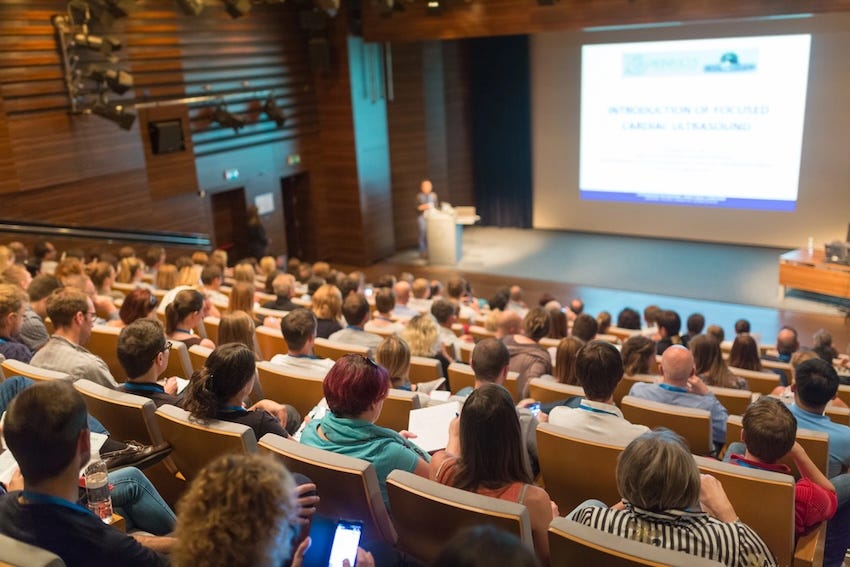
Whether large-scale or small, international or local, your first academic conference is always a nerve-wracking experience. Conferences are great places to present research and meet other scholars, but to get the most out of these events, it helps to start preparing early, ideally as soon as your abstract is accepted. Some PhD students might be fortunate enough to attend their first conference with someone they know, a colleague, co-worker, or their supervisor. But what do you do when you don’t have that support? How do you navigate your first conference on your own? As members of the British International Studies Association (BISA) Postgraduate Network (PGN) committee, we have written this article to share practical advice on how to prepare for, and what to expect at, a conference, symposium, workshop, or other academic event. Our network facilitates monthly events and a yearly conference for PhD students and early career researchers (ECRs) interested in international studies and politics, the latter of which is a fantastic space to present your own work and connect with other scholars at the forefront of their careers.
Get E-International Relations delivered to your inbox, free. As you sign up, consider becoming a paid subscriber, or make a donation, to support our work.
Choosing the right conference
Applying for a conference early is important: it enables you to find the most appropriate event to present your research and network at - which is imperative in a time of limited funding - and to decide what your expectations of this conference are. The best way of deciding which conferences might be most relevant to your research is simple: look at your own bibliography. Which journals appear repeatedly? Which scholars do you keep citing? Where do those scholars present their work, and which academic associations or specialist groups are they part of? By looking at the scholars and journals that appeared most frequently in our own research, the four of us, coming from different fields of International Studies and different universities, were led to the same place, BISA. We are now involved in the BISA PGN committee and aim to attend the conference every year. Asking yourself where the academic community you want to be part of is debating the most relevant issues is the best way to start selecting relevant conferences.
Before submitting your application, it is also worthwhile thinking about what you expect to get out of that conference. PhDs often treat conference attendance as a necessary academic step without considering what would make it useful for their research. Expectations might differ from event to event: at smaller (often discipline-specific) conferences you may want to refine a specific research idea, or get specific feedback on a paper draft from researchers within your field who are knowledgeable on your subject matter. At larger conferences (like BISA, for example), you may want to practise your presentation skills or simply meet new people and fellow researchers outside of your field of study.
The main objective of IR PhD students is often to leave a conference with something useful: a clearer argument, a new perspective, relevant contacts, or a better sense of what to do next. This means understanding both what is expected of us at a conference and what we want to gain.
Given the financial cost of conferences, you need to bring work an audience can meaningfully engage with. Choose something you can present in ten minutes and identify where you need help. Unfinished work can generate valuable feedback, but it still needs a clear question, approach, emerging findings, and an explanation of what remains unresolved.
For IR researchers, these conversations also reveal connections across contexts and intellectual traditions. Linking a specific empirical study to wider politics can be difficult. A large conference such as BISA lets us test whether those connections make sense beyond our immediate research circle and learn how others approach similar problems.
Finally, keep practicalities in mind: time, location, budget, and available funding should also factor into which conference you apply for. The most prestigious conference is not necessarily the best choice if attending it creates significant financial or logistical challenges.
Preparation starts before you arrive
Preparing for the conference is often considered the most important stage. Of course, if your first conference is online, then some of the advice regarding practicalities may be less applicable. Nevertheless, preparation is vital for all academic events. Familiarise yourself with funding options, register for the conference, and plan your journey well in advance, especially if you want to attend a much bigger (and busier) conference like BISA or the Political Studies Association (PSA). If you plan ahead, you will be more likely to secure accommodation closer to the event location, which can save you so much time when walking from your hostel, hotel or friend’s sofa. You might also be able to find funding opportunities at this time, as many larger associations offer student grants for conference attendance.
Do not leave it until the last minute to choose what panels or talks you want to go to. It is good practice to make a ‘conference schedule’ of sorts before you get to the event, just in case you are unable to access the online version of the programme on the day. Some conferences even have apps to help you create a schedule and find when and where you present or chair a session. However, remember to plan realistically rather than trying to attend everything. Conferences are often tiring, especially if you travel from overseas.
You could also identify any speakers that you want to network with or speak with in advance of the conference. Think of some questions to ask, and maybe even send them an email a week or two before the conference – you might always be able to arrange a meeting with them; you never know! But don’t be too upset if they don’t reply; academics are very busy after all.
Conferences are about people
Attending conferences also changes how you understand networking. It is tempting to approach conferences with a list of well-known scholars whose work you admire and hope to meet. Those conversations can certainly be useful, but some of the most valuable relationships are often with other PhD students and ECRs. These are the people whose careers develop alongside yours and who may later become colleagues, collaborators, or even co-authors.
Networking takes time. At your first conference, it can feel like everyone else already knows each other while you stand alone, unsure how to enter a conversation. Joining networks like BISA PGN or volunteering at conferences can help make this process easier. Participating in online events, such as online conferences, workshops, or talks, lets you connect with others virtually before you meet them face-to-face. You may go to your first conference knowing only one person, but that one person can introduce you to several others. One connection can very quickly become a network of fifteen. By your second or third conference, you may already have friends from different parts of the world, people you look forward to seeing again, and perhaps even a future collaborator. There is also another side to this. Once you have found your own circle, remember to introduce newcomers to it. There will always be someone attending their first conference, standing where you once stood and wondering how everyone else seems to know one another.
Presenting without panicking
Your presentation doesn’t have to be perfect, but you can do a few things beforehand to feel more confident speaking at your first conference. It is important to practice time management, so you leave enough time for questions and comments, which are often most useful to your research. During the Q&A, you may face challenging questions. Remember that people usually ask questions because they are genuinely curious or think their comments might help you, rather than to assess your level or test your knowledge. Many recognise that their questions come from their own research puzzles and may concern something you have not worked on. After attending hours of sessions, they may also be unsure whether they understood you correctly, so the person asking can be just as nervous as the person answering.
It helps to accept that you may not have an answer at that moment. A difficult question does not necessarily undermine your argument or invalidate what you know. You can always reply by thanking the audience for the question and saying that you will consider the comment.
One of the most reassuring realisations is that even a challenging comment from someone familiar, or from an academic whose work is well known and respected, does not constitute an immediate verdict on a research project. Feedback can instead be treated as something to reflect on carefully, assess in context, and respond to thoughtfully over time.
It can be useful to record the comments and return to them later, but not every comment has to become a revision. Different audiences interpret a project through different intellectual frameworks, and following every suggestion can easily pull a paper in contradictory directions. Learning what not to change can be as important as learning what to revise.
What happens between the panels
Some conferences can also offer unexpected opportunities. Publishers may bring large numbers of books to display, and on the final day, some exhibitors may give away display copies rather than take them back. If you see a book that is important for your dissertation or another project, it is worth asking at the publisher’s table whether they have a copy available. Conferences can be expensive for PhD students, so coming home with a book you need is a gift.
Conferences can also create opportunities beyond research. Academic associations, universities, think tanks, NGOs, and publishers may advertise jobs, internships, visiting positions, or funding opportunities. Informal conversations during coffee breaks can also lead to useful contacts, future collaborations, or information about opportunities that have not yet been widely advertised.
What you should expect from a conference also depends greatly on where you are going. At a very large conference such as the International Studies Association, you may need to be more self-sufficient during long conference days, including bringing your own coffee, snacks, or food. At BISA, the European Studies Association, and other conferences, scheduled coffee and tea breaks help you through the day. These may sound like small details, but when you are spending an entire day moving between panels, they matter.
Remember to enjoy it
A conference is not just a space to exchange ideas, get feedback on your work and build connections with other researchers. It’s also a fantastic space to make new friends and celebrate your academic achievements – so go on, have a good time! And if you are feeling nervous or struggling with imposter syndrome, remember that you don’t have to prove yourself to everyone in the room. Set yourself small, achievable goals: ask one question, introduce yourself to another PhD student, or join a conversation over coffee. If you are presenting, remember that you know your own research better than anyone else in the room, and you are not expected to have all the answers. Most importantly, don’t measure your conference experience by how impressive or confident you appear to others. You are there to learn, connect and enjoy yourself. After all, all work and no play makes Jack a very dull boy.
İpek Nil Ozat is a third-year PhD candidate in International Relations at Bilkent University and is Vice-Chair of the British International Studies Association (BISA) Postgraduate Network (PGN) committee. She has contributed to research projects involving archival research, qualitative text analysis, and political ethnographic research, including a TÜBİTAK-funded project. Prior to her doctoral studies, she gained professional experience at the Republic of Türkiye Ministry of Treasury and Finance and holds an MSc from Middle East Technical University, where she wrote her thesis on a critical geopolitical analysis of the Fergana Valley, and a BA from Hacettepe University. Her broader research interests include militarism and militarisation, feminist approaches to security, and critical geopolitics.
Jenni Rall is a PhD student in IR at Passau University and a scholar of the German Academic Scholarship Foundation. is Communications Officer of the British International Studies Association (BISA) Postgraduate Network (PGN) committee. Her research examines silence as a political and discursive practice in responses to mass atrocities, focusing on Gaza and Sudan. Drawing on critical constructivist approaches, she explores how silence in foreign policy discourse shapes political narratives, normative commitments, and international responses to atrocity crimes. She holds a BSc in Psychology and an MA in International Cultural and Business Studies. Her broader research interests include foreign policy analysis, human rights, atrocity prevention, feminist IR, and peace and conflict studies.
Genevieve Gunn is a second-year PhD student in Politics and International Relations at Cardiff University, where she researches the relationship between neoliberalism, far-right politics and gender. She is Events and Elections Officer of the British International Studies Association (BISA) Postgraduate Network (PGN) committee. Her thesis specifically examines how gendered discourses, hierarchies and identities are mediated within UK and US breakfast/morning television shows. Prior to starting her PhD, she achieved a first-class BScEcon in Politics and International Relations, and a distinction MA in International Relations from Cardiff University. She currently holds an ESRC-funded studentship to undertake her PhD research from the Wales Graduate School of Social Sciences (WGSSS).
Iris Magne is a PhD candidate in Russian and Eurasian Studies at King’s College London, where her research explores vaccine diplomacy across different world orders. She is Chair of the British International Studies Association (BISA) Postgraduate Network (PGN) committee. She is also a researcher on the Politics of Grievance and Democratic Governance (PLEDGE) project, funded by Horizon Europe and UKRI, and has conducted research at Columbia University. She holds a BA in History and International Relations from KCL and an MSc in International Relations from LSE. Alongside academia, she has conducted policy research at the House of Lords and the Downing Battcock Institute, University of Cambridge.
Editorial Credit: Scarlett Vickers