

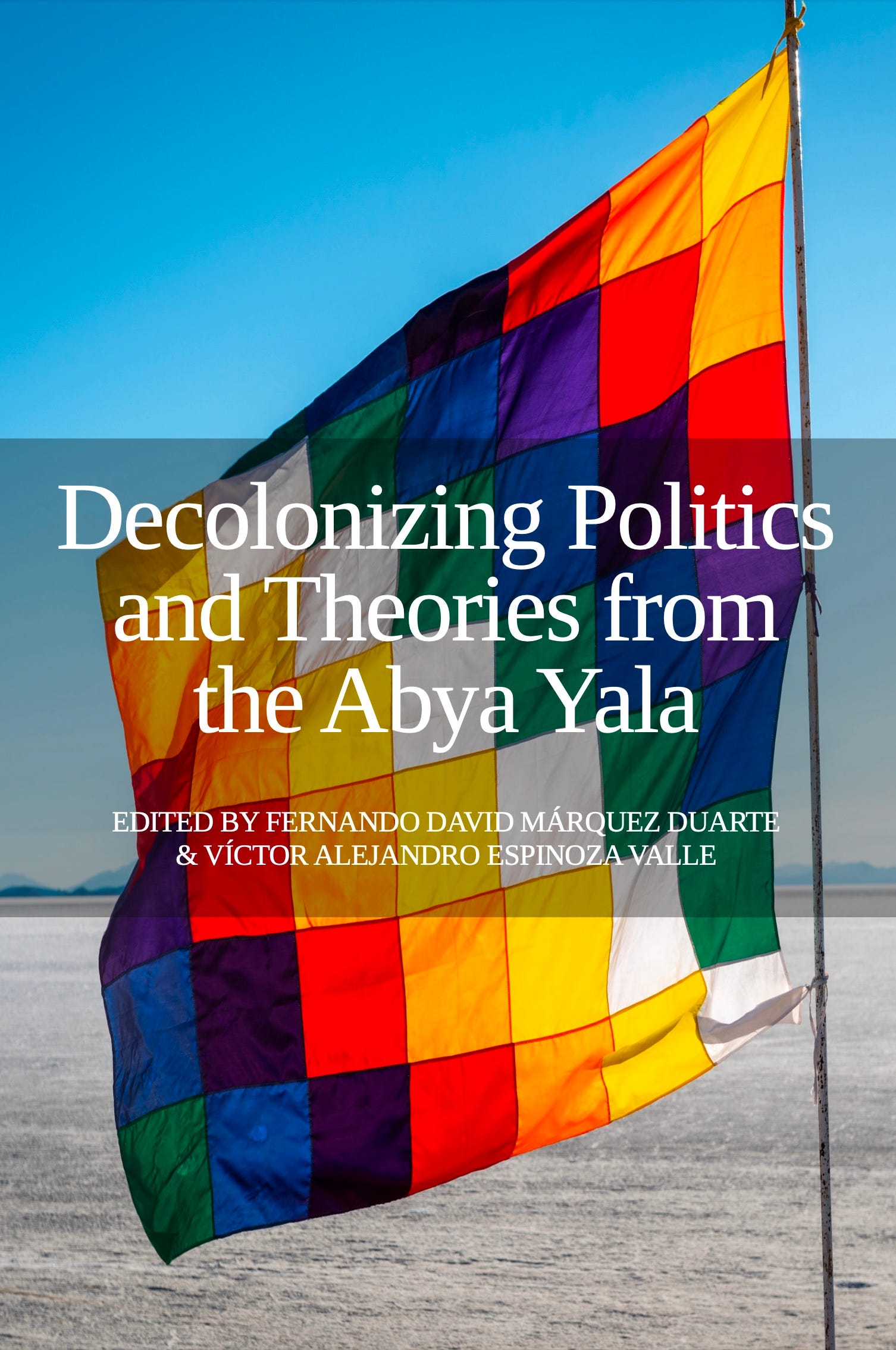
Download the book free of charge (below) or buy a paperback version on Amazon and in all good book stores.

This book addresses, from a decolonial approach, various aspects of the original history of Abya Yala. Together, the chapters provide a critical view of the colonization of Indigenous Peoples that not only explains social or economic subjugation of Latin American people, but also makes it clear that colonization is ontological and epistemological. It is a way of conceiving history and memory as subjugation imposed by those who set themselves up as lords and masters of the land and of the social and cultural heritage of Latin America. Thus, colonization must be conceived as a totality. Therefore, deconstructing the hegemonic vision of history is necessary in order to recognize the ancestral rights of Indigenous communities. The decolonial vision is radical in the sense that it goes beyond the European descendants or mestizo visions from which the explanation of Latin American development was constructed. This book aims to investigate the roots of hegemonic thought and provide theoretical and empirical tools to imagine other readings of Abya Yala.
Get E-International Relations delivered to your inbox, free. As you sign up, consider becoming a paid subscriber, or make a donation, to support our work.
Contributors: Rocio Arredondo Botello, Marina Bolfarine Caixeta, Francisco Javier Castellón Najar, Christian Crevels, Aura Cumes, Guilherme de Lima Souza, Ellen Monielle do Vale Silva, Sebastián Granda Henao, Carla Ladeira Pimentel Águas, Marcos Moraes Valença, Adriana Teresa Moreno-Gutiérrez, Etienne Mulume Oderhwa, Iran Neves Ordonio, Kenia María Ramirez Meda, Maria do Carmo Rebouças dos Santos, Alina Ribeiro, Valeria Victoria Rodríguez Morales, Miguel Alejandro Saquimux Contreras, Marina Scotelardo, Deisy Milena Sorzano Rodriguez, Christina Soto van der Plas.
What stands out to me is the connection between political power and the production of knowledge. Decolonizing analysis requires more than revisiting historical narratives; it also requires examining whose experiences, concepts, and forms of knowledge are treated as legitimate.
From a field-informed perspective, history is not only something interpreted from archives. It is also experienced through institutions, conflict, geography, displacement, memory, and the consequences of political decisions.
This creates an important bridge between lived experience and international relations theory: theory can explain patterns, while experience can test whether those explanations remain valid when confronted with reality.
— Wahidullah Noorzai (NIDA)
Former Senior ANCOP Officer | Field Strategist | Military & Security Analyst