

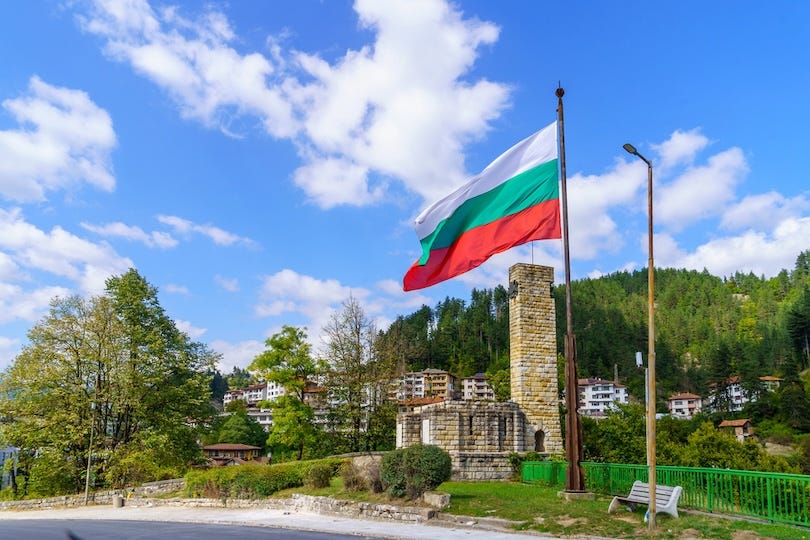
After 1989, the rapid dissolution of state socialism forced most Bulgarians to reckon with the political bearings and visions of a regime that had seemed strong and stable. Others were returning home after bearing the brunt of the so-called ‘Revival Process’ — the Bulgarian Communist Party’s final attempt at assimilating the Turkish and Muslim populations through a systematic policy of name-changing and the suppression of traditional attire and religious customs. That campaign drove 360,000 Turks and Muslims to seek refuge in Turkey between June and August 1989, culminating in what amounted to de facto ethnic cleansing — recognised as such by the Bulgarian Parliament only in 2012.
Get E-International Relations delivered to your inbox, free of charge. As you sign up, consider becoming a paid subscriber to support our work.
During that summer, the Party euphemistically depicted the long queues of those fleeing at the border and the gatherings at various train stations as ‘the great excursion’ of tourists heading off on their summer holidays. That rhetoric concealed not only the aftermath of the ‘Revival Process’ but also the history of the so-called ‘May Events’ of 1989 — the almost forgotten resistance of Turkish and Muslim populations that unfolded through freedom walks, hunger strikes, and grassroots protests demanding civil rights, religious freedom and the liberalisation of visa requirements.
The ‘May Events’ of 1989 put the Communist authorities under severe pressure, and they eventually allowed the ‘unpatriotic citizens’ to leave the country. Historicising both the resistance of Turks and Muslims and the overlooked complicity with the Party’s assimilation campaign would do more than uncritically explore the horrifying crimes of the ‘Revival Process’, in which victims have been portrayed only as passive. It would, for instance, unsettle the received account of the country’s peaceful transition to democracy, situating it within the far wider regional violence that erupted in Romania and tore Yugoslavia apart. It could also illuminate Bulgaria’s decoupling from the Global South during the late Cold War and the erosion of its already incoherent posture towards peoples’ decolonial efforts on the world stage.
Bulgaria’s Geopolitical Anxiety
While the echoes of the ‘May Events’ of 1989 resonated deeply in Turkey and across the Muslim world, the years of late socialism laid bare an age-old Bulgarian anxiety that neither socialism nor, later, the democratic transition succeeded in eradicating from the depths of society.
Before 1989, the final stage of the ‘Revival Process’ took place between November 1984 and late January 1985, following the tragic events of the summer of 1984. The bomb attacks at Plovdiv Central Railway Station and at Varna Airport convinced the Party that the country faced an existential security threat. In the Party’s reading, both events were the work of rising Turkish terrorism, which was gathering momentum through a subversive network of local Turkish agents, whose intent was to turn Bulgaria’s southern regions into a ‘Third Turkish Republic’. The Party’s geopolitical anxiety stemmed from the conviction that Turkey could easily replicate its 1974 invasion of northern Cyprus in Bulgaria, relying on the support of the Bulgarian Turkish population.
This misperception entered the Party’s secret intelligence reports, now declassified, which purported to show Turkey’s ambition to extend its geopolitical control over Greece, Cyprus, Iraq and Syria. Turkey’s so-called ‘new Ottoman plan’ never materialised, however, proving the Party’s intelligence wrong. Even as state violence against Turks and Muslims intensified during the 1980s, Turkey neither intervened in nor lent external support to the grassroots resistance that was led by members of the Turkish minority and that gave rise to the ‘May Events’ of 1989.
Among the leaders and spokespersons, Ahmed Doğan stood out: in 1985 he presented himself as a Marxist doctoral student and a prominent figure of the ‘Turkish national liberation movement in Bulgaria’. He was, however, an informant for State Security (Darzhavna Sigurnost), the regime’s secret police — as were other leaders of the Turkish movement, such as Mehmed Riza and Lyutvi Mestan.
The ‘New Light’ that Faded Away
Doğan’s political leadership brought the ‘May Events’ to a de facto end. It also failed to move the civic struggle of Turks and Muslims beyond ethnic and religious representation. By the time the fatigue of democratisation had eroded the premises of liberal multiculturalism, that struggle had hardened into a modern form of identity politics. Yet an alternative history — one of unrealised prospects for ‘democratising socialism’ — went largely unnoticed after 1989.
Aleksandar Lilov, the powerful Party cadre who initiated the transformation of the Bulgarian Communist Party into the Bulgarian Socialist Party, addressed the thorny question of the reintegration of the Muslim and Turkish communities in Bulgaria. In a long analysis published on 4 January 1990, Lilov acknowledged the arbitrariness of the ‘Revival Process’ and the acts of terror by which the name-changing campaign had been implemented. Lilov went even further by advocating a new phase of democratisation and socialisation of the former Party system in order to avoid a Cyprus-like scenario in Bulgaria.
Lilov’s analysis was published in Nova Svetlina, a daily established in 1945 and published bilingually (Нова светлина / Yeni Işık, meaning ‘New Light’) until 1970 to inform Bulgaria’s Turkish and Muslim masses. Lilov’s article carried particular weight precisely because the daily had itself been tasked with promoting the ‘Revival Process’, giving space to schoolteachers, university professors and journalists required to express joy and pride at the name changes.
Following Lilov’s appeal for ‘socialising socialism’, Nova Svetlina radically changed its editorial line. On 20 January 1990, the daily published the ‘Manifesto for Democratic Socialism in Bulgaria’ — a political declaration written for the Fourteenth Congress of the then-fading Bulgarian Communist Party. The text briefly summarised the history of Bulgarian socialism and asked: ‘What party do we want to be?’ The signatories firmly restated their Marxist positions and their desire to represent students and workers, and to champion intellectual labour and technological innovation. They also spelled out the need for the democratisation and decentralisation of the Party administration, and for the right to self-organisation among the different bodies of Bulgarian society.
In 1990, the daily returned to publishing bilingually. A wealth of polemics and commentaries asked how brotherhood among peoples might be restored, how to live together anew, and how to fight the syndrome of ‘Asian backwardness’ that haunted democratisation. Undoubtedly, the ‘Revival Process’ had taken a heavy toll on Bulgarian society, and the ‘democratisation of the Party’ could not repair the damage on its own. However, Nova Svetlina shed light on a new geography of pro-democratic voices that emerged from the most peripheral and rural areas of Bulgaria — Maidan, Yablanovo, Silistra, Karlovo — as well as the biggest Bulgarian cities. The daily reported on political rallies and on democratic unions of Pomaks and Roma demanding civil rights and equality, while most Turks and Muslims demanded the return of their original Turkish and Muslim names. In this regard, Nova Svetlina played a central role in supporting this civic campaign, publishing instructions on how readers could reacquire their original names at their local municipalities.
Party Cadres or State’s Enemies?
The history of the ‘May Events’ of 1989 raises a central question: beyond resisting state assimilation in late socialism, did Turks and Muslims ever develop their own project of political emancipation? Did the socialist framework pave the way for their self-determination within Bulgaria, or did they, like Yugoslav Muslims vis-à-vis the Non-Aligned Movement, seek an alternative path of emancipation outside the socialist context?
The journalist İsmail Cambazov recalled the tense atmosphere that Turkish and Muslim intellectuals had endured since the 1970s. In the wake of the 1974 Cyprus crisis, Professor Vasil Ivanov, then the Party cadre responsible for the Central Committee’s Department of Agitation and Propaganda, accused Şükri Tahirov (known also by his Bulgarianised name, Orlin Zakarov) of publishing the Bulgarian Turks and the Path to Socialism. According to Ivanov, the publication aimed first at agitating Turks in those regions where they constituted the ethnic majority, and second at launching a nationalist campaign for territorial autonomy. In his memoirs, Cambazov records his reply to Ivanov: ‘I’ve become a nationalist myself to protect my identity and self.’ Ivanov’s charge was itself an echo of the anti-Turkish propaganda that Nova Svetlina had been tasked with carrying after its ‘Bulgarisation’ in 1970.
On 12 March 1970, the daily underwent a process of ‘Bulgarisation’ after Decree No. 176 of the Central Committee of the Bulgarian Communist Party dismissed its leading figures — Hasan Tekkeliev, Süleyman Gavazov and Aziz Aliev, who had been with the paper since 1953 — while, ironically, expanding the number of contributors to 75 by late 1970. From then on, the foreign affairs section of Nova Svetlina was given over to interviews with Turkish dissidents and the alternative press, depicting Turkey as an ‘African state’, a country of the ‘Third World’, a lackey of the imperialist United States, and a broken democracy where basic rights were denied and state power violently crushed any form of dissent. On the same page, however, news from the decolonial world and the anti-imperialist voices of the Global South may well have reached — and informed — the Turkish and Muslim masses in Bulgaria.
In the 1970s, Communist Bulgaria reversed its earlier botched attempts to win the hearts of local Turks and Muslims. Between the 1950s and 1970s, Sofia and Baku established close cooperation, aligning their ‘patriotic education’ with the older Soviet model of channelling Muslim populations into a socialist state discourse. Communist Bulgaria’s ultimate objective was to solve the ‘national question’ for Turks and Muslims and to insulate them from the echoes of Kemalism and Turkish nationalism. Many young Turks became students at Azerbaijan State University and the Lenin Pedagogical Institute, where they had to re-master their Turkish language skills and knowledge of Turkish culture. Meanwhile, Azeri instructors and academics were invited to Sofia University to reorganise the curriculum in Turkish Philology.
Among the invited scholars and pedagogues, one name in particular drew attention: Nâzım Hikmet. The Communist credo of the renowned Trotskyist ‘poet of freedom’ was instrumentalised to boost the Party’s credibility among ordinary Turks and Muslims. The new educational axis between Sofia and Baku failed utterly, degenerating into a state-run exercise in mass pressure that sparked confusion among Turks over the new standardisation of the Turkish language and brought Muslims closer to their faith. After visiting cities and villages, holding private meetings with Party activists and interacting with an estimated 130,000 people, Hikmet himself concluded that Turks in Bulgaria did not understand Azeri.
In the 1980s, Nova Svetlina reported extensively on the Kurdish struggle for political autonomy. The right to political autonomy was praised by the Bulgarian Communist authorities when claimed by Kurds in Turkey, yet denied to the Turkish masses at home under the guise of socialist unity and brotherhood. Championing self-determination abroad while hijacking the calls for religious freedom and civic rights of Turks and Muslims at home was, in the end, an act of ideological speculation.
After the Liberal Takeover
The ‘return to Europe’ did not set democratisation in motion so much as decouple Bulgaria from its former socialist orbit on the world stage and reorient its geopolitical position within a Euro-Atlantic framework. While Turkey and Islam never ceased to assume an inevitable position of historical enmity within Bulgarian political discourse, Doğan and other leaders of the emerging Movement for Rights and Freedoms co-opted the liberal discourse of minority rights imported from the West in an attempt to make inroads into the new democratic institutions and whitewash their previous collaboration with the Communist regime. The Movement for Rights and Freedoms was thus led by the same Turkish dissidents who had largely collaborated with the Party and, after 1989, became the representatives of minority populations. Yet they failed to deliver justice or confront the crimes of the ‘Revival Process’. Not only were no senior Party officials or State Security collaborators ever put in the dock, but the Movement for Rights and Freedoms also remained deaf to the campaigns led by local Muslims calling for human rights. The grassroots protests of Pomaks held in Sofia in late December 1989 are instructive: protesters reclaimed their original names by chanting for ‘Unity’, ‘Democracy’ and ‘Ancestry’ and publicly reciting their Muslim prayer.
Bulgaria’s democratic transition allowed the Movement for Rights and Freedoms to establish itself within the new institutions, ironically cooperating with the Bulgarian Socialist Party in 1992. However, the project of ‘democratising socialism’ that Nova Svetlina advocated were recast as rigid postulates of ethnic and religious representation and boundaries. Doğan’s political party soon became an ‘enigma-within-an-enigma’; minority representation was captured within the then-newly established democratic institutions where representatives consolidated both the political and the cultural influence of the Movement among traumatised Turkish and Muslim communities. The party’s ‘grey zones’ led the wider public to accuse Doğan of ‘electoral tourism’ — mobilising dual Bulgarian-Turkish citizens at election time — and of stoking interethnic tensions across the country. The public use of Turkish at political rallies, as well as the party’s ties with authoritarian and nationalist figures in Turkey, further reinforced deep-seated Islamophobic and anti-minority sentiment among Bulgarians.
In recent years, the political and historical role of the Movement — and of Doğan in particular — has met with dissent and discontent among its traditional electorate. While internal divisions produced splinter groups struggling to make inroads into high politics — the People’s Party Freedom and Dignity, and the Democrats for Responsibility, Freedom and Tolerance — Bulgaria’s post-pandemic institutional standoff has confronted the party with yet another internal crisis. New Beginning, a splinter formation founded in 2024 by Delyan Peevski, appears to be gaining ground. Peevski, a Bulgarian media mogul who has nothing in common with Doğan’s history or political legacy, was sanctioned under the US Global Magnitsky Act for corruption.
Critical voices against Peevski’s political sabotage and his exploitation of Turkish, Muslim and Roma voters have been growing in Bulgaria. His success in the elections of late April 2026, however modest, reveals the newest phase of state capture: the Movement continues to represent Turks and Muslims in peripheral and rural areas, even as it has been reduced at the national level to a relic of the post-socialist order.
At the same time, a new generation of Bulgarian citizens of Turkish origin and of Muslims with neither experience nor memory of the ‘Revival Process’ remains largely unrepresented — politically distant from the old Turkish leaders and morally opposed to Peevski’s vote-buying. Their young voices are barely heard, and they themselves struggle to articulate alternative visions of democratic participation and emancipation with almost no political agency within the party proper.
Francesco Trupia is Adjunct at the Nicolaus Copernicus University in Toruń, and postdoctoral researcher at the CEU Democracy Institute in Budapest. His research focuses on the intersections of democracy, memory politics and minority groups in Southeast and Eastern Europe. After obtaining his PhD in Political Philosophy from the Sofia University Saint Kliment Ohridski, he has conducted his postdoctoral research at the Centre for Migration Research at the University of Warsaw, the Centre of Political History at the University of Antwerp, and at Humboldt University in Berlin. Francesco has also worked as a policy analyst for the Institute of European Democrats in Brussels, the Kosovo Foundation for Open Society in Pristina, the Caucasus Resource Research Centre in Yerevan. He is the author of “Islamophobia in European Cities: Solidarities, Responses and Dilemmas for Young Balkan Muslims” (Routledge 2025), “The Balkans and Palestine: Old Frictions, New Convergences” (Palgrave 2025) and “Rethinking Subalternity in Central-East Europe” (Transnational Press London).
Editorial Credits: Konstantina Oikonomou