

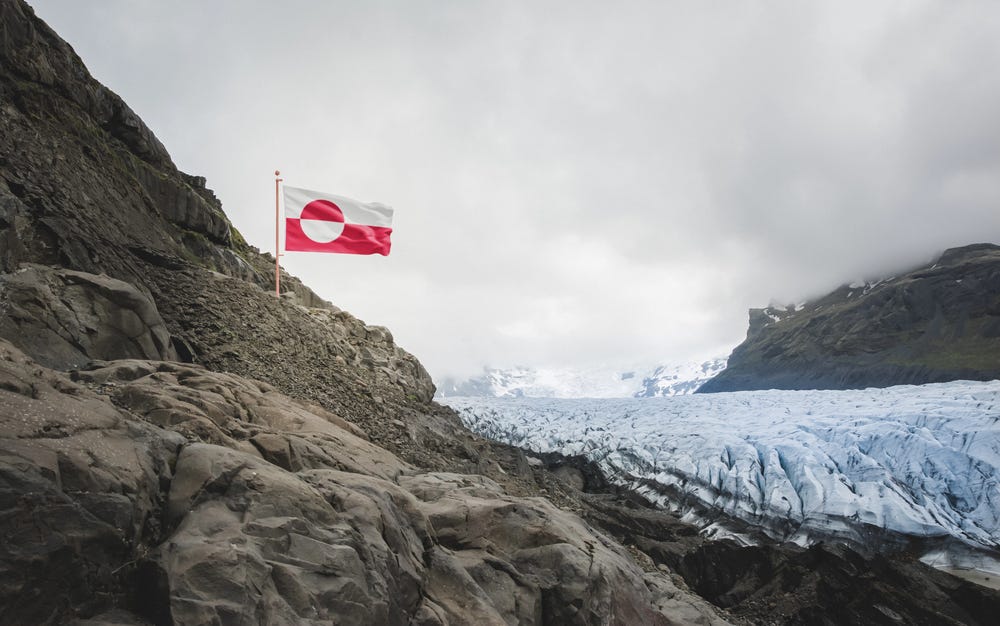
In a joint press conference on the 22nd of September 2026, the Greenlandic premier, Jens-Frederik Nielsen, and the Danish Prime Minister, Mette Frederiksen, announced that the renewed trilateral Arctic security agreement between the U.S., Denmark, and Greenland would not only strengthen the NATO alliance, but also reaffirm “the kingdom’s sovereignty and territorial integrity,” whilst respecting future Greenlandic self-determination. Hailed as a victory for Danish and Greenlandic diplomacy, the renewal of the 1951 Agreement on Greenland makes continued NATO membership a condition of the U.S. security presence on the island and appears – at least for now – to mark an end to recent U.S. threats of military intervention and annexation. Greenland was also a party to the negotiations, as it had been in the 2004 Igaliku Agreement, the 2026 agreement also being the first international agreement authenticated and executed in the Greenlandic language (kalaallisut). Yet as in 2004, participation did not translate into visible leverage. The substantive gains – new U.S. bases in Narsarsuaq and Mestersvig, American influence over future investment, the preservation of Danish sovereignty – went to the same two powers that have settled Greenland’s status in the mid-twentieth century.
Get E-International Relations delivered to your inbox, free. As you sign up, consider becoming a paid subscriber, or make a donation, to support our work.
The agreement’s central promise, to reaffirm “the kingdom’s sovereignty and territorial integrity,” rests on an assumption that Danish sovereignty over Greenland is the natural starting point from which Greenlandic self-determination may one day depart. This article argues that this assumption obscures more than it explains. Danish sovereignty over Greenland was not simply inherited; it was assembled in the early twentieth century through a series of bargains with outside powers, most notably the U.S., in which Greenlanders had little to no part. Seen in that light, despite Greenland gaining a seat at the negotiation table, the 2026 agreement is less a break with the past than its latest instalment.
Tracing Danish-Greenlandic-U.S. relations historically reveals how layered and contested sovereignty over Greenland has always been. I argue that Danish sovereignty was built and maintained through bargains with outside powers – first Norway, but above all the United States – and that today’s agreement sustains that relationship rather than breaking from it. This article first traces how Denmark secured recognition of its claim to all of Greenland, then examines how that claim came to depend on American power during and after the Second World War. It then draws on scholarship in international law, sovereignty and hierarchy to explain why this pattern has proved so durable.
Sovereignty by recognition
Originally colonised in 1721 by the Danish-Norwegian missionary Hans Egede, Greenland’s colonial status ended in 1953, after increasing pressure from the newly established United Nations. Greenland was subsequently integrated into the Danish Commonwealth as a constitutionally “equal” county – an equality that existed largely on paper (Natalia Loukacheva 2007). To get Greenland to Danish levels of welfare in the postwar world, the Danish government implemented the G50 and G60 Commissions to “Danify,” that is, to urbanise and improve general welfare conditions for the Greenlandic Inuit. Recent revelations have, however, revealed several injustices committed towards the Greenlandic Inuit since the incorporation into the Danish Commonwealth (see e.g., the ongoing IUD scandal, the “Little Danes Experiment,” or the birthright criteria that set up a dual-wage system). In 2023, the UN Rapporteur on the rights of Indigenous Peoples, Francisco Cali-Tzay, noted that Greenlanders living in Denmark still go through systemic racism and discrimination (2023). During the decolonisation negotiations in the early 1950s, the option of independence was never on the table; no Greenlander was present to negotiate the conditions of integration (Anne Kirstine Hermann 2021). Greenland later obtained Home Rule in 1979 and, in 2009, Self-Rule as an autonomous region, which also included a self-determination clause through a national referendum in Greenland. Today, Greenland receives an annual block grant (bloktilskuddet) of around 4.5 billion DKK (~ £516 million or $683 million), and Denmark oversees all borders and foreign affairs in Greenland, despite Greenland’s increased presence on the international stage. In addition to participation in the Arctic Council and the Inuit Circumpolar Council, Greenland was first represented in Igaliku in 2004, then, in 2008, alongside Denmark at Ilulissat, and most notably in the recent trilateral negotiations between Denmark, Greenland, and the U.S.
What Greenland holds, in other words, is self-government under Danish suzerainty: internal autonomy combined with external subordination, with Copenhagen retaining final authority over foreign and security policy. In 2014, Adler Nissen and Gad published a special issue in Cooperation and Conflict examining the conceptualisation and workings of “post-imperial sovereignty” within the Nordic context, that is, Denmark, Finland, Norway, and Sweden, as well as semi-or fully autonomous regions such as Åland, the Faroe Islands, Iceland, and Greenland. In this, they argued – echoing Iver Neumann (2014) – that the post-imperial situation can be understood as an imperial configuration that is transformed beyond the original hierarchy, from which new identities, groups, or even states emerge, which continues to dominate how we think about world politics (2014, 5). In this context, they argue that Greenland does not fit into any existing conceptual category of sovereignty within international relations or international law, due to particular self-governing arrangements (2014, 16). Although this may be true, I would push the argument further: from the 1916 Lansing declaration after the sale of the Danish West Indies, to the 1951 Agreement and its 2026 renewal, the imperial configuration that shaped Greenland’s sovereignty was always triangular, with the U.S. a constitutive third party. Post-imperial sovereignty in Greenland, in other words, cannot be understood within a Nordic frame alone. It has to be read through the history of bargains between Copenhagen and Washington that continue to define what sovereignty is in Greenland as well as what Greenlandic self-determination can mean today.
Sovereignty by contract
Despite the initial shock from the Trump Administration’s assertions, the bid to extend U.S. territory to Greenland is not new. Already in 1867, the Secretary of State, William H. Seward, acting under President Andrew Johnson, explored purchasing Greenland and Iceland from Denmark to expand U.S. geopolitical dominance, to both put additional pressure on Canada to join the union as well as applying the core principles of the Monroe Doctrine (Benjamin Mills Pierce 1868). The proposition was quickly scrapped in the U.S. Congress, due to the high cost and general political instability, but it was later revisited in 1910 by Maurice F. Egan, the U.S. Ambassador to Denmark acting under President William Taft, who suggested that the U.S. should buy Greenland from Denmark in exchange for Denmark gaining the Southern groups of the Philippines – a proposal which fell flat in both Danish and U.S. circles (Egan was the main facilitator behind the sale of the Danish West Indies to the U.S. in 1916-17) (Maurice F. Egan 1910). Nonetheless, when Denmark sold the Danish West Indies to the United States in 1916, it asked for something in return beyond the $25 million: a declaration from Secretary of State Robert Lansing that Washington would not object to Denmark extending its political and economic interests to the whole of Greenland (1916). This was significant as, at the same time, Norway was contesting the ‘rightful’ colonisation of Greenland, immediately after their own independence from Sweden in 1905. They argued that because Denmark and Norway were under one kingdom in 1721, and because Denmark had lagged in developing the Eastern coast of Greenland and mainly focused on the Western and Southern parts, then Norway should be able to claim East Greenland in the name of terra nullius. In 1921, this was further intensified when Denmark started seeking wider international recognition of sovereignty in Greenland (see e.g., Hans Christian Gulløv 2017). After a decade of diplomatic disputes between Denmark and Norway during the 1920s, Norwegian fishing boats occupied East Greenland in July 1931. In 1933, the Permanent Court of International Justice, however, ruled in favour of the Danish kingdom’s claim to sovereignty in Greenland, especially due to its extensive scientific knowledge of the area (especially polar exploration) and recognition of sovereignty by other major international powers, most notably from the U.S. (Permanent Court of International Justice 1933).
Seven years after the court ruled in Denmark’s favour, Denmark was under German occupation. With Denmark unable to govern or defend Greenland, the question of who controlled the island was settled in Washington, D.C. – between Denmark’s envoy, Henrik Kauffmann, and the U.S. government, and signed on the 9th of April 1941. In this agreement, Danish sovereignty over Greenland is fully recognised (1941, art. 1), but because the Danish state was unable to exercise its powers in Greenland during occupation, the potential seizure of Greenland by an adversary could pose a grave threat to national security on the North American continent. Therefore, in accordance with both the Monroe Doctrine and the Act of Havana, signed on 30 July 1940, the U.S. accepted the responsibility of assisting Greenland in the maintenance of its then status within the Danish Kingdom. To do this, Kauffmann signed off on granting the U.S. the right to construct, maintain, and operate military bases to set up landing fields, radio installations, among other critical infrastructure, as the U.S. would deem necessary – a near-unconditional access (1941, arts 2–5). After the 1941 Agreement, U.S. military bases opened in Narsarsuaq (Bluie West One), Søndrestrøm, Kangerlussuaq (Bluie West Eight), Grønnedal (Bluie West Seven), with smaller military setups in East Greenland.
During the Second World War, a renewed interest in acquiring Greenland emerged, which this led to an official proposal in 1946 under U.S. President Harry S. Truman, with the U.S. offering Denmark $100 million in gold (Foreign Relations of the United States 1947). This was rejected by the Danes, who instead offered to make the Thule Air Base permanent, which ultimately came into effect through the 1951 Defence Agreement, wherein Denmark and the U.S. formalised U.S. access to Greenland into a lasting framework. During the Cold War, the U.S. maintained 17 military installations and more than 10,000 military personnel; Thule Air Base (also known as Pituffik Space Base) is still functioning today with around 200 stationed U.S. military personnel (1951).
Why Small Empires Matter
In International Relations literature, Sebastian Schmidt has argued that U.S. military basing takes up an instrumental role in post-war global orders due to a reconfiguration of strategic relationships, whereby practices of sovereignty changed drastically (2020, 2, 5). Before the Second World War, permanent foreign military presence during peacetime was widely considered incompatible with sovereignty, as this would otherwise mean occupation or colonial subordination. After 1945, hosting U.S. bases through negotiated agreements came to be understood as an exercise of sovereignty, rather than a surrender of it. The conceptualisation of sovereignty, therefore, transformed with the establishment of U.S. bases in the U.S.-led post-war order. Policymakers thus gained something previously unavailable: the ability to grant foreign powers extensive military rights on their territory while remaining fully sovereign. The 1951 Agreement is a clear example. At the same time, however, as Alexander Cooley has argued, overseas bases are not merely military installations, but institutions and embodiments of U.S. power that become embedded in host states’ domestic politics, creating hierarchical arrangements in which hosts cede real control over parts of their territory (2008, 9–10; 2009). In Greenland, both were true at once: Denmark remained formally sovereign by ceding control over certain territories in Greenland. This was most famously seen in the forceful removal and displacement of Inughuit populations in northern Greenland in 1953 in the expansion of the Thule Air Base (Svend Aage Christensen and Kristian Søby Kristensen 2009).
Kenneth Waltz famously held that small states like Denmark “don’t matter” (quoted in Robert Cox 1992, 143, footnote 21): great powers make the international system, and lesser powers merely inhabit it (Kenneth Waltz 1979, 72–73). I argue the opposite. Denmark matters precisely because of its intermediate position – subordinate to Washington, yet sovereign over Greenland (see also John de Bhal 2023). Denmark matters not because it is small but because it was sovereign in more than one way at once: subordinate in one relationship, imperial in another. Following Grovogui, I argue that sovereignty has never been uniform across time and space: different institutional arrangements, governed by different rules, have produced different forms of sovereignty in different regions (2022, 316). This, arguably, makes sovereignty historically contingent, open and unstable, and cannot be studied apart from its relations to other concepts and contexts (Jens Bartelson 1995, 2). With the U.S. imperial centre governing the periphery through separate, tailor-made bargains running through Copenhagen, it may be possible to understand the U.S.-Danish imperial setup as a “hub-and-spoke” model, as per Nexon and Wright’s account of empire (2007).
Danish sovereignty over Greenland had always depended on American acceptance, but after April 1940, it depended on American power. It survived, in other words, because it was partly contracted away: Denmark kept the formal title by granting the U.S. extensive rights of use. The 2026 Arctic Security Agreement extends this logic beyond the military sphere. Alongside the enduring presence of U.S. forces, it bars investment from outside the EU and NATO, as well as the establishment of crewed or uncrewed military installations by third parties (2026, art. IX–X). In effect, Washington now holds a veto over who may invest in Greenland – a provision whose significance becomes clear when one considers the future of Greenlandic mining and its deposits of rare earth minerals – all crucial in the strengthening of a local and national economy. This raises an uncomfortable question: throughout the negotiations, both Copenhagen and Nuuk insisted on respecting the “red lines of sovereignty” – but if the U.S. must sign off on Greenland’s economic future, whose red lines have been protected? In other words, the enduring presence of foreign military instruments does bring the U.S. some political authority in Greenland – especially considering the permanent nature of the arrangements. According to Article XI, the agreement has no end date – unless any of the involved parties withdraw from NATO – and can only be amended by mutual consent (2026, art. XI). Strikingly, should Greenland exercise its right to self-determination and become independent, Denmark and Greenland are jointly obliged to ensure that the new state remains in NATO and assumes, from the day of independence, all of Denmark’s rights and obligations under the agreement. Greenland statehood, in other words, appears to be pre-negotiated or even pre-determined: the triangular arrangement is written into the conditions of independence, which is yet to happen.
Still between empires
The post-imperial sovereignty Adler-Nissen and Gad (2014) identify in Greenland is, in this light, not only Nordic but transatlantic – and the 2026 Agreement has written that triangle into Greenland’s future. As Adom Getachew has shown in her study of African and Caribbean anticolonial thinkers, formal independence without a change in the wider order can reproduce the very hierarchies it was meant to end (2019). Whatever path Greenland’s leaders choose, any future Greenland nation-state would inherit Denmark’s place in that triangle. From the 1916 Lansing declaration, issued alongside the sale of the Danish West Indies in support of Danish sovereignty in Greenland, to the agreements of 1941, 1951 (and 2004), and 2026, the terms of Greenland’s sovereignty have repeatedly been set in negotiations that it did not attend – or could not shape independently. Even Greenland’s formal decolonisation in 1953, when it was incorporated into Denmark, did not unsettle these arrangements but consolidated them – a story that deserves its own telling. Sovereignty, Adler Nissen and Gad remind us, is played strategically, and its exercise is “about maintaining control” (2014, 18). In Greenland, however, the question has always been: whose?
References
Adom Getachew. 2019. Worldmaking after Empire: The Rise and Fall of Self-Determination. Princeton & Oxford: Princeton University Press.
‘Agreement between Greenland, Denmark, and the United States of America Which Strengthens Defense and Security in the Arctic and North Atlantic.’ 2026. Udenrigsministeriet. New York City. September 22. https://um.dk/media/amjdsgal/aftale_eng.pdf.
Alexander Cooley. 2008. Base Politics: Democratic Change and the U.S. Military Overseas. Ithica and London: Cornell University Press.
Alexander Cooley and Hendrik Spruyt. 2009. Contracting States: Sovereign Transfers in International Relations. Princeton University Press.
Anne Kirstine Hermann. 2021. Imperiets Børn. Lindhardt og Ringhof.
Benjamin Mills Pierce. 1868. A Report on the Resources of Iceland and Greenland. Washington DC: Government Printing Office. https://archive.org/details/areportonresour00statgoog/page/n12/mode/2up.
‘Convention on Denmark’. 1916. U.S. Government Publishing Office. Washington DC. August 4. https://www.govinfo.gov/content/pkg/STATUTE-39/pdf/STATUTE-39-Pg1706.pdf.
Daniel H. Nexon and Thomas Wright. 2007. ‘What’s at Stake in the American Empire Debate’. American Political Science Review 101 (2): 253–71. doi:doi:10.1017/S0003055407070220.
‘Defense of Greenland: Agreement Between the United States and the Kingdom of Denmark, April 27, 1951’. 1951. Yale Law School. April 7. https://avalon.law.yale.edu/20th_century/den001.asp.
‘Denmark-United States: Agreement Relating to the Defense of Greenland’. 1941. The American Journal of International Law 35 (3): 129–34. doi:https://www.jstor.org/stable/2213493.
Foreign Relations of the United States. 1947. ‘The Secretary of State to the Legation in Denmark’. Office of the Historian. January 2. https://history.state.gov/historicaldocuments/frus1947v03/d414.
Francisco Cali-Tzay. 2023. United Nations Special Rapporteur on the Rights of Indigenous Peoples: Visit to Denmark and Greenland 1-10 February 2023. End of Mission Statement. Copenhagen: United Nations Human Rights Special Procedures.
Hans Christian Gulløv. 2017. Grønland: Den Arktiske Koloni. Copenhagen: Gads Forlag.
Iver Neumann. 2014. ‘Imperializing Norden’. Cooperation and Conflict 49 (1): 119–29. doi:https://doi.org/10.1177/0010836714520745.
Jens Bartelson. 1995. A Genealogy of Sovereignty. Cambridge: Cambridge University Press.
John de Bhal. 2023. ‘Rethinking “Middle Powers” as a Category of Practice: Stratification, Ambiguity, and Power’. International Theory 15 (3): 404–27. doi:doi:10.1017/S1752971923000118.
Kenneth Waltz. 1979. Theory of International Politics. Reading: Addison-Wesley.
Maurice F. Egan. 1910. ‘Minister Egan to the Assistant Secretary of State’. Office of the Historian. September 20. https://history.state.gov/historicaldocuments/frus1917/d759.
Natalia Loukacheva. 2007. The Arctic Promise: Legal and Political Autonomy of Greenland and Nunavut. Toronto: Toronto University Press.
Permanent Court of International Justice. 1933. Legal Status of Eastern Greenland 3–75.
Rebecca Adler-Nissen and Ulrik Pram Gad. 2014. ‘Introduction: Postimperial Sovereignty Games in the Nordic Region’. Cooperation and Conflict 49 (1): 3–32.
Robert Cox. 1992. ‘Towards a Post-Hegemonic Conceptualization of World Order: Reflections on the Relevancy of Ibn Khaldun’. In Governance without Government: Order and Change in World Politics, edited by James N. Rosenau and Ernst-Otto Czempiel, 132–59. Cambridge: Cambridge University Press. doi:10.1017/CBO9780511521775.
Sebastian Schmidt. 2020. Armed Guests: Territorial Sovereignty and Foreign Military Basing. Oxford: Oxford University Press.
Siba N’Zatioula Grovogui. 2022. ‘Regimes of Sovereignty: International Morality and the African Condition’. European Journal of International Relations 8 (3): 315–38. doi:https://doi.org/10.1177/1354066102008003001.
Svend Aage Christensen and Kristian Søby Kristensen. 2009. ‘Greenlanders Displaced by the Cold War: Relocation and Compensation’. In Historical Justice in International Perspective, edited by Manfred Berg and Bernd Schaefer, 111–31. Cambridge: Cambridge University Press.
Eva Leth Sørensen is a PhD candidate in the Political Science Department at Johns Hopkins University. Her work focuses on the Danish Empire, Greenland, decolonisation, international order, and hierarchies. Prior to joining Johns Hopkins, she was based at the London School of Economics, where she also worked as one of the Vol. 52 editors at Millennium: Journal of International Studies. She is currently visiting the Political Science Department at the University of Copenhagen.