

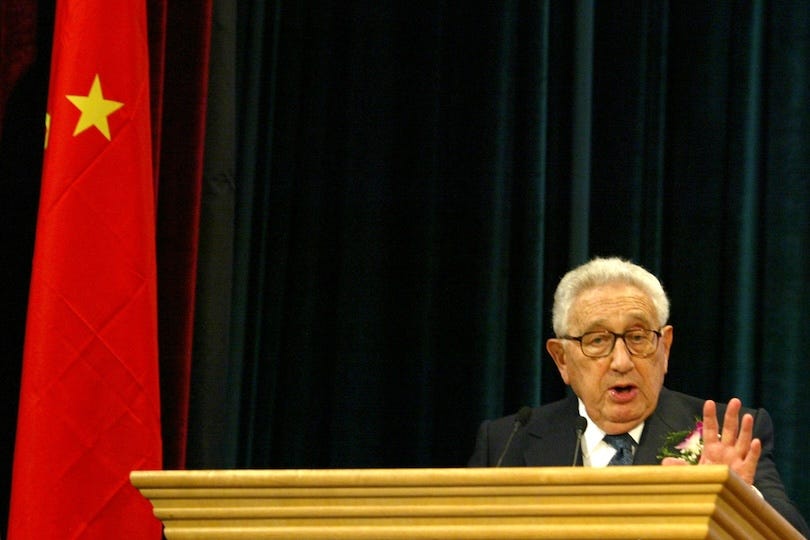
Henry A. Kissinger’s opening to China has long occupied a near-mythical place in the history of the Cold War. His secret trip to Beijing in July 1971, followed by Richard Nixon’s historic visit the following year, is often remembered as the quintessential act of geopolitical statecraft, with a master strategist exploiting the Sino-Soviet split, playing the “China card,” and transforming the Cold War balance of power. The durability of this interpretation is visible even in the U.S. Department of State’s own historical framing. In its summary of Foreign Relations of the United States, 1969–1976, Volume I: Foundations of Foreign Policy, 1969–1972, the Office of the Historian writes that “The national security advisor discovered that playing the ‘China card’ had worked its magic.” The formulation neatly captures a familiar interpretation of the opening. China mattered above all because it gave Washington new leverage over Moscow. Contemporary accounts had already helped cast Kissinger as a latter-day Metternich, an American Machiavelli (Fallaci 1977, 38-41).
Get E-International Relations delivered to your inbox, free. As you sign up, consider becoming a paid subscriber, or make a donation, to support our work.
Yet this familiar account begins with the outcome rather than the origins of the policy. Kissinger was neither a China specialist nor, for much of his intellectual career, particularly concerned with Asia. His understanding of international order was formed overwhelmingly through European history and the Atlantic world, and his early outlook bore a distinctly Anglophile and Atlanticist imprint (Ferguson 2015). China initially occupied only a marginal place within that worldview—not as the indispensable strategic partner it would later become, but as a disruptive power whose revolutionary politics, contested legitimacy, and potential nuclear capabilities posed problems for an international order Kissinger still understood largely in Atlantic terms. This marginal position also shaped Kissinger’s view of the Sino-Soviet split before he entered government. He was sceptical of proposals that the West should deliberately encourage the division between Beijing and Moscow. He regarded such a split as a stroke of good fortune, not an objective to engineer, warning that attempts to encourage it might drive Beijing and Moscow back together; it was more realistic to clarify and readjust Western purposes than gamble on uncertain fissures (Kissinger 1961, 202, 256).
The opening to China mattered for more than the geopolitical opportunity it created. It also changed the categories through which Kissinger understood international politics. During the Nixon administration, China was gradually redefined from a revolutionary and potentially destabilising outsider into a state with which the United States could negotiate, and which could be treated as a legitimate, “treaty-worthy” participant in international order. This article argues that the China opening should therefore be understood as part of a broader expansion of Kissinger’s diplomatic framework—from an Atlantic-centred conception of order towards a more plural system linking Europe, the Soviet Union, and East Asia. In this sense, Kissinger’s encounter with China helped expand the boundaries of the chessboard itself, from the Atlantic towards the Pacific.
Kissinger Before China
The intellectual path that eventually led Kissinger to China did not begin with China at all. Long before Beijing became central to his diplomacy, Kissinger was preoccupied with a different question: how political actors could create and sustain a legitimate order in a history that imposed constraints without determining outcomes. In his 1950 undergraduate thesis, The Meaning of History, Kissinger worked through Oswald Spengler, Arnold Toynbee, and Immanuel Kant to ask whether historical patterns left meaningful room for freedom, political judgement, and responsibility.
Spengler gave Kissinger a powerful sense of historical form and of the dependence of political institutions on accumulated practices, traditions, and legitimacy rather than formal rules alone. But Kissinger rejected the determinism towards which Spengler’s account tended. The tension was clearest in “Caesarism”: the condition in which shared traditions and legitimacy collapse and naked power become the final source of order (Kissinger 1950, 102-3). The concept would remain important in Kissinger’s later thinking about revolution, mass mobilisation, and fragile states, but he refused to treat such outcomes as historically inevitable. Political actors confronted constraints, but they also confronted choices.
Toynbee’s model appeared to offer a way beyond this fatalism. His model of ‘challenge and response’ offered more room for creativity and adaptation. Kissinger was especially interested in what he called “inward fitness”: the moral and political vitality that enabled a community to respond meaningfully to historical challenge. Yet Toynbee, too, seemed to substitute one form of historical necessity for another when endurance became evidence of purpose. Kant therefore supplied the decisive criterion. Kissinger drew from him a distinction between natural causality and moral autonomy. Historical circumstances might constrain action, but they could not relieve actors of responsibility. Peace, in the same way, was not a condition history guaranteed but a political and moral task to be realised through responsible choice (Kissinger 1950, 323-49). Diplomacy would later become one arena in which such “inward fitness” could be tested, as political communities sought to reconcile power with legitimate purpose and responsible restraint.
These ideas became a historical grammar that Kissinger later carried into international politics: legitimacy mattered more than formal stability, revolutionary power was dangerous when it denied the legitimacy of the existing order, and political judgement remained necessary even under severe constraint. His doctoral dissertation, later published as World Restored, translated these concerns into the problem of reconstructing international order after revolutionary disruption. The continuity was especially visible in his treatment of Napoleon. Spengler’s “Napoleonism” became, in Kissinger’s account, a form of Caesarist revolutionary power that had overturned Europe’s existing legitimacy without creating an accepted alternative (Kissinger 1950, 103). The problem facing Castlereagh and Metternich was therefore not simply how to defeat France, but how to turn revolutionary disorder into a sustainable order.
Yet World Restored was not a mere celebration of Metternichian Realpolitik. Metternich represented both the achievement and the danger of conservative statecraft. He recognised the need to restrain revolutionary disruption, but his rationalist conception of an objective order encouraged him to treat political arrangements as fixed laws that could be preserved through manipulation (Kissinger 1964, 319). Castlereagh offered a different model. His effort to transform a temporary coalition against Napoleon into a durable framework of restraint and cooperation better reflected Kissinger’s view that legitimate order had to accommodate historical change rather than freeze it. Conservatism, in this sense, meant preserving legitimacy while incorporating change gradually and limiting excessive political claims (Kissinger 1979, 1062-4).
During the late 1950s and 1960s, these arguments were recast once again in The Necessity for Choice and The Troubled Partnership. The problem of legitimate order became the problem of the political vitality of the Atlantic world. Kissinger asked whether the United States and its European allies possessed not only sufficient power but also a shared sense of purpose and responsibility capable of sustaining the alliance. Nuclear strategy and alliance management therefore became tests of whether American commitments were credible and whether the Atlantic system possessed the internal cohesion necessary to survive crisis. Hence, Kissinger argued that Europe should no longer remain under American “tutelage”, but should become a partner in the management of the common order (Kissinger 1965, 234). Rather than dissolving European autonomy through integration, the United States should enable its allies to preserve their sovereign interests while assuming greater responsibility for sustaining the Atlantic system.
China exposed the limits of this Atlantic conception of partnership. China did not fit neatly into Kissinger’s category of newly independent states. He nevertheless viewed it through a related set of anxieties about revolutionary legitimacy, mass mobilisation, Caesarist authority, and nuclear proliferation beyond the Atlantic system. Unlike Europe, China could not yet be imagined as a partner sharing responsibility for an established order (Kissinger 1961, 240–1, 311; Kissinger 1965, 233–36). It therefore appeared as a boundary case in which his earlier concerns about revolutionary power and political legitimacy intersected with the question of whether an Atlantic-centred order could manage powerful actors beyond its established boundaries. By the time Kissinger entered government, then, he possessed no ready-made theory of China. What he carried with him was instead a vocabulary of legitimacy, restraint, responsibility, revolutionary power, and political adaptation through which China would initially be understood.
China Becomes a Diplomatic Actor
After 1969, the change in Kissinger’s approach involved more than assigning Beijing greater strategic importance. It also meant reconsidering the terms on which China could participate in international politics. Before entering government, Kissinger had largely encountered China through the categories of revolutionary power, political instability, and nuclear proliferation. Once in office, however, the question increasingly became whether the United States could deal with China as a sovereign political actor whose choices could be negotiated and incorporated into a wider diplomatic settlement.
This change should not be read backwards as the execution of a fully formed strategy for reconstructing international order. The more immediate problem was Vietnam. Kissinger’s initial interest in opening a channel to Beijing was closely connected to the Nixon administration’s search for a way to withdraw from the war without appearing simply to accept defeat. China, as one of North Vietnam’s principal supporters, offered a possible way of widening the diplomatic space within which the conflict could be managed. Only gradually did the meaning of the China relationship expand beyond Vietnam, as Beijing became connected to the Soviet relationship, the rise of Japanese nationalism, alliance management, and the wider diplomacy of détente. What later appeared as a coherent global linkage therefore emerged incrementally from a more immediate political problem rather than from a master plan conceived in advance (Lord 2019, 48; Kissinger 1979, 31, 41, 418, 711).
Nor did Nixon and Kissinger invent the idea of improving relations with China. China specialists and State Department officials had already proposed changes in American policy, including reconsideration of Beijing’s representation at the United Nations and diplomatic status. Yet much of this advice remained cautious. China specialists tended to prioritise representation and recognition, while the State Department remained more receptive to direct contact if Beijing moved towards greater participation in international society and conformity with international legal norms. What distinguished Nixon and Kissinger was their greater willingness to test political engagement before such prior changes had occurred. Kissinger increasingly treated Beijing as a sovereign political authority with which the United States could bargain even while fundamental disagreements remained unresolved (Kissinger 1979, 834, 850-1). This did not require Kissinger to abandon his earlier suspicions about revolutionary politics. Kissinger could still describe Mao Zedong in terms of highly centralised, even Caesarist, authority (Kissinger 1979, 1057). The significant change was that such characteristics no longer automatically placed China beyond the boundaries of meaningful diplomacy. Political difference itself was no longer sufficient grounds for exclusion from negotiated order.
The Sino-Soviet split likewise acquired a different practical significance. Before entering government, Kissinger had been sceptical of deliberate attempts to encourage the division between Beijing and Moscow, regarding it as a favourable development if it occurred rather than a Western strategic objective. Once in office, however, the existing Sino-Soviet conflict provided a geopolitical condition through which China’s recovery of international status could be connected to American interests. Beijing’s return to international politics and the use of Sino-Soviet rivalry were therefore not separate questions. China’s re-emergence could be accommodated while being situated within a broader effort to constrain Soviet power and readjust the balance in Asia (Kissinger 1979, 691, 702). This was why China’s representation at the United Nations acquired importance beyond the institutional question itself. Kissinger did not regard Beijing’s entry into the UN as the cause of rapprochement; his first secret visit had already taken place. Rather, the transfer of China’s representation to the People’s Republic in October 1971 publicly confirmed a change already taking place in practice. China was becoming a legitimate and “treaty-worthy” participant in international politics. Kissinger increasingly regarded Beijing’s return to the international stage as a development that the United States could neither simply prevent nor passively observe. The question, as he framed it, was whether Washington would merely react to change or attempt to shape events purposefully (Kissinger 1979, 770, 776).
Here the vocabulary Kissinger had developed before entering government returned to the foreground. He had long rejected the idea that political actors could escape responsibility by treating historical change as inevitable. If China’s re-emergence could not be reversed, the United States still had a responsibility to influence the form it would take. Kissinger retrospectively described his method as a form of political realism, but this did not mean that power had become an end in itself. In his own understanding, secret diplomacy, bureaucratic manoeuvre, and executive discretion served a larger purpose by helping to construct a more stable order in which China could be incorporated as a legitimate participant. In this sense, his China policy combined what might be called a Kantian purpose with increasingly Bismarckian means (Kissinger 1979, 182). The tension lay precisely there. The pursuit of an order justified in the language of responsibility increasingly depended on coercive and discretionary methods that could narrow the meaning of that responsibility itself.
Taiwan exposed both the possibilities and the costs of this approach. Kissinger increasingly treated it not as an isolated bilateral dispute but as part of a wider set of questions involving Chinese security, Soviet pressure, Japanese nationalism, and the regional consequences of Vietnam. The Shanghai Communiqué gave this logic a diplomatic form. Washington and Beijing did not resolve their fundamental disagreements over Taiwan; instead, each retained its basic position while placing the dispute within a longer process of regional adjustment. The reduction of American forces on Taiwan was linked to the withdrawal from Vietnam and the relaxation of tensions in Asia, allowing an unresolved territorial and political dispute to be deferred rather than settled. This made continued cooperation possible, but at a cost. The pursuit of a wider order depended on deferring claims that remained unresolved (Kissinger 1979, 1077-80).
The Shanghai Communiqué institutionalised a way of sustaining political cooperation without requiring prior agreement on fundamental differences. China’s incorporation into this framework therefore represented a categorical change before it became the familiar strategic “China card.” Beijing could now be treated as a sovereign, negotiable, and treaty-worthy participant whose relationship with Washington could be connected to the Soviet balance, Japan, alliance management, and negotiations beyond Asia. Yet this expansion also carried the tension already visible in Kissinger’s use of Realpolitik. The attempt to construct a more stable order depended on the power to connect, defer, and manage conflicts whose underlying claims remained unresolved. Only within this wider and inherently uneven framework does Kissinger’s later image of a “three-dimensional chess game” become analytically useful.
Beyond the ‘China Card’: From Beijing to Berlin
Kissinger’s later metaphor of a “three-dimensional chess game” becomes clearest when the opening to China is placed alongside events in Europe. Beijing did give Washington additional leverage in its relationship with Moscow, but the familiar image of a “China card” captures only one part of the process. China was not a bargaining chip exchanged directly for Soviet concessions on particular issues. The opening instead became one element in a wider diplomatic structure in which developments in Asia, Soviet-American relations, and European détente increasingly shaped one another.
Berlin provides the clearest example. Long before Kissinger’s secret journey to Beijing in July 1971, the city’s status had become entangled with Willy Brandt’s Ostpolitik and the wider effort to stabilise relations between West Germany and the Soviet bloc. Through a private channel with Brandt’s adviser Egon Bahr, Kissinger sought to influence this process without reducing West Germany to an American client. Bahr later recalled that Kissinger wanted the Federal Republic treated as a partner, while both men used channels that partly bypassed their foreign-policy bureaucracies (Bahr 2014, 86–7; Lord 2019, 51). Kissinger would subsequently call Berlin “living proof” of the importance of linkage: a European negotiation could retain its own political logic while being connected to wider Soviet-American diplomacy (Kissinger 1979, 406).
The opening to China altered this landscape without creating it. Once Kissinger’s secret trip became public, Washington had a relationship with Beijing that Moscow could no longer treat as hypothetical. The Nixon administration expected improved Sino-American relations to strengthen its position not only in dealing with the Soviet Union directly, but also in the negotiations surrounding Ostpolitik and SALT. The connection was indirect but consequential. China did not cause the Berlin settlement; rather, Beijing’s emergence as an additional diplomatic interlocutor changed the environment in which Washington and Moscow calculated the costs of delay and the advantages of negotiation.
The sequencing of diplomacy therefore became important. Nixon’s China visit could precede the Moscow summit while negotiations over Berlin and strategic arms continued to advance (Kissinger 1979, 829). After the Quadripartite Agreement was signed in September 1971, shortly after Kissinger’s secret trip, Kissinger interpreted the more accommodating Soviet response not as a sudden change of conviction but as a consequence of the altered international balance (Kissinger 1979, 837–38). What mattered was less a direct trade between China and Berlin than Washington’s growing ability to shape the diplomatic environment by connecting negotiations that had previously followed more separate trajectories.
Yet this linkage should not be mistaken for a master plan conceived in advance. The opening to China had initially grown out of the immediate problem of Vietnam; Ostpolitik reflected West German priorities that Washington did not control, and Bahr retained his own agency within the relationship. The logic of linkage instead expanded as Beijing became connected to negotiations already under way with Moscow and in Europe. In White House Years, Kissinger later described this emerging structure as a “three-dimensional chess game”, a phrase he used in connection with both Ostpolitik and the diplomacy surrounding the Shanghai Communiqué (Kissinger 1979, 809, 1076). The metaphor was retrospective, but the diplomatic linkage it described had developed through the practice of connecting previously distinct regional and strategic problems with different origins.
The significance of the China opening lay in this expansion. Kissinger’s linkage diplomacy had developed largely within a European and Atlantic framework; the new relationship with Beijing allowed that logic to extend into the Pacific. China’s emergence as a negotiable actor gave Washington additional leverage over Moscow. Its significance was wider, however, because it enabled Asian questions to be connected with Soviet-American détente and negotiations in Europe. The “China card” captures the strategic advantage produced by this change. It does not fully capture the broader transformation through which Kissinger’s Atlantic-centred diplomatic framework acquired a Pacific dimension.
Redrawing the Chessboard
The familiar image of Kissinger playing the “China card” captures an important part of the story. The opening gave Washington new leverage in its relations with the Soviet Union, and Kissinger was prepared to use the opportunities created by the Sino-Soviet split. But that leverage became possible only after China’s place in Kissinger’s political imagination had changed. A state he had previously regarded largely as a revolutionary and nuclear problem outside the established order became a sovereign, negotiable, and ultimately treaty-worthy participant within a wider diplomatic framework.
That transformation did not follow a strategy fully conceived in advance, and it cannot be reduced to a conversion from idealism to Realpolitik. Kissinger carried into office a vocabulary of legitimacy, responsibility, restraint, and historical choice formed largely through European and Atlantic experience. What changed was the range of actors to which it could be applied, as an opening initially connected to Vietnam developed into a wider linkage encompassing China, Soviet-American détente, and European diplomacy. Kissinger increasingly sought to realise what he understood as a Kantian purpose—a more stable order grounded in responsible political action—through increasingly Bismarckian means of power, secrecy, and executive discretion. The result was a tension at the heart of his statecraft. He sought to construct an order whose creation he regarded as a political and moral responsibility, but did so through methods that concentrated power and could defer the claims of those most directly affected. His later image of a “three-dimensional chess game” captured a linkage that had developed through this process rather than a strategy fully formed from the outset.
This interpretation should not produce a different kind of heroic narrative. Kissinger’s effort to construct a more manageable order relied heavily on secrecy, executive discretion, and great-power bargaining. Taiwan most clearly exposed the resulting tension. A framework that made continued negotiation possible also depended on deferring unresolved political claims in the service of a wider order. The language of responsibility could therefore coexist with political costs that it did not fully account for. Seen in this way, the opening to China was more than a card played in the Cold War balance of power. It was also a moment in which Kissinger’s own map of international order was redrawn. The diplomatic chessboard did not merely acquire another piece. Its boundaries changed.
References
Bahr, Egon. 2014. 독일 통일의 주역, 빌리 브란트를 기억하다[Remembering Willy Brandt, a Key Figure in German Unification]. Translated by Park Gygeong-seo and Oh Yong-ok. Seoul: Booklog Company. Originally published in German as Das musst du erzählen: Erinnerungen an Willy Brandt.
Fallaci, Oriana. 1977. Interview with History. Boston: Houghton Mifflin Harcourt.
Ferguson, Niall. 2015. “Niall Ferguson on Kissinger | Institute of Politics,” YouTube video, Institute of Politics at Harvard University, November 20, 2015. Accessed August 29, 2026.
Kissinger, Henry A. 1950. The Meaning of History: Reflections on Spengler, Toynbee, and Kant. Undergraduate thesis, Harvard College. Internet Archive. Accessed March 23, 2025. https://ia803000.us.archive.org/23/items/HenryAKissingerTheMeaningOfHi storyReflectionsOnSpenglerToynbeeAndKant/Henry%20A%20Kissinger% 20-%20The%20Meaning%20of%20History_%20Reflections%20on%20Spe ngler%2C%20Toynbee%2C%20and%20Kant.pdf
Kissinger, Henry A. 1961. The Necessity for Choice: Prospects of American Foreign Policy. New York: Harper.
Kissinger, Henry A. 1964. World Restored: Europe after Napoleon. New York: Grosset & Dunlap.
Kissinger, Henry A. 1965. The Troubled Partnership: A Re-Appraisal of the Atlantic Alliance. New York: McGraw-Hill.
Kissinger, Henry A. 1979. White House Years. Boston: Little, Brown and Co.
Lord, Winston. 2019. Kissinger on Kissinger: Reflections on Diplomacy, Grand Strategy, and Leadership. Introduction by Henry Kissinger. New York City: St. Martin’s Griffin.
Daeho Kwon is an Officer at the Secretariat of the International Conference of Asian Political Parties (ICAPP), researching regional institutions and supporting programme planning. He holds an MA in International Relations from Seoul National University and a BA in Economics from the University of St Andrews. His research focuses on U.S. grand strategy, Cold War history, and East Asian international relations. His MA dissertation examined Kissinger’s changing conception of China, ideas of freedom, responsibility, and order, and the transformation of liberal values in statecraft.
Isn't this can be written in simple language?