

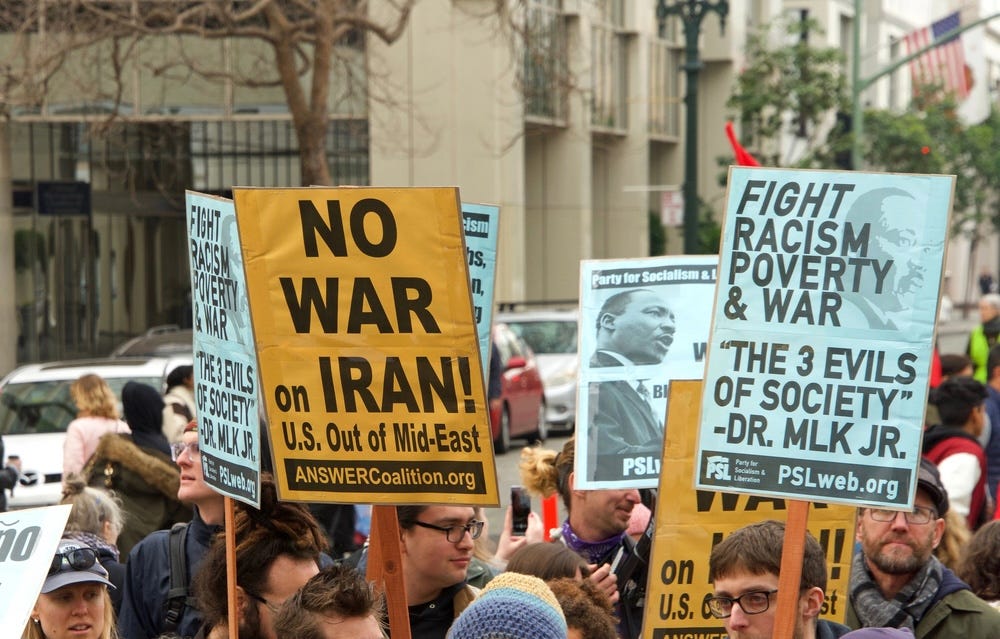
In this the 250th anniversary of American democracy, we still all agree with the basic premise of democracy—that the demos (the people) ought to rule. Recognizing, however, that it would be impossible for citizens to be well-informed about every potential political issue, the Founders designed a political system where citizens delegate their political power to representatives to rule in their behalf. In the context of domestic politics, the potential abuses of power in this principal-agent relationships are curtailed (somewhat) by the separation of executive, judicial, and legislative power. When it comes to foreign affairs, however, the trend over time has been complete investiture of power solely in the executive branch. What this means in practice in 2026 is an American President who has the power to more or less act as they see fit. It is an unprecedented concentration of power in one person’s hands, with the power (as we have seen) to fire missiles at whatever target they like, seize or assassinate any foreign head of state, declare tariffs as they like, carry out huge bombing raids and other military action which devastate foreign countries, and even potentially unleash nuclear holocaust upon the world. No small potatoes here.
Get E-International Relations delivered to your inbox, free. As you sign up, consider becoming a paid subscriber, or make a donation, to support our work.
There is one constant source of accountability in foreign affairs that American Presidents face, however—the general public. Given desires for either reelection or to cement their historic legacies, presidents pay close attention to public opinion, especially in the form of the now ubiquitous opinion polling. But should they? Political thinkers have been pondering this for millennia. In his History of the Peloponnesian War, the ancient Greek historian Thucydides, for example, scornfully records an encounter between Athens and Lesbos, where the Athenian citizens vote to first send one ship to destroy Lesbos on the advice of one hawkish politician, but then quickly vote to send another ship to intercept the first ship on the advice of a more dovish politician. Clearly, Thucydides thought that the general Athenian citizen was too ill-informed to sense whether Lesbos posed any real danger to Athens, too likely to be swayed by persuasive speakers who manipulated their emotions, and generally not possessing any coherent foreign policy views that leaders ought to take seriously. The result of listening to the demos in the matter of what to do with Lesbos was sending one ship to destroy Lesbos and another ship to stop the first ship from carrying out those orders!
In a similar vein, in his Speech to the Electors of Bristol, British statesman Edmund Burke informed his potential constituents that, by virtue of his superior knowledge about politics and foreign affairs, paying too close attention to their preferences meant serving them poorly:
Certainly, gentlemen, it ought to be the happiness and glory of a representative to live in … the most unreserved communication with his constituents. Their wishes ought to have great weight with him ... But his unbiased opinion, his mature judgment, his enlightened conscience, he ought not to sacrifice to you … Your representative owes you, not his industry only, but his judgment; and he betrays, instead of serving you, if he sacrifices it to your opinion. My worthy colleague says, his will ought to be subservient to yours … But government and legislation are matters of reason and judgment [i.e., not simply surrender to the popular will].
A century later, and on the other side of the pond, George F. Kennan (the architect of the U.S. policy of containment) expressed his thoughts on the prospect of a foreign policy guided by popular opinion even less diplomatically:
I sometimes wonder whether in this respect a democracy is not uncomfortably similar to one of those prehistoric monsters with a body as long as this room and a brain the size of a pin: he lies there in his comfortable primeval mud and pays little attention to his environment; he is slow to wrath-in fact, you practically have to whack his tail off to make him aware that his interests are being disturbed; but, once he grasps this, he lays about him with such blind determination that he not only destroys his adversary but largely wrecks his native habitat.
Kennan was writing in a world of realism and realpolitik. Practitioners of such a foreign policy believe that coldly and rationally pursuing the self-interest of a country (a self-interest usually defined by power) is the only sensible foreign policy. For such thinkers, relying on the beliefs of uninformed citizens who are likely to be wildly erratic in determining what represents America’s self-interest and how to achieve it, and who are more likely to be swayed by less rational considerations such as emotion, nationalism, and contested ideas about fairness and justice, is obviously anathema.
Unsurprisingly, political scientists throughout the early twentieth century were influenced by this general skepticism about following public opinion in foreign affairs. Seminal works by Philip Converse and Gabriel Almond that used new-found techniques in analyzing mass surveys found a general public who were not only hopelessly uninformed about even the basics of the world outside of the United States, but who also failed to hold coherent and consistent foreign policy views at all. How can citizens meaningfully weigh in on debates about U.S. policy towards Ukraine and Russia, for example, when (as reported by Dropp, Kertzer, and Zeitzoff) only one in six Americans can correctly locate Ukraine on a map?
More recent generations of political scientists, however, have been more optimistic about the abilities of the general public when it comes to foreign policy. While they accept that the average American is pretty hazy about what goes on in the rest of the world, this newer cohort of scholars find that ordinary Americans do possess one or more of the following: basic orientations towards the rest of the world, deep-seated values that shape foreign policy preferences, and the ability to rely on elite cues to provide guidance as to the United States’ foreign policy stances (see the Holsti, Kertzer & Zeitzoff, and Berinsky in the References for examples of this type of scholarship). These basic orientations I mention generally fall into types such as isolationist or internationalist, and citizens can rely on these general orientations to inform how they feel about any given foreign policy issue. The elite cues that are most important to citizens come from the American President who is directing whatever the foreign policy question is. Citizens need not know anything about a given country (let’s say Iran); they know what stance they would prefer the United States to take towards Iran by evaluating the American President’s stance. Thus, both Democrat and Republican citizens can use President Trump’s hawkish stance towards Iran to inform their own views. Naturally, the Democrats will conclude that war with Iran is a bad idea, and Republicans that it is a good one. This is simplistic and does not explain all the foreign policy motivations of the average citizen, but this is precisely the evidence Political Scientist Adam Berinksy finds in evaluating citizen attitudes towards the Iraq war and World War II. That is, that partisan cues were the most important signals that shaped citizen attitudes towards foreign policy in these wars.
This is an unsurprising finding given that we all rely on partisan cues for so many other political beliefs, why not for foreign policy beliefs too? It is also an interesting issue to think about during this current era of hyperpolarization. The American public has always had the power to hold American Presidents accountable for their foreign policy decisions by voting against them (or their successor) in the next election cycle. Greater polarization, however, raises the costs of punishing co-partisan Presidents. If I am a Republican voter, I may wish to express disapproval of the decision to intervene militarily in Iran, but if that comes in the form of voting against the Republican party in the next election, that may be too unpalatable if the Democratic party contradicts my political preferences in every other category. What this means is that Presidents theoretically have a freer hand than ever in ignoring public sentiment given that they should expect that polarization will raise the costs of holding co-partisan Presidents accountable for unpopular foreign policy.
The Trump administration is a worthy empirical illustration of the problem just identified. This administration came into office with promises to avoid the foreign entanglements of previous ones, especially in the Middle East. As President Trump put it:
Let someone else fight over this long-bloodstained sand … They [the Democrats] are the ones that got us into the Middle East mess but never had the vision or the courage to get us out … How many Americans must die in the Middle East in the midst of these ancient sectarian and tribal conflicts? After all of the precious blood and treasure America has poured into the deserts of the Middle East … Across the Middle East, we have seen anguish on a colossal scale. We have spent $8 trillion on wars in the Middle East, never really wanting to win those wars. But after all that money was spent and all of those lives lost, the young men and women gravely wounded — so many — the Middle East is less safe, less stable, and less secure than before these conflicts began.
Promises to avoid foreign intervention were music to the ears of a Republican constituency who were arguably more isolationist than any in modern memory. And yet, despite a public more wary of foreign intervention, the Trump administration has embarked on a highly interventionist foreign policy. This has included military action in Venezuela and Iran, threatening to seize Greenland, and threatening to topple the current regime in Cuba. It seems unlikely, however, that Republicans will pay any meaningful cost electorally for these unpopular decisions (unpopular in the sense that they contradict the general predisposition of Republican voters), given that the distance between the Republican and Democratic parties is now so great that, for most Republican voters, the thought of voting for a Democratic candidate is so unpalatable that one can forgive unpopular foreign policy decisions by a co-partisan president. Indeed, President Trump appears to be counting on that outcome. The Wall Street Journal reports that, in response to a question about worries on his stance on Ukraine among his base, President Trump responded “I think they support what I support.” If there is no electoral cost in the upcoming elections for a foreign policy out of step with the American electorate, this will indicate that polarization in the U.S. has reached the point where Presidents have a much freer hand in guiding foreign policy than in any time in recent memory.
Where polarization will not make a difference, of course, is in the party primaries. If we are going to see any electoral consequences for foreign policy decisions, we should see it there. This is especially applicable to the Republican candidates who are currently part of this administration (i.e., Marco Rubio and J.D. Vance). It will be interesting to see how they navigate the consequences of this fairly unpopular interventionist foreign policy strategy during the upcoming primaries.
In this essay, I have made the point that citizens can form meaningful foreign policy preferences despite limitations in knowledge, time, and energy. That capacity does not, by itself, however, determine the extent to which presidents ought to follow those preferences. As discussed, many influential political observers throughout history would be alarmed at the thought of leaders following the dictates of the “unwashed masses.” These days people are generally more optimistic about the abilities of the general public, although it strikes me that the answer to the question of how closely American Presidents ought to follow public opinion in foreign affairs will still depend on the model or conception of democracy we have in mind. Elitist models that rely on citizens to merely choose between competing groups of elites are going to look different in regard to this question than more deliberative models where citizen input is key. If we take the sort of liberal pluralist model that most Americans seem to have in mind when they talk about democracy, however, and if we accept that American citizens do possess basic and coherent orientations towards the rest of the world and can supplement that by learning from politicians or other elites they trust, that suggests that earlier thinkers were too ready to dismiss the general public’s role in sensible foreign policy.
I do think, however, that there are limits. So many foreign policy issues require such a high level of knowledge about countries and cultures obscure to the ordinary citizen, and that cannot be adequately addressed by simply relying on very basic orientations such as isolationist or interventionist, that citizen input on these decisions is likely to be less useful. That is precisely the value of a representative system, however. The average citizen has better things to do with their time than exhaustively researching the minutia of foreign policy; that is why we delegate our authority to people who do. A principal-agent relationship is no insult to the principal. When athletes and actors hire an agent to represent their interests, nobody begrudges them that right; we recognize that the athlete is too busy working on her game, the movie star on his film, to have enough time to do the work the agent is doing on their behalf. Likewise for the American voter. We need to seek out good and wise political representatives and then let them (aided by a committed corps of civil servants) dedicate themselves to doing what we do not have the time to do, such as learning about how tax policy in Uzbekistan is affecting the price of cotton in Texas.
I make an exception to this point in the case of significant American military action. War is such a costly endeavor (not only in human life but in monetary terms as well) that I believe American Presidents should avoid dragging the country into war if most Americans oppose that war. Some of the most unpopular and unproductive wars in American history could probably have been avoided if U.S. entry to the war had been put to a general vote.
If one accepts that the American public are capable of forming rational foreign policy preferences, and that, given the liberal pluralist model of democracy most people have in mind, the American public ought to be listened to (except in highly technical cases), where does that leave us? It leaves us in a position to believe that presidents should have a greater normative commitment to finding out the will of their citizens regarding foreign policy and executing that will. This is especially important in the case of military action. It also behooves us as citizens to punish leaders more readily at the ballot box who deviate too far from our foreign policy preferences. If jumping partisan lines is too great a leap, at least make your voice heard in the primaries.
After all, as citizens, I believe we possess a collective wisdom, a repository of common sense that can serve as a check on more volatile Presidents, who sometimes abandon this common sense in favor of questions of legacy or pride. For example, Political Scientist Jarrod Hayes has shown that despite concerted efforts by the Nixon administration to portray India as a threat to the U.S., the American public overwhelmingly rejected that framing because they (rightly) thought of India as a fellow democracy. There is, therefore, certainly an important role for the American public to play in determining U.S. foreign policy. As the (probably apocryphal) quote by Abraham Lincoln goes “you can fool some of the people all of the time, and all of the people some of the time, but you cannot fool all of the people all of the time.”
References
Almond, G. (1950). The American People and Foreign Policy. New York: Praeger. Reprinted in 1960 with a new introduction.
Almond, G. (1956). Public Opinion and National Security. Public Opinion Quarterly 20:371-378.
Berinsky, A. J. (2007). Assuming the Costs of War: Events, Elites, and American Public Support for Military Conflict. The Journal of Politics, 69 (40), pp. 975-997.
Burke, E. (1774). Speech to the Electors of Bristol. From The Founders’ Constitution, The University of Chicago Press. Volume 1, Chapter 13, Document 7 (http://press-pubs.uchicago.edu/founders/documents/v1ch13s7.html).
Converse, P. E. (1964). The Nature of Belief Systems in Mass Publics. In Ideology and Discontent, edited by D. E. Apter. New York: Free Press.
Dropp, K. A., Kertzer, D.E., & Zeitzoff, T. (2014). The Less Americans Know about Ukraine’s Location, the More They Want U.S. to Intervene. Washington Post: Monkey Cage.
Hayes, Jarrod. 2012. Securitization, Social Identity, and Democratic Security: Nixon, India, and the Ties That Bind. International Organization 66(1): 63-93.
Holsti, O. R. (1992). Public Opinion and Foreign Policy: Challenges to the Almond-Lippmann Consensus Mershon Series: Research Programs and Debates. International Studies Quarterly, 36(4), 439–466.
Kennan, G. F. (1951). American Diplomacy, 1900-1950. Chicago: University of Chicago Press.
Kertzer, J. D., & Zeitzoff, T. (2017). A Bottom-Up Theory of Public Opinion about Foreign Policy. American Journal of Political Science, 61(3), 543–558.
The White House. Remarks by President Trump on the Situation in Northern Syria – The White House. Retrieved January 13, 2026, from https://trumpwhitehouse.archives.gov/briefings-statements/remarks-president-trump-situation-northern-syria/
Thucydides. (2004). The History of the Peloponnesian War. Translated by Richard Crawley. Project Gutenberg eBook: https://www.gutenberg.org/cache/epub/7142/pg7142-images.html#link2HCH0009.
Wall Street Journal. (2026). Impressed by Ukraine’s Battlefield Gains, Trump Warms to Zelensky. https://www.wsj.com/world/impressed-by-ukraines-battlefield-gains-trump-warms-to-zelensky-bc138190
Caleb Griffin has a PhD from the University of Illinois, and teaches political science at Sam Houston State University. His primary research focus is on the role of social identities in shaping political behavior.
Please subscribers