


*Originally published in 2021 and preserved as part of our archive project.
E-International Relations is free to read. We rely on reader support to make this possible.
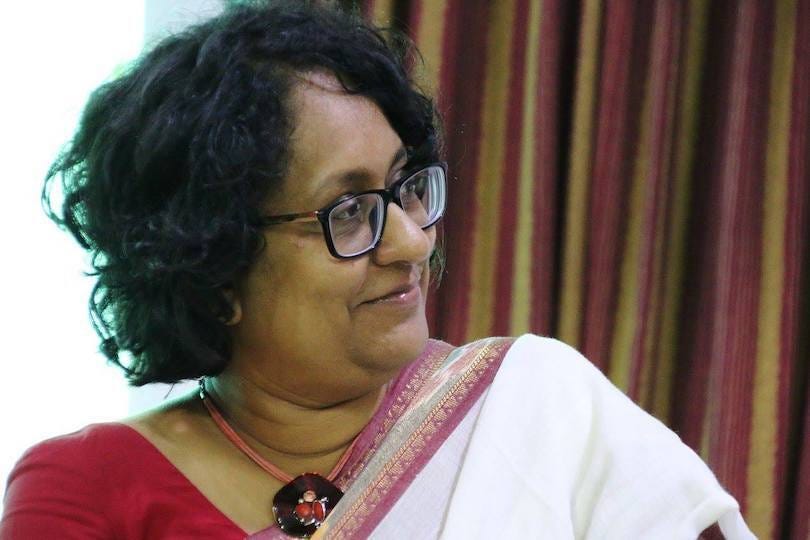
Harini Amarasuriya is a Senior Lecturer in the Department of Social Studies, of the Open University of Sri Lanka. She obtained her PhD in Social Anthropology from the University of Edinburgh. Her research interests include state society relations, political movements, dissent and activism. Her publications include Tracing Conscience in a Time of War: Archiving a History of Dissent in Sri Lanka, 1960s-2000s, in the Intimacy of Dissent, edited by Tobias Kelley, Elite Politics and Dissent in Sri Lanka in The South Asianist, With that, discipline will also come to them”: politics of post war urban Colombo in Current Anthropology, and Protests and Counter Protests: competing civil society spaces in post-war civil society in Sri Lanka in Economic and Political Weekly. The Intimate Life of Dissent: Anthropological Perspectives (Edited with Tobias Kelly, Sidharthan Maunaguru, Galina Oustinova-Stjepanovic, and Jonathan Spencer) is forthcoming later this year.
Where do you see the most exciting research/debates happening in your field?
Anthropology is a very broad field and there are lots of emerging areas of debate and research. For one thing, methodology in the field of anthropology is changing quite a bit. As you know, anthropology is usually linked to a ‘fieldwork site’ with which an anthropologist has a sustained relationship. Doing ‘fieldwork’, was the hallmark of the anthropological method. The more remote and exotic your field, the better! However, that has changed quite a bit now and you can find anthropologists in a range of settings – even in social media, in institutional settings, sometimes not just in one site, but multiple sites. So there’s a lot of variety in anthropology now and I think that’s great.
For the last several years, I have been engaging with the emerging literature on activism, and the link between activism and emotions, intimacy, relationships – the sociality of activism as it were. I am finding that to be a fascinating area of research. I think its opening up research in the sub-disciplines of political anthropology and also kinship – in extremely interesting ways. I think in many ways, the influence of women’s studies, feminist scholars, queer studies have taken these areas in directions that are quite different from how classical anthropologists approached these subjects. It is allowing us to look at the lives of people – for instance, women – and their role in politics and activism, that usually get left out of studies about politics, revolutions, resistance etc. Also, I find that the work being done on intimacy and dissent provides us with a fascinating perspective on how the everyday, family, friendship and relationships shape significant events in society. This is an area in my field that I have found very exciting and productive in recent times.
How has the way you understand the world changed over time, and what (or who) prompted the most significant shifts in your thinking?
This is a very interesting question! It made me reflect on the various directions my life has taken and the people who were part of those shifts. When I was exploring options for higher education, my interest was in English literature – I had done English literature for the Advanced Levels (qualifying examination for university in Sri Lanka) and I loved it. My father wanted me to meet a friend of his – a rather eccentric, former diplomat, for me to discuss my ‘future’ with him. When I announced that I wanted to study English literature, this was immediately scoffed at as a typical, elitist, middle class, Sri Lankan thing! And he introduced me to the work of Gananath Obeysekere, Bruce Kapferer, Michael Roberts and others. It opened up a whole new world to me and I was hooked. It developed this curiosity about the world around me and encouraged me to try and understand human society in a much more empirical way than I would have following my initial ambitions of studying literature.
Then when I finished my undergraduate degree, I started working with a local community mental health organisation, called Nest. Nest and the woman who founded Nest, Sally Hulugalle, influenced my thinking in important ways. Sally is someone who has a remarkable nose for finding the people and communities that are most neglected and excluded in society and charging right in and shaking things up. Because of Nest, I got to work with people living long term in mental institutions, people living with HIV/AIDS and children in so-called ‘rehabilitation and reform’ homes. I understood the power of stigma and social exclusion in shaping people’s lives through my work at Nest and this has remained a very significant influence in my life.
Then when I joined the university system around 2010, I was plunged almost directly into what was to become one of Sri Lanka’s longest trade union actions in recent times. University academics started agitating for better working conditions and more investment in higher education in 2011, culminating in a three-month strike action in 2012. Through this, I was privileged to meet some remarkable people across Sri Lanka’s university system and those experiences really stimulated my interest in activism, education, politics etc.
To what extent has the women’s movement and radical Christians influenced dissent in Sri Lanka?
Sri Lankan women have been part of most major events in Sri Lanka – whether in the fight for independence, labour movements, the universal franchise movement, free education movements etc. There have always been prominent women activists, especially in Sri Lanka’s left movements. But autonomous women’s organisations really started forming around the 1980s with the establishment of several women’s movements that described themselves as explicitly feminist movements. These women tried to articulate a position on women in Sri Lankan society. Many of these women came from left-wing politics and they faced resistance from their male colleagues who thought that they were diluting the class struggle. Yet, the women’s movements played a significant role during that time in several key struggles. For instance, when the then government was very repressive of trade unions and trade union leaders, it was women’s trade union actions, especially in the newly set up Free Trade Zones, that continued to function and agitate. Then women also came to the forefront in protesting against disappearances, torture and extrajudicial killings. Women in the North and East as well as in the South organised themselves to protest against government atrocities and these were instrumental in mobilising resistance against the government at the time. Even today, women in the North of the country have not given up their fight asking questions about their loved ones who were disappeared during the final stages of the war between the military and the Liberation Tigers of Tamil Eelam (LTTE) in 2009.
Regarding the Christian influence, when I first started researching into dissent and resistance in Sri Lanka, I was struck by the number of radical Christians who were part of some of the key movements and events of the time. I was also struck by the number of people who mentioned certain Christian priests as influencing their interest in activism. So I started exploring this area a little more seriously – and I found that the influence of radical Christianity on dissent in Sri Lanka was quite disproportionate to their minority status. What was most interesting for me was that the influence of these people and organisations were not in any sense articulated in terms of religion – but ideas of social justice and the fight against oppression. The influence of Vatican II, Liberation Theology was unmistakable, but so was Marxism. Radical Christian priests from various denominations set up organisations and movements that were sites (physically and intellectually) where alternative ideas could be discussed and debated; where resistance was organised and sometimes where shelter was provided for those who were at risk of being disappeared or worse. These organisations and priests were critical of the mainstream church and usually operated outside the established church. But up to about the mid-1990s, there was enough support for them from within the church hierarchy so that they became quite influential during that period. Many of Sri Lanka’s best known social and political activists today can trace a link to one of those organisations or individuals in the 1970s and 1980s.
How has the nature of civil society in Sri Lanka changed in recent years? What role have resistance groups played?
I think two things happened to civil society in Sri Lanka. One, they became NGOised, which meant they are far more dependent on donor funding for their work, and donor-driven. Donors have also changed – funding in the 1970s, and 80s was much more flexible and less structured. This affected the kinds of issues that civil society could work on – and the way they worked has become much more projected.
Two, civil society has become quite dependent on political patronage – not just for its survival but in terms of influence. Civil society does not organise ‘people’ or ‘communities’ as much; instead – they function like special interest groups or advocacy groups – which means they have to negotiate with those in power. This has challenged conventional ideas of civil society as being a space that lies somewhere between governments and markets. In practice, they are quite linked to both and as a result, their effectiveness in challenging established networks of power and privilege is compromised.
What forms of social exclusion and discrimination are present in Sri Lanka and which groups are particularly at risk? What factors account for this?
Sri Lanka is particularly known for its fault lines along ethnoreligious nationalist lines. There is no doubt that Sinhala Buddhist majoritarianism has been a hugely significant factor in our post-independence history. Nevertheless, this has often masked other sources of social exclusion and discrimination that underlie many sources of inequality in our society. For instance, I don’t think we talk enough about class relations in Sri Lanka and how significant that is as a source of social exclusion and discrimination. We talk of language rights of minority groups (quite rightly) but we don’t understand sufficiently, how English – as a marker of class and status – cuts across all ethnic and religious lines. Caste still remains an issue, again one that we are unwilling to openly talk about, and gender remains a huge source of inequality.
I think because Sri Lanka was a welfare state for a long time – where policies of public education, public health, social security are still important – because we have managed to have policies that provide for vulnerable sections of communities, at least to some extent, we tend to rest on our laurels a bit and not really acknowledge the continuing existence and reproduction of relationships of exclusion and discrimination based on a range of factors. Depending on the context, the risk you face can be different. In that sense, it is not one form of exclusion or discrimination – but the intersection of several – that defines which group is at risk at which moment.
What role does stigma play in social exclusion, particularly in Sri Lanka?
I think stigma is invoked at various times to reinforce social exclusion. Let's take the current COVID 19 pandemic as an example. The Muslim community was targeted as potentially spreading the virus because of their refusal to follow rules – or ‘cultural’ habits that made it difficult for them to follow social distancing rules properly. This stigmatisation built on certain stereotypes about being ‘Muslim’ that are currently popular: Muslims have large families, they all live together in crowded conditions, they don’t follow rules except religious rules etc. Within an increasingly Islamophobic context (this has been going on for several years now), the Muslim community became targeted during the COVID pandemic. Those who died of the virus were not allowed to be buried (cremation became compulsory) despite appeals from the Muslim community. So you can see how stigma plays into or reinforces existing layers upon layers of social exclusion. You can see this happening all over the world – groups that are stigmatised, black communities in the US, migrant workers all over the world, minority communities – they have faced the brunt of the pandemic and that is linked to their access to services due to pre-existing conditions of stigmatisation leading to social exclusion and discrimination.
How can the interests of the socially excluded be better addressed by the state and civil society in Sri Lanka?
I don’t know if there is a simple answer to this question. The rationalisation of social injustice based on privilege (majority privilege, class privilege, language privilege, political privilege, professional privilege) is institutionalised in Sri Lanka. This is evident in policy, practice and even in activism. What I am saying probably sounds contradictory, but I think that is what is so unusual about Sri Lanka. Even when we try to bring in policies that are actually about equal opportunity or social justice – we put in place exceptions to those policies that are actually about protecting privilege. For example, take education. Sri Lanka has a history of free education. Early debates on free education were passionately argued on the grounds of social justice – of the need to ensure that an emerging democracy, a newly independent country must have an education policy that is grounded on an equal opportunity where socio-economic conditions should not determine your access to quality education.
Yet, when it comes to actual policies, legislation, government directives that operationalise those lofty ideals, you can see how, repeatedly, the most crucial structures of privilege were untouched. While the state withdrew funding for private schools, they were allowed to continue; quotas for university admission were introduced ostensibly for affirmative action for youth from underprivileged areas, but ultimately resulted in minority communities being unfairly disadvantaged. There are rules for school admission which say that the only factors for consideration in school admission should be the child’s distance to the school (so a child can/should be admitted to the nearest school), yet, there are ‘quotas’ for past pupils, for ‘special professions’ like doctors, university academics, the military, that override those rules, so that elite schools are still dominated by the privileged. No one has the guts – not the state, nor civil society – to take on these entrenched forms of privilege from which many of us who flourish in society have benefitted. I think until we as a society acknowledge and confront this, we will never be able to really deal with the problem of social exclusion and discrimination in Sri Lanka.
What is the most important advice that you would give to young scholars?
As scholars, I think we cannot afford to be cynical about our work and our role in society. I think more than ever before there is a need for important issues in society, issues that affect the lives of people to be debated, discussed, written about and thought about not just in the privacy of our lecture halls, our journals and our books, but in public life. As difficult as it is, we need to bring nuance and some integrity back into public discourse – that has become so polarised and vicious today. I think we all need to step out of our comfort zones and get more involved in public life.
The other thing I would say is – and I say this because the ways in which your worth is measured as a scholar has been shifting so much – don’t underestimate the power or the importance of teaching – including undergraduate teaching. I love teaching – but so often, it is easy to lose sight of the fact that as a scholar, one of your most important responsibilities is towards your students.
I am also very aware of how young scholars are exploited in academia, the precarity of work conditions and how that breeds a kind of competitiveness that works against the spirit of dialogue, exchange and camaraderie that I think is essential among scholars. This is linked to the commodification of education and a corporate culture of ‘efficiency’ and ‘productivity’ that is very damaging in universities. So, I think it’s also important that scholars young and old (particularly older scholars who have less to lose) take on some of these issues so that we challenge the corporate takeover of our universities and higher education.
What I find particularly valuable in this interview is the insistence that political life cannot be understood only through formal institutions, governments, elections, or moments of open conflict. The deeper political story often exists in the relationships between institutions and society, in stigma, exclusion, family, community, activism, memory, and the everyday experiences of people who rarely appear in conventional accounts of political history.
This point is especially significant when we look at societies affected by prolonged conflict. From my own experience inside Afghanistan’s security institutions, I have learned that institutional strength cannot be measured only by organizational charts, formal authority, equipment, or the number of personnel. Institutions ultimately depend on relationships: between the state and citizens, between commanders and those they lead, between political authority and local communities, and between formal structures and the social realities in which they operate.
I was also struck by the discussion of how civil society can gradually become dependent on donors, political patronage, and institutional incentives. This raises a broader question for international politics: what happens when organizations created to represent society become increasingly dependent on the structures of power they are expected to scrutinize?
Perhaps the most important lesson is that exclusion is rarely produced by a single factor. Class, language, ethnicity, gender, political affiliation, professional status, and institutional privilege can intersect and reinforce one another. The same is true in conflict-affected societies, where historical grievances, security institutions, political patronage, and external assistance can combine in ways that are difficult to see if we examine each factor separately.
For me, this is where anthropology and security studies can speak to each other. Security is not only about armed forces and threats. It is also about legitimacy, belonging, trust, memory, exclusion, and the relationship between institutions and the people they are supposed to protect.
The challenge, therefore, is not simply to study institutions, resistance, or conflict as separate subjects, but to understand the human relationships that connect them.
Wahidullah Noorzai
Former Senior ANP/ANCOP Officer | Strategic & Security Analyst