


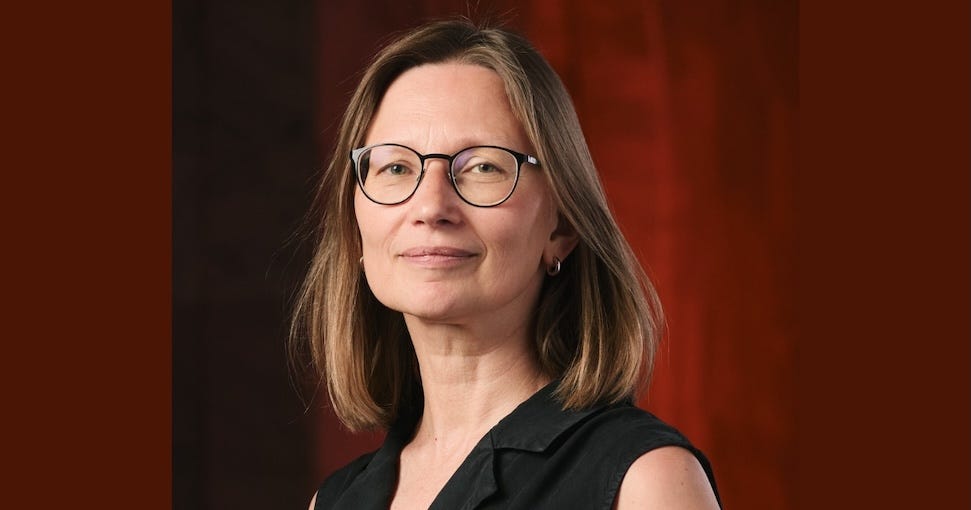
Jeanne (Zhanna) Kormina is an anthropologist specialising in religion and post-Soviet transformations. She is the Director of the Yerevan Center for International Education in Armenia, having previously taught at the Higher School of Economics in St Petersburg and served as Research Professor at GSRL–EPHE (PSL) in Paris. Her publications include two books, several co-edited special journal issues, and numerous articles, including “Popular Theopolitics and the Last Russian Tsar’s Intangible Remains” (Comparative Studies in Society and History, 2025), “Fervent Christians: Orthodox Activists in Russia as Publics and Counterpublics” (Religion, State & Society, 2023), and “‘The Church Should Know Its Place’: The Passions and the Interests of Urban Struggle in Post-Atheist Russia” (History and Anthropology, 2021).
Get E-International Relations delivered to your inbox, free of charge. As you sign up, consider becoming a paid subscriber to support our work.
Where do you see the most exciting research/debates happening in your field?
In my view, some of the most interesting debates in anthropology over the past couple of decades have developed around what is usually called the ontological turn, associated, among others, with Bruno Latour in sociology and Eduardo Viveiros de Castro in anthropology. Like other “turns” before it, it offers a new way of describing and understanding the world, in which the capacity for agency — for acting independently — is attributed not only to humans but also to a broad category of things and entities referred to as “non-humans”. A non-human can be a deity, a jaguar — mythological or real — or, in Latour’s work, microbes.
Trying to imagine the world and the human being through the eyes of a jaguar or a baobab is a useful exercise. It can be quite mind-blowing, because it makes us question familiar analytical categories and, more generally, an anthropocentric view of the world. It develops the imagination, which I think is extremely important for a researcher, especially a young one, and teaches us not to think in ready-made categories. But I still think that the human being is the measure of all things. When we anthropologists write about forests, doors, jaguars, or gods, we do it, after all, because we want to understand how human societies work and how they change. In fact, much of the research that contributed to the “ontological turn”, addresses a very classical question: that of social hierarchies and inequality.
How has the way you understand the world changed over time, and what (or who) prompted the most significant shifts in your thinking?
It is difficult for me to name a particular book or person who influenced me at some particular stage of my intellectual development. Besides, I think that learning continues throughout a researcher’s life, so I hope there are still important things ahead of me. I tend to see academic life as a kind of flow, made up of institutions, people, projects, and places where we meet — conferences, seminars, and many less formal settings — and where knowledge and opinions are constantly exchanged. Ideas emerge in dialogue: sometimes after giving a paper, even one that did not go particularly well; sometimes while thinking about a reviewer’s critical comments on your article, even if your first reaction was to disagree completely. They also emerge in smoking areas and over meals. And quite often an idea does not really have a single author. Ideas are collective.
For an anthropologist, fieldwork has a special place in this flow. Immersion in another social and cultural world gives us not only new empirical knowledge but also new concepts with which to think about the social world. Conversations with our interlocutors, regardless of their level of formal education, can be a powerful source for reflecting on our own ideas and transforming them. But I should add one more thing: knowledge is historical, and we, as analysts and authors, are part of history ourselves. I began as a history student in Sverdlovsk, now Yekaterinburg, where I was trained, among other things, in critical source analysis and close reading. As a graduate student in St Petersburg, I encountered cultural semiotics and structuralism, while friends and colleagues were also initiating me into anthropology through reading Western scholarship, conferences, and fellowships at European and American academic centres. I was fourteen when perestroika began, so, like others of my generation, I watched and lived through the enormous social transformations of the USSR and then Russia, the country in which I lived. One aspect of these transformations — the way atheists became religious believers — eventually became the main subject of my research.
IR scholarship typically treats religion either as soft power or as a source of civilisational conflict, and public debate increasingly demands clear answers and binary positions. Your work instead examines lived religion and insists that the task of scholarship is to complicate the world. What can this anthropological imagination offer scholars of international politics that conventional approaches miss?
I am not sure that anthropology can teach scholars of international politics what to do. We use different tools and ask different questions of our material. But anthropology can perhaps offer something useful precisely because it is suspicious of categories that seem self-evident. Political science sometimes seems to me more normative than anthropology tends to be: democracy is better than authoritarianism, for example, or religiosity is expected to correlate with political conservatism. Anthropology, with its interest in local knowledge and particular forms of social life, and its long and complicated relationship with evolutionary thinking, values the possibility of looking at the world relativistically. Marshall Sahlins made this point beautifully in his classic Stone Age Economics (1972), which challenged some of the basic assumptions of capitalist orthodoxy. His famous argument about the “original affluent society” reminds us that there is more than one formula for affluence: we can produce and consume a great deal, or we can need and consume relatively little. Western society represents only one possible version of normality, one way of organising social life. This is remarkably difficult to comprehend.
Anthropology keeps asking a very simple question: what does this mean to the people involved? What does conversion to Islam mean, for example? In Politics of Piety: The Islamic Revival and the Feminist Subject (2004), the American anthropologist Saba Mahmood writes about a women’s piety movement in Cairo, in which educated middle-class Muslim women organised religious groups in mosques. She shows that what looks from a liberal perspective like submission to religious tradition can also be a form of active ethical self-formation involving agency and freedom. A recent example of a similarly attentive, almost anthropological way of looking at the very political questions of religion and migration is Cristian Mungiu’s film Fjord. A religious Romanian-Norwegian family arrives in a small Norwegian community and violates a whole series of unwritten cultural norms: too many children, too much religion, and, on top of that, they are migrants. The film shows how differently people can understand love, care, parenthood and justice, and what happens when different systems of norms come into conflict. The conflict is also unequal, because one of the parties in this drama is backed by state institutions and has the power to intervene in people’s lives. In the end, one might say, the secular state defeats the Christian God.
As the post-Cold War order fragments into competing geopolitical and normative projects, Armenia navigates shifting relationships with Russia, Europe, and its region while reassessing assumptions about security and identity. From an anthropological perspective, what does this reveal about how societies experience such transitions?
From inside a society, transformations usually look quite different from the way they appear from outside. What at the level of international politics looks like a shift in geopolitical orientation is experienced in everyday life as a change in people’s strategies and in the range of possibilities available to them: where they can go to work, study, or spend a holiday, whom they trade with, and what new groups of people appear around them. In Yerevan, for example, Indians have become very visible. They come as workers and students and work in delivery services, manufacturing, cafés, and shops. Some learn Armenian remarkably quickly. From their perspective, Armenia occupies a very different place on the global map than it does from the perspective of someone looking at it from Europe.
At the same time, political ruptures can happen very quickly, while social worlds change much more slowly. More than thirty years later, we are still living through the consequences of the dissolution of the Soviet Union, which has been an exceptionally painful process in many parts of the former USSR, including Armenia. The Soviet political project disappeared, but the social space it created proved remarkably durable, sustained through migration, marriages, and family networks. You can see this simply by looking at the departures board at Zvartnots airport: Yerevan is still connected by direct flights to many Russian cities, and one can fly to Moscow at any time of the day. Some people in Armenia argue that Armenians living in Russia should return to Armenia and build their country together with their compatriots; others tell me about relatives who are doing well in Russia and have no intention of leaving. Recently I spoke to a boy who had come to Armenia to visit his uncle and cousins. They are Yazidis, Armenia’s largest ethnic minority. The boy lives in Kaliningrad and considers it his homeland. Political maps can be redrawn relatively quickly; the social geographies people inhabit are much more persistent.
Across the post-Soviet space, many societies seem suspended between declining orders and uncertain alternatives. You have described communities inhabiting an “expanded present“. Do you recognise a similar temporality in Armenia after the loss of Nagorno-Karabakh?
I used the concept of the “expanded present” to describe a sense of frozen time experienced by some of my interlocutors living in Russia — a time suspended between the past and the future, in which they felt themselves living. In that case, this sense of being stuck was connected with the processing of history and the restoration of justice: punishing, or at least naming, those responsible for the crimes of the Soviet period, including the terror of the Civil War and 1937. These people believe that if the truth is established and accepted by society, a kind of moral purification will become possible and a better future will finally arrive. What exactly that future might look like they do not really know. This is, importantly, a religious story, involving ideas of sin, atonement, and repentance.
In Armenia, as far as I can judge, a rather different temporality is being debated. Part of society argues for drawing a line after the tragic recent past and directing the country’s energies towards building a future. People do not want another war. At the same time, it is difficult to find a family in Armenia that was not affected in some way by the 44-day war of 2020 or the exodus from Nagorno-Karabakh in 2023. In schools you see memorial walls with portraits of former pupils who were killed in action; in many courtyards there are vernacular memorials, and on city walls murals with portraits of dead neighbours, classmates, and friends. This is still very recent history; it has not yet become a real past. What will happen to this past is an open question. Social scientists sometimes use the rather cynical expression “usable past” — a reminder that the past can be a political resource and that there is always a struggle over who gets to define it. The memory of the war and the loss of Karabakh may acquire meanings and political uses that are difficult to predict today. It is still too early to know what kind of past it will become.
Over 100,000 Armenians displaced from Nagorno-Karabakh mourn a lost homeland, yet the peace agreement with Azerbaijan makes no reference to their rights. Your research shows that the past is not simply remembered but actively reconstructed. Can a peace settlement prove durable when it leaves collective memory and loss unaddressed?
I do not have an answer to this question. Anthropologists are generally reluctant to make predictions, and I certainly would not try to predict whether this peace agreement will last. But we can look at other cases of displacement and see what happened there. Let me give an example from the work of the anthropologist Yael Navaro-Yashin in Northern Cyprus. Cyprus was divided in 1974 as a result of war. Around 200,000 Greek Cypriots were forced to leave the north of the island for the south, while around 65,000 Turkish Cypriots moved from the south to the north. Many Turkish Cypriots settled in abandoned Greek houses, used the furniture and other things left behind, and cultivated fields and orchards that had belonged to Greeks. At the same time, many of them were themselves displaced people who had lost homes and property in the south. Navaro-Yashin uses the concept of ruination to describe this situation. By this she means not simply the physical ruins left by war, but the material remains of destruction and violence together with the affects that persist afterwards. An abandoned house or a piece of furniture becomes a material presence of an absent other: in using it, a person continually encounters traces of someone else’s loss as well as their own. Navaro-Yashin therefore treats maraz — a deep and persistent melancholy among Turkish Cypriots — not simply as an internal psychological state, but as an affect produced by the postwar environment itself. Houses, things, abandoned villages, and neglected landscapes become what she calls melancholic objects. The unfinished past is simultaneously inside and outside the person, emerging in the relationship between people and the material world they inhabit. As so often in anthropology, the focus is on the everyday life of a local community, where decisions made by states and the effects of big politics become visible, but not always in ways that could have been predicted. A political settlement can draw a new border and establish new property regimes, but it cannot determine what it will feel like to live among the material remains of loss.
The Cyprus case is obviously not a model for Nagorno-Karabakh, and I would not want to draw a direct analogy between them. Navaro-Yashin’s work tells us that displacement continues long after people have physically moved elsewhere. A political settlement does not necessarily put an end to loss either. It continues through houses, objects, landscapes, and family histories. For Armenians displaced from Nagorno-Karabakh, the lost homeland is now physically inaccessible, but this does not make it socially absent. Family photographs, keys, recipes, place names — all these can continue to make a lost place present in everyday life. A peace agreement can establish borders and relations between states. It cannot prescribe what people should remember, how long they should mourn, or what a lost home will mean to them ten or twenty years later.
Armenia’s 2026 elections were reportedly targeted by foreign and domestic disinformation. You use the concept of “aphasia“ to describe how ready-made symbolic constructions replace people’s own words. What can this reveal about why such narratives find audiences — something security-focused analyses often miss?
I am not sure that aphasia is the right concept for Armenia today. Many Armenians are active on Facebook and other social media; they argue endlessly and openly about politics, and there is certainly no shortage of words. When I wrote about aphasia immediately after Russia’s full-scale invasion of Ukraine, I had something rather different in mind. Following Serguei Oushakine, I was interested in situations where people seemed either to lose their own language or simply not have a language for what was happening to them — the familiar “I have no words” when reality can no longer be described with the means available. They fall back instead on a limited repertoire of ready-made formulas. What struck me particularly was the inability of many people to speak in the first person. Propaganda is not only about making people believe false things; it can also provide a language in which one does not have to speak in one’s own name.
In contemporary Armenia, by contrast, people speak about politics very much in their own voices, and there is no lack of arguments and competing interpretations. So I think the question of propaganda in Armenia needs to be posed differently. The question is not “why are people aphasic?”, but why, among so many competing interpretations, some narratives prove more attractive than others.
In Armenia, Prime Minister Pashinyan has framed his campaign against the Apostolic Church as a matter of “spiritual security” — distinct, in his words, from the “national security” concern of a head of state. What does this securitisation of a national church tell us about how religion becomes a security question in the post-Soviet space?
What is interesting to me is how easily religion can move from one side of the security equation to the other. In Russia, the Orthodox Church is presented as a protector of society and its “traditional values” against foreign influence. In Ukraine, the Ukrainian Orthodox Church (UOC), historically linked to the Moscow Patriarchate, came to be seen as a possible channel of Russian influence. The Church says it broke with Moscow after the full-scale invasion, while the Ukrainian authorities dispute the extent of that separation. Armenia now offers yet another configuration: the Armenian Apostolic Church is an independent national church, but its leadership can nevertheless be presented as a possible channel of foreign, implicitly Russian, influence. So perhaps “spiritual security” tells us in the first place about changing ideas of sovereignty: who has the authority to speak for the nation and to decide when a religious institution becomes a matter of state concern.
There is another paradox here. Identification with the Armenian Apostolic Church in today’s Armenia does not necessarily mean an active church life. For many people, the Church is as much a national and historical institution as a religious one. And political, too. In May 2024, before I moved to Armenia, Archbishop Bagrat Galstanyan led a march from the border region of Tavush to Yerevan in protest against the government’s border agreement with Azerbaijan. Tens of thousands gathered in Republic Square, and the protest movement continued for weeks. Since then, things have gone much further. Several senior clerics have been arrested, and the World Council of Churches has expressed concern about what it described as “undue interference in inner church matters.” So the Church may have a much greater capacity for political mobilisation than the level of everyday religious practice would suggest. This may be one reason why the language of security becomes possible in the first place. Behind the conflict over the Church there is also a question of authority: who has the right to say what is spiritually good for the nation — the Church or the state?
Yerevan has recently become a significant site of academic mobility, partly as a consequence of geopolitics itself, including the departure of many scholars from Russia after 2022. At a time of prominent debates about decolonising knowledge, what opportunities and limitations do you see in producing knowledge from locations traditionally regarded as peripheral to dominant academic centres?
Indeed, after February 24, 2022, a significant number of researchers and university professors left Russia. Many of them already had professional connections abroad and went to join colleagues; special programmes for scholars at risk in Europe and the United States also helped enormously. This was one way for academics who left Russia to adapt. Another was to create new institutions in the countries where they found themselves. The centre where I work is one of them. It was founded in May 2022 as an educational centre, essentially a branch of a Russian private postgraduate college, but soon became a fully independent institution with an international academic board. We organise conferences, summer and winter schools for MA and PhD students in the social sciences and humanities. We also started a programme of short research fellowships. These are basically short academic residencies: a researcher comes to Yerevan and simply does their academic work here — finishes a dissertation or an article, thinks about a new project, or, if their research happens to concern Armenia, which is by no means a requirement, works in archives or does fieldwork. Fellows give a public lecture at our centre and become involved in the local academic community; some also speak at universities or to broader audiences through the media. If we want to use the language of decolonisation, this is one practical thing we can do: invite international scholars to Yerevan not to impress them with local colour, but to make it a perfectly normal place for producing high-quality scholarship, just like Berlin or London. Of course, this is easier said than done.
Knowledge production requires infrastructure — academic journals and publishers, grants, universities, libraries — and much of this infrastructure is still concentrated in the Global North. The language of international academia today is English, and it is very difficult to build an international academic reputation without an excellent command of it. In many academic systems, even to gain recognition at home, scholars are expected to publish in journals and with publishers based in the Global North, and to do so in English. Perhaps we can call this situation colonial: it reproduces inequalities that are deeply rooted in economic geography.
But this is not the only way to look at it. It is also wonderful to have a lingua franca in which you can talk to colleagues from very different places about the things that matter to you as scholars. Today it is English; at other times it was Latin, or German. A common language creates connections that would otherwise simply not exist.
Simply moving academic activity from London or Berlin to Yerevan does not therefore decolonise knowledge. You can create new institutions and new places of intellectual exchange, while the resources and mechanisms of academic recognition remain concentrated elsewhere. Our own situation is complicated by something else as well: a Russian presence in Armenia, including an academic one, can itself be perceived as colonial. This is something we have to keep in mind. For us, it means constantly thinking about how to become part of the academic landscape in Armenia through collaboration and friendship with scholars who were here before we arrived.
You have described how, doing anthropology “at home” after Russia’s invasion of Ukraine, the ethnographic principle of non-intervention collapsed and you were forced to redefine your position in the field. For early-career scholars who may work in settings shaped by war, repression, or moral rupture, what is the most important advice you would give?
Take care of yourself. No academic fame is worth your life or your freedom. Be realistic about the risks you take in doing research and making it public, and about the risks you may expose your interlocutors or colleagues to.
If you write about a society living through war or growing authoritarianism, you do not necessarily have to approach these conditions directly. An ethnography of orphanages or grassroots cultural initiatives may tell us more about a society at war than interviews with veterans. Anthropology always sees people as human beings, whether they are cannibals or members of the far right. It is difficult to do ethnographic work in a climate of strict moral judgement, because anthropology is impossible without empathy. But empathy does not mean agreement or moral justification. How to remain capable of understanding people with whom you fundamentally disagree, without turning understanding into justification, is a question to which I myself do not have a final answer.
Editorial Credit: Konstantina Oikonomou