


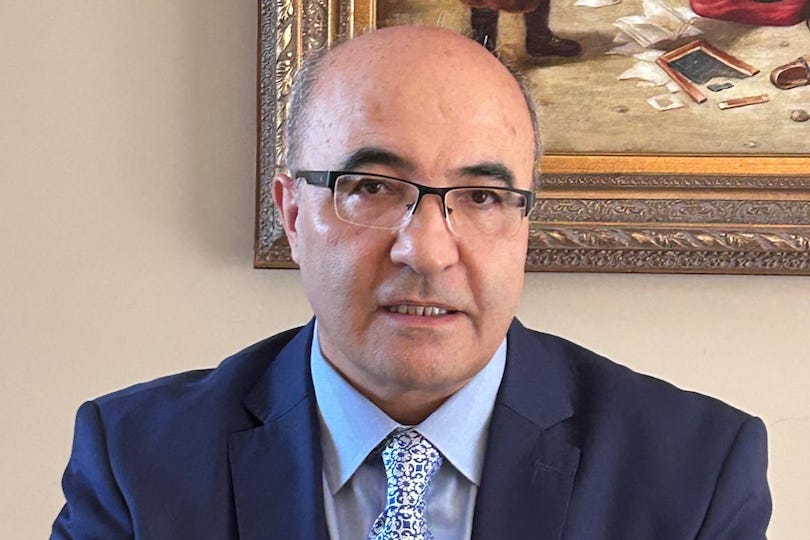
M. Hakan Yavuz is Professor of Political Science at the University of Utah. His research focuses on the transformation of modern Turkey, political Islam, secularism, Kurdish nationalism, and the relationship between domestic identity and foreign policy. In his work, he examines how Islamic and national identities are constructed through political institutions, social movements, historical memory, and changing international contexts – with particular attention to the transformation of Turkey from the late Ottoman period to the Erdoğan era. He is the author of Islamic Political Identity in Turkey (Oxford University Press 2003), Secularism and Muslim Democracy in Turkey (Cambridge University Press 2009), Toward an Islamic Enlightenment: The Gülen Movement (Oxford University Press 2013), Nostalgia for the Empire: The Politics of Neo-Ottomanism (Oxford University Press 2020), and The Torn Republic: Turkey’s Search for Civilizational Identity (Oxford University Press 2026).
Get E-International Relations delivered to your inbox, free. As you sign up, consider becoming a paid subscriber, or make a donation, to support our work.
Where do you see the most exciting research/debates happening in your field?
The most exciting debates in my field concern the erosion of the norm-based international order under pressure from both global and domestic forces. We are witnessing intensifying conflict, populist nationalism, mass violence and genocide, alongside new forms of religious, nationalist, and civilizational consciousness. Future research should examine how the boundaries between the national and international are being reconstructed; the relationship between nationalism and genocide; the political uses of memory and nostalgia; and the rise of “civilizational states” that challenge universal norms in the name of history, sovereignty, and cultural authenticity.
How has the way you understand the world changed over time, and what (or who) prompted the most significant shifts in your thinking?
My understanding of the world has shifted from viewing politics primarily through ideological and institutional structures to examining how global economic transformations reshape identities, social solidarities, political institutions, and humanity’s relationship with nature. The post–Cold War period was decisive: neoliberalism was not simply an economic doctrine but a far-reaching political project that reorganized state–society relations, weakened public institutions, intensified inequality, and accelerated environmental degradation by subordinating both society and nature to market imperatives.
These structural transformations produced pervasive forms of insecurity—economic, social, cultural, ecological, and ontological—making fear an increasingly powerful force in both domestic politics and international relations. As collective institutions weakened and the idea of the common good collapsed, a new kind of political self emerged: insecure, anxious, and increasingly inclined to interpret the world through perceived threats. Rather than dissolving ethnic, religious, and national identities, globalization created new conditions for their politicization as sources of recognition, belonging, and protection. The result has been the fragmentation of the political sphere, the rise of exclusionary nationalism, and the weakening of human rights as a universal normative framework. I therefore came to understand identity not as a fixed inheritance, but as a relational and situational response to institutional decline, ecological crisis, social dislocation, fear, and struggles for recognition.
In The Torn Republic: Turkey’s Search for Civilizational Identity you distinguish between a “torn country” and a “liminal country.” What is the difference, and why did you choose “torn” to characterize Turkey?
Liminality and tornness describe related but fundamentally different conditions. A liminal country occupies an in-between position. It inhabits borders—geographical, cultural, political, or civilizational—and may creatively draw upon several traditions simultaneously. Liminality therefore does not necessarily imply conflict. Indeed, it can be productive. A society may turn its intermediate position into a source of hybridity, flexibility, or strategic advantage. “Tornness,” as I use the term, is more conflictual. It describes not simply being between different worlds but experiencing that betweenness as a persistent political struggle over identity, legitimacy, and belonging. Turkey is torn because its competing civilizational orientations have been institutionalized in political parties, state institutions, educational systems, historical narratives, lifestyles, and foreign-policy projects.
I borrow the phrase “torn country” from Samuel Huntington but substantially revise it. Huntington treated civilizations too much as coherent cultural blocs and tended to regard identity as something relatively fixed. My approach is sociological and historical. Civilizational identity is not an essence that determines behavior. It is constructed, contested, institutionalized, and activated under particular historical conditions. The important question is therefore not “Is Turkey Western or Islamic?” but when, how, and under what conditions do political actors mobilize particular civilizational identities, and with what consequences? This is why I call Turkey a torn republic. The republic itself became the institutional arena in which rival understandings of civilization struggled for political authority. Kemalism sought to resolve the question by relocating Turkey culturally and institutionally into Europe. Islamists challenged that project by arguing that Turkey could modernize without abandoning its Ottoman-Islamic historical self. Neither project completely defeated the other. Turkey is certainly liminal geographically and historically. But politically it is torn. Liminality describes its location; tornness describes the struggle over the meaning of that location.
Turkey’s tornness is not an Erdoğan-era phenomenon. Erdoğan represents the most radical attempt to resolve a much older conflict. The four sections of the book thus trace a movement from Kemalist civilizational engineering, through Cold War accommodation, neoliberal pluralization, and finally Erdoğanist reconstruction. The actors change, but the underlying question remains remarkably persistent: What civilization does Turkey belong to, and who gets to decide?
You argue that Turkey possesses both internal and external identities. What do you mean by this distinction, and how has the conflict between secularist and Islamist conceptions of Turkey shaped its foreign policy?
One of the book’s central arguments is that foreign policy begins at home. States do not simply respond mechanically to distributions of material power. They also act according to historically produced understandings of who they are, where they belong, and from whom they seek recognition. By internal identity, I mean the struggle over the legitimate definition of Turkish society: Is Turkey primarily a secular European nation-state? A Muslim society whose historical center is the Ottoman-Islamic world? A Turkish national state extending culturally toward Central Asia? Or some synthesis of these traditions? By external identity, I mean the international expression of these domestic understandings: where Turkey believes it belongs, whose recognition it seeks, which regions it regards as politically meaningful, and which historical relationships it considers constitutive of its role in the world. The two are inseparable.
Kemalist elites sought to construct a secular, national, European-oriented internal identity. Foreign policy became part of that project. NATO membership, relations with Europe, and eventually the pursuit of European Community and EU membership were not simply strategic decisions; they also confirmed a particular answer to the question, “What is Turkey?” Islamist movements offered a competing historical geography. For them, Sarajevo, Damascus, Jerusalem, Cairo, and later Gaza possessed meanings that could not be captured by conventional calculations of national interest. They were sites of historical memory and religious solidarity. This helps explain why Turkey has been neither simply Western nor Eastern. It is not because Turkey somehow possesses an eternal cultural essence divided between two civilizations. Rather, successive political coalitions have attempted to privilege different components of a multilayered historical inheritance. Foreign policy consequently becomes an arena of domestic identity politics conducted beyond the borders of the state. The struggle over Europe, the Middle East, the Ottoman past, Islam, and the West is simultaneously a struggle over who has the authority to define Turkey itself.
How did the Cold War facilitate the Islamization of Turkish society and the state?
The Cold War transformed the political meaning of Islam. In the early Republic, Islam had often been viewed by the ruling elite as an obstacle to modernization and a potential source of political opposition. Under Cold War conditions, however, religion increasingly came to be viewed as a resource against communism. This was not simply a Turkish development. The global Cold War encouraged alliances among nationalism, religion, and anti-communism in many societies. In Turkey, however, it had particularly important consequences because it softened the earlier Kemalist opposition between Islam and the state.
The crucial process I examine is the nationalization of Islam. Islam was not simply “returning.” It was being reconstructed as an element of Turkish national identity. The Turkish-Islamic synthesis eventually provided an intellectual vocabulary through which Islam could be presented not as the enemy of the Republic but as one of the foundations of national solidarity. This process accelerated after the 1980 military coup. The military suppressed leftist movements while simultaneously encouraging a controlled religious morality that it believed could protect society against both communism and radical Islamism. Religious education expanded, Islamic vocabulary became increasingly legitimate in public discourse, and new social actors entered politics and civil society. Here we encounter one of the paradoxes of modern Turkish history: the secular state helped create some of the institutional and cultural conditions for the later rise of Islamic politics.
The Cold War therefore did not simply preserve Kemalism. It transformed it from within. By using Islam instrumentally against the Left, the state helped normalize religious identity in the public sphere. Once Islam acquired greater institutional legitimacy, however, it could not remain merely an instrument of the state. New Islamic actors developed their own organizations, economic networks, intellectual traditions, and political ambitions. What began partly as an antidote to communism eventually contributed to the transformation of the Republic itself.
You present Erdoğan as representing a break in the history of the Republic and describe the emerging system as a Şahsım Devleti. What does this mean, and how has this transformation reshaped Turkey’s external identity?
Erdoğan represents both continuity and rupture. He emerged from social transformations that long preceded him—the nationalization of Islam, Anatolian economic mobility, the expansion of religious education, neoliberalism, and the political incorporation of previously marginalized conservative constituencies. In that sense, Erdoğan is a product of the Republic’s unresolved contradictions. The rupture lies in what happened after political power was consolidated. I use the term Şahsım Devleti—roughly, “the state of my person” or personalized state—to describe the fusion of political authority, state institutions, and the person of the leader. The expression captures a transformation beyond ordinary presidentialism. Institutions increasingly derive their authority from proximity and loyalty to the leader rather than from autonomous legal or bureaucratic norms. Party, government, bureaucracy, and leader become progressively intertwined. This has profound consequences for foreign policy because external identity also becomes personalized.
Earlier Turkish foreign policy was constrained by a relatively autonomous bureaucracy, the military, the foreign ministry, alliance commitments, and the powerful normative aspiration of Europeanization. Under Erdoğan, foreign policy increasingly became an instrument for narrating a new Turkey: post-Kemalist, Muslim, historically conscious, autonomous from the West, and entitled to leadership in the former Ottoman geopolitical space. Neo-Ottomanism in this sense should not be understood literally as a project of imperial restoration. It is better understood as a politics of historical re-centering. Ottoman and Islamic symbols provide a vocabulary through which Turkey claims greater strategic autonomy and civilizational status.
Yet the great irony of the Erdoğan period is that the attempt to overcome Turkey’s tornness has not resolved it. Erdoğan sought to replace the Kemalist hierarchy of identities with another hierarchy, elevating Ottoman-Islamic memory over the secular-European narrative. But reversing the hierarchy does not eliminate the underlying plurality of Turkish society. This is ultimately the larger argument of The Torn Republic. Turkey’s problem has never been that it possesses multiple identities. Most societies do. Its problem arises when political projects seek to transform that plurality into a hierarchy and declare one historical inheritance the authentic identity of the nation. Turkey cannot escape its geography, but neither can it escape its memories. It remains European, Middle Eastern, Balkan, Mediterranean, Muslim, secular, national, and post-imperial at the same time. The tragedy of the Torn Republic begins whenever one of these inheritances tries to silence all the others.
Your work examines both Islamist perceptions of Europe and European perceptions of Turkey, and show that neither has remained constant. You also problematize “Europe” itself as an identity. As of 2026, how does Europe perceive Turkey and vice versa?
One of the arguments I make is that we should stop treating “Europe” as a fixed civilizational object against which Turkey simply defines itself. Europe has an identity problem of its own. What counts as European, where Europe ends, and whether European identity is primarily geographical, Christian, liberal-democratic, institutional, or geopolitical have themselves been historically contested questions. Turkey has been one of the cases through which Europeans have debated these questions. This is why Turkey’s relationship with Europe is best understood relationally. Turkey asks, “Are we European?” But Europe, when confronted with Turkey, is simultaneously forced to ask, “What is Europe?”
Historically, Turkish Islamists tended to view Europe through two contradictory lenses. Europe represented Christianity, imperialism, materialism, and the civilization that had dismantled the Ottoman world. Yet Europe also represented constitutional government, rule of law, freedom of religion, economic prosperity, and—especially after the 1980 military coup—a political space in which Turkish Islamists themselves could organize and speak more freely than they sometimes could in Turkey. This ambivalence became particularly important during the early AKP period. Erdoğan and the reformist wing of Turkish Islamism discovered that Europeanization could become an instrument for dismantling the authoritarian dimensions of the Kemalist state. EU reforms weakened military tutelage, expanded certain civil liberties, and opened political space for religious conservatives, Kurds, and other previously marginalized groups. Thus, paradoxically, Europeanization initially facilitated the political incorporation of Islamists into the Republic.
But the relationship changed once Erdoğan consolidated power. The EU ceased to function primarily as an external anchor for democratization and increasingly became an external “Other” against which a new civilizational narrative could be constructed. Erdoğan’s discourse presented Europe as Islamophobic, culturally arrogant, declining, and unwilling to accept Turkey regardless of what Turkey did. The old Islamist suspicion of the West returned, now reinforced by nationalism and a language of sovereignty. Europeanization was gradually displaced by the search for “strategic autonomy.” Europe changed as well. During the 1990s and early 2000s, the EU could plausibly imagine itself as a post-national normative project whose borders might expand as countries democratized and fulfilled the Copenhagen criteria. Turkey’s candidacy made sense within that universalistic conception: Europe was theoretically something a country could become through institutional transformation. By 2026, however, Europe has become simultaneously more geopolitical and more anxious about its own boundaries. Russia’s war against Ukraine, uncertainty about American security commitments, migration, the rise of populist and radical-right parties, and debates over Islam and national sovereignty have strengthened the question of who belongs to Europe. Enlargement has returned, but increasingly as an instrument of security and geopolitics rather than simply the expansion of a post-national liberal order. This produces a fascinating paradox. Turkey is politically further from EU membership than it was twenty years ago, yet strategically it may be more important to Europe than it has been for decades.
The European Parliament’s position illustrates this distinction very clearly. In June 2026, it again stated that accession cannot be revived without tangible progress on democracy and the rule of law, while simultaneously emphasizing Turkey’s strategic importance to the European Union. Europe increasingly needs Turkey for NATO’s southern flank, Black Sea security, Ukraine, migration management, energy routes, the Eastern Mediterranean, and developments in Syria and the Middle East. Yet this strategic indispensability does not translate into a willingness to admit Turkey into the European political community. I therefore distinguish between strategic Europeanization and civilizational Europeanization. Turkey is deeply embedded in Europe’s economy and security architecture, but its political and normative incorporation has stalled. Europe increasingly treats Turkey less as a future member than as an indispensable neighboring power. This is also where Europe’s own contradiction becomes visible. The EU insists, correctly, that membership depends upon democracy, human rights, and the rule of law. But European governments also cooperate extensively with Erdoğan on migration, security, Russia, Ukraine, and regional stability. The result is a transactional relationship in which Europe criticizes authoritarianism while simultaneously depending upon the authoritarian government that produced it. Turkey is therefore simultaneously kept outside Europe’s political identity and inside Europe’s strategic order.
What is especially interesting, however, is that Erdoğan’s two decades in power have not produced a corresponding civilizational withdrawal from Europe within Turkish society. The most recent evidence is striking. An EU-commissioned survey conducted between February and April 2026 found that 46 percent of Turkish respondents supported EU membership. The previous 2025 survey had found that 58 percent would vote for membership in a referendum, while 66 percent believed EU membership would bring more advantages than disadvantages. Respondents associated membership particularly with improved living standards, employment opportunities, and visa-free travel. Different surveys produce different percentages depending on wording and methodology, so I would not fetishize a single number. The broader pattern is more important.
Despite two decades of Erdoğan’s increasingly anti-Western rhetoric, despite the effective freezing of accession negotiations, and despite widespread Turkish resentment toward what many regard as European double standards, the European idea has not disappeared from Turkish society. But its meaning has changed. For many Turks today, Europe is less a civilizational identity than a normative benchmark. Europe signifies functioning institutions, predictable law, accountable government, educational opportunity, economic prosperity, freedom of movement, and a dignified everyday life. This is particularly significant among younger, urban, educated, and opposition constituencies. Their attachment to Europe does not necessarily mean that they want to become culturally “European” in the old Kemalist sense. They want Turkey to possess institutions and opportunities associated with contemporary Europe. This marks an important transformation from the early Republic. Kemalism effectively said: we must become European because Europe represents civilization. Erdoğanism increasingly says: we do not need Europe because we are a civilization in our own right. Yet a substantial part of Turkish society is saying something different from both: we do not necessarily want to become culturally European, but we want European standards of governance, prosperity, mobility, and freedom.
The Turkish-European relationship has therefore moved through several stages: from Westernization as a state-led civilizational project, to Europeanization as democratization, from Europeanization to Erdoğanist resistance, and finally toward what we might call post-civilizational pragmatism. Neither side any longer believes seriously in the transformative membership narrative of the early 2000s, yet neither can disengage from the other. And this returns us to the concept of the torn republic. Turkey’s tornness does not mean that half the country is Western and the other half Islamic. That would reproduce precisely the essentialism I reject. Tornness emerges because different political actors assign different meanings to the same historical relationships. Europe can simultaneously signify domination, democracy, Christianity, prosperity, hypocrisy, law, exclusion, and freedom. Perhaps the deepest irony is that after twenty years of Erdoğan seeking to liberate Turkey from the psychological need for European recognition, Europe still matters enormously—but increasingly as a standard by which many Turks measure their dissatisfaction with their own state rather than as a civilization they wish simply to imitate. Turkey has not become European. Nor has it ceased to be European. It has instead transformed Europe from a destination into a mirror.
What is the most important advice you could give to early career scholars?
Follow the question that genuinely unsettles you, not the latest academic fashion. Read beyond your discipline, ground theory in history and lived experience, and remain intellectually independent. Write with courage and clarity—and never allow professional ambition to replace curiosity, integrity, or the pursuit of truth.
Editorial Credit: Ahmet Erdi Öztürk
Professor Yavuz’s comments are quite insightful: “The [Turkish] military suppressed leftist movements while simultaneously encouraging a controlled religious morality that it believed could protect society against both communism and radical Islamism. ... Here we encounter one of the paradoxes of modern Turkish history: the secular state helped create some of the institutional and cultural conditions for the later rise of Islamic politics.” On the international level of analysis, this invites comparison with the conduct of the US-led anti-Soviet coalition during the final decade of the Cold War. In its determination to defeat the Soviet military and its Afghan allies, the US-led coalition (with Saudi Arabia and Pakistan) supported an armed resistance dominated not merely by nationalists and anti-communists, but by increasingly radical Islamists. The circumstances and causal mechanisms were different, but the underlying historical irony is striking: in both cases, the struggle against communism contributed to the empowerment of religious-political forces whose subsequent development escaped the intentions and control of those who had helped create the conditions for their ascendancy.
This interview was very interesting to me and helped me understand more about Turkish politics which I know very little about. I thought the emphasis on "torn country" was very interesting, this definition helps me to better understand the meaning behind the location of the country. Another interesting point to me was how the cold war affected the Turkish identity. Islam played a huge role in normalizing religion as this interview said, "in the public sphere". I also find it fascinating how this history has played a role in later Islam politics. This interview opened my eyes to the identity of Turkey and the history that has played a role in creating this identity.