

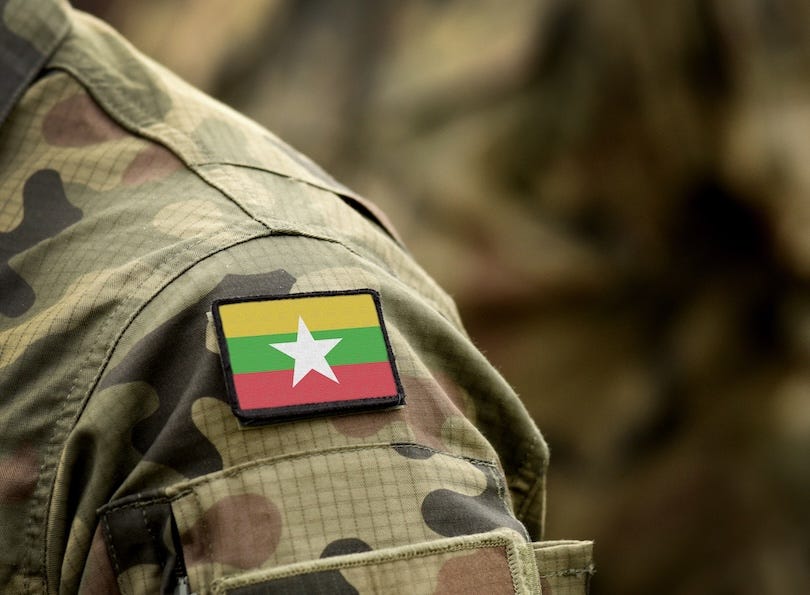
For more than half a decade, a coalition of armed groups have struggled against the military junta of General Min Aung Hlaing in Myanmar. Despite achieving some successes in their first two years of rebellion, this alliance of protesters-turned-guerillas and ethnic militias from the country’s hinterlands have found little support beyond their country’s borders. Military rule in the country has endured due to the lifeline offered to it through external support from fellow authoritarian states, particularly Russia, and more cautiously China. Substantial geopolitical changes since the beginning of this decade, such as the emergence of a neo-authoritarian bloc, a general drift toward multipolarity, and democratic backsliding internationally, have together given Myanmar’s new military rulers an upper hand over its democratic challengers since 2021.
Get E-International Relations delivered to your inbox, free. As you sign up, consider becoming a paid subscriber, or make a donation, to support our work.
The Spring Revolution
Following the military coup of February 1st 2021, a massive non-violent protest movement, dubbed ‘the Spring Revolution’, was brutally suppressed by Myanmar’s military forces. In the following weeks, Gen Z-led protests coalesced into the armed wing of the newly formed opposition National Unity Government. Yet unlike previous insurgencies, this current conflict has united the former-protesters with a number of ethnic armed organizations (EAOs) who have been struggling against the central government for decades, posing a new multi-front challenge to the junta.
The first two years of this new Civil War saw the alliance slowly gaining ground against the junta. In September 2021, the National Unity Government officially declared a ‘people’s defensive war’, and sped up the formation of the ‘People’s Defence Forces’, a nation-wide coalition of local militias formed to push back against the new junta. Over the next two years, the junta’s administration was mainly reduced to urban areas and to the centre of the country as the rebels slowly took more territory. As they continued to lose ground, the junta resorted to scorched earth tactics: burning thousands of villages to the ground, shelling residential areas, and carrying out airstrikes. The most infamous of these was the Pazigyi massacre in Sagaing region in April 2023, when more than 160 civilians were killed in one operation by the junta.
A dramatic change came with Operation 1027 in October 2023, when an alliance of ethnic militias overran over 200 military outposts in 90 days. Later, the junta lost a regional command centre for the first time in the conflict. These significant losses shattered the military’s image of invincibility, and overall, Operation 1027 was seen as a turning point by many Myanmar analysts.
Yet, within a year, the junta had recovered after receiving a huge increase in support from their fellow authoritarians. This external support, coupled with the re-introduction of general conscription that brought more than 100,000 young men into military, stabilized the conflict during 2024 and 2025. Since 2024, the junta has carried out a number of counter-offensives which has led to a loss of territory for the People’s Defence Forces and EAOs. The increased use of airstrikes and drones has taken a toll on the civilian population, food insecurity has become more prevalent, and the number of internally displaced people within Myanmar has risen to over three million. Despite their recent gains, the military has lost control over vast swathes of the country, including key trade routes with neighbouring states, and still only controls less than half of the country’s overall territory.
Throughout 2025, the junta employed lobbying groups in Washington DC in an attempt to normalise their image to US politicians. This was followed by the sham election held in December 2025 and January 2026, which was condemned by journalists, civil society, and political activists but garnered praise from the junta’s fellow authoritarians. Since the beginning of the second administration of President Donald Trump, the junta in Myanmar has continued to represent the PDF and EAOs as criminals and terrorists, while making cosmetic concessions such as transferring former-State Councillor of Myanmar, Aung San Suu Kyi, from prison to house arrest.
In an interview with the author in early-2026, an NUG spokesman based in Prague argued that: ‘if we received even five per cent of the weapons and equipment that Ukraine had received, we would have already won this war’. To procure weapons, some members of the PDF have made their own using 3D printers, while many have stolen guns from the military and the police, and others have bought weapons on the black market from Thailand and China. One civil society activist interviewed by the author claimed that ‘although Chinese officials have instructed EAOs not to sell weapons to the PDF… these instructions have not always been followed’.
Yet, despite their ingenuity and early successes, the coalition itself has been unstable. In addition to the difficulties experienced in procuring weapons, there has been in-fighting and disagreements over the long-term aims of the Spring Revolution. Some of the EAOs involved in the conflict have been struggling against the state since the late-1940s and have been running de-facto states for years; some of these EAOs are now aiming to gain independence from Myanmar after the defeat of the junta. Some EAOs have developed a strong dependency on China, while others have been open to negotiations with the junta. One foreign analyst interviewed described the armed opposition in Myanmar as ‘a mosaic of rebel groups… more than an alliance’.
Rebels had more setbacks and losses during 2026, and without military support from Western states, it is possible that the PDF will be driven further back to the remote and mountainous parts of the country in the near future. Despite more than five years of requests for arms, the NUG and PDF have been left isolated and bereft of support by Western states, who have been distracted by the wars in Ukraine and the Middle East.
A Struggle Without Support
There is no sign of any foreign state developing a willingness to support the PDF militarily, and support from the advanced industrial democracies and within Southeast Asia has been erratic, yet the NUG have been allowed to establish offices in Korea, Japan, Czechia, France, Norway, the UK, and Australia in recent years. Starlink has provided the rebels with equipment for maintaining internet connectivity, and with the assistance of some big tech firms, the Spring Development Bank was established to circumvent junta-controlled financial institutions.
Before cuts to aid spending by the US, UK, and Sweden in 2025, civil society organisations challenging military rule in Myanmar had received millions of USD in funding. Over the last twelve to eighteen months, this funding has declined significantly. 2025 saw the end of funding by USAID and then reductions in foreign aid by both the British and Swedish governments.
The Paetongtarn Shinawatra administration in neighbouring Thailand deported civil society activists from Myanmar in 2024 and 2025, after coming under pressure from the junta. In its near abroad, the junta has maintained increasingly strong relations with the other authoritarian states of mainland Southeast Asia: Cambodia, Laos, and Vietnam. In January 2022, Hun Sen, the former Prime Minister of Cambodia, was the first former head of state to visit following the military coup. Similarly to Thailand and Cambodia, the other mainland states of Southeast Asia have chosen a policy of non-interference officially, yet have effectively provided both moral support and diplomatic shielding to the junta since the coup. Military-dominated regimes or systems of single-party rule are the norm in mainland Southeast Asia. Authoritarian regimes such as those in Vietnam and Laos have been in power for nearly half a century and share more commonalities with the junta than with the NUG and PDF.
The democratic or maritime states of Southeast Asia: Indonesia, Malaysia, the Philippines, and Singapore have all met with the National Unity Government, have pushed for peace talks between the two sides, and have provided criticism of the junta and its human rights offences. However, due to this division within the region concerning how to respond to the crisis, the Association of Southeast Asian Nations (ASEAN) has been ineffective and has failed to sanction the junta for either the military coup, or the subsequent war crimes committed.
Neighbouring India has played a double game in Myanmar by engaging with armed ethnic organisations along its borders while also maintaining good relations with the junta. Japan, a long-time trade partner and major investor in Myanmar, has reduced aid while also attempting to protect its investments in the country. Overall, beyond the sanctions imposed by Western states and a resolution by the United Nations General Assembly (UNGA) in 2021, the junta has faced little opposition beyond its borders.
The Role of the Neo-Authoritarian Bloc
I have used the term ‘neo-authoritarian bloc’ to refer to the sustained collaboration of a new bloc of non-Western states comprising China, Russia, Belarus, North Korea, Iran, Myanmar, and until recently, Venezuela, since the beginning of this decade. This group is neither a formal alliance in the traditional sense, neither is it an axis, as its members lack any shared ideology. However, the regimes that came to form this bloc share the commonality of being isolated by Western states in the past, in addition to maintaining the shared interests of self-preservation, the domination of their near abroad, and the creation of an assertive response to their challengers in the West.
The junta’s primary supporter has been Russia, followed secondly by China. However, the overall global shift toward multipolarism and the decline in influence of Western states has also had an effect on how the international community has reacted to the military coup in Myanmar and the subsequent conflict. Western states sanctioned the newly established junta in the weeks following the coup. This was followed by a United Nations General Assembly (UNGA) resolution calling for an arms embargo against Myanmar. Belarus, who have since become one of the junta’s key collaborators, opposed this resolution, while other bloc members abstained from voting. Later, China and Russia used their veto powers to obstruct a United Nations Security Council resolution against the junta.
The relationship between Vladimir Putin’s Russia and the junta of Min Aung Hlaing has gone from strength to strength since the beginning of this decade. In February of 2026, the two countries signed a five-year military pact. This pact was the culmination of half a decade of substantial support and engagement from Moscow, including assisting the junta’s application to join BRICS and the Eurasian Economic Union (EAEU), in addition to sponsoring a number of economic projects in the country, such as the Dawei Special Economic Zone and a planned nuclear power plant.
Russia has sold more than 400 million USD of weapons to the junta since the coup, in addition to providing training programs. These arms exports from Russia have included highly sophisticated military aircraft and drones. 2025 saw Russia providing the junta with its largest shipment of weapons to date, following substantial losses and failures by the military in 2023 and 2024. Both Russia and China have also been instrumental in assisting the junta with the establishment of their own ‘national internet’: the ‘Golden Firewall’, based on China’s ‘Great Firewall’ and Russia’s ‘Digital Iron Curtain’.
Belarus, who openly opposed the UNGA resolution against the junta in 2021, have since become a major arms supplier to Myanmar. In 2025, Alexander Lukashenko, the President of Belarus, became the first sitting head-of-state to visit post-coup Myanmar. Similar to his support for Vladimir Putin’s war in Ukraine, Lukashenko has thrown his weight behind the junta’s war. North Korea have also exported a substantial amount of arms to Myanmar since 2021, including ballistic missiles and aerial weapons. In addition to this, both regimes have collaborated on rocket building projects in recent years.
Despite not maintaining an embassy in Naypyidaw, there has also been significant support provided to the junta by Iran. Tehran has sold weapons and provided training projects to military officers in Myanmar since 2022. Iran also provided the junta with much-needed jet-fuel for airstrikes, delivered by its ‘shadow fleet’, until the onset of military action by the US and Israel in February 2026. In total, the sum of the diplomatic, economic, technological, and military support provided to the besieged junta has allowed the regime to endure over half a decade of fierce insurgency.
Beyond the neo-authoritarian bloc, the junta has also benefit from wider support from the global South and backsliding regimes. It has purchased arms from Pakistan and Serbia, as well as Israel. Despite often being labeled a ‘pariah’ by media outlets, the junta has not become diplomatically isolated since the coup. In contrary, new embassies have been opened in Saudi Arabia, the UAE, Kuwait, Ethiopia, and Somalia in the last four years, while the junta has maintained its older embassies with influential regional powers, such as South Africa and Brazil.
China: The Cautious Hegemon
In comparison to the other states in the bloc, China has played a double-game in Myanmar and has effectively backed both sides in the conflict. Unlike other states in the neo-authoritarian bloc, China maintains a border with Myanmar which is more than 2,000 kilometres in length and has been investing significantly in the country since long before the 2021 military coup. Additionally, China’s engagement with EAOs along its southern border goes back to the 1960s. In recent decades, Beijing has attempted to play the role of mediator between northern EAOs and successive central governments.
These attempts at mediation intensified when negotiations concerning the China-Myanmar Economic Corridor (CMEC) began in 2018. Following the coup in 2021, China then had to balance its relationships with these EAOs and also with the newly-established junta. In the first two years of the conflict, some EAOs along the border began to develop a high level of dependency on China for both weapons and aid. Beijing has used this dependency to maintain its strong influence over these northern EAOs, who run their borderlands as effectively de-facto states. Following pressure from Beijing, EAOs have removed scam centres run by criminal organisations in their territories in recent years. Additionally, some EAOs have even given up territory to the junta, when pressured to do so by China.
Operation 1027 of October 2023 pushed China off the fence, as the stalemate that had lasted from 2021 to 2023 had collapsed. Since this time, China has increased its level of support for the junta. After Russia, China has been the junta’s second largest supplier of arms. Since 2021, Chinese companies have sold more than 250 million USD worth of aircraft, armoured vehicles, and more conventional weapons to the junta.
In early-2026, Chinese officials voiced support for the junta’s elections. To compete with the junta, the NUG has adhered to the ‘One China Principle’ as a means to attract Beijing. As one NUG representative explained: ‘despite appearances, China is keeping all options open… and has held numerous meetings with the NUG in recent years… which has led to friction between Beijing and the junta’.
China’s balancing act in Myanmar can be explained by examining its wider stakes in the country. The China-Myanmar Economic Corridor (CMEC), a component of the Belt and Road Initiative (BRI), was established in 2018 to connect China’s landlocked southern provinces to the Indian Ocean through infrastructural projects built across Myanmar. This planned corridor would become an economic lifeline for China if armed conflict were to erupt in the Taiwan strait in the near future. Yet, some Chinese development projects in Myanmar have faced major opposition since before the coup, such as the Myitsone Dam project, which has been stalled since the 2010s. Other major projects of the BRI, such as the Kyaukpyu Deep-Sea Port and the Muse-Mandalay Railway have been postponed since the outbreak of the conflict. However, many projects related to oil and gas pipelines, roads, bridges, and power plants have continued since 2021.
In addition to the above, hundreds of private Chinese firms have operated in Myanmar since the 2010s or before, from mining or manufacturing firms, to scam centres and more illicit enterprises. Chinese firms have also made significant profits through arms sales to both sides in the Civil War. Despite the widespread destruction experienced across Myanmar, Beijing has been successful in protecting Chinese citizens and Chinese businesses, in addition to using EAOs to eliminate criminal operations run by Chinese triads inside the country.
Beijing has maintained consistent communication with both the NUG and EAO representatives since the early years of the conflict; yet Beijing’s support for the PDF has been extremely limited, as China needs to obstruct the emergence of a pro-western government on its borders, while simultaneously preventing the complete collapse of the state. Overall, China has used a hedging strategy that keeps both sides dependent on Chinese patronage and responsive to Beijing’s requests. China’s involvement in the conflict illustrates how cautious and flexible Chinese officials can be when Chinese investments come under threat. In conclusion, Beijing’s flexible and adaptable engagement with its collaborators, whether at state or sub-state level, has been the key to its continued economic successes in Myanmar, despite the devastation wreaked by the Civil War there.
Conclusion
More than 90,000 people have been killed in Myanmar’s Civil War since 2021. Despite the huge disparity in terms of external support, the alliance of the PDF and EAOs saw significant successes between 2021 and 2023 and the NUG have slowly begun to develop partnerships abroad in recent years. However, the wars in Ukraine and Iran, divisions within the West, and democratic rollback internationally are all factors that have led the worlds democracies to turn their backs on the struggle for democracy over tyranny in Myanmar.
This conflict is significantly different from that seen during the five decades of military rule from the early 1960s to the early 2010s, due to the involvement of this new bloc of ambitious and coordinated authoritarian states. Russia, Iran, Belarus, and North Korea have provided a substantial amount of weapons, ammunition, and aircraft to the junta, in addition to providing a high level of diplomatic and economic support, which has led to the endurance of the regime since 2021. I contend that without this support and collaboration from their fellow authoritarians, the junta would have long fallen. Increases in support since 2024 have led to the junta reclaiming territory and making a comeback over the last year.
China’s involvement in the conflict is more complex than the other authoritarian states discussed above, due to a shared border with Myanmar, a long history of investment, and also interaction with both EAOs and successive central governments in the country for decades. Overall, despite providing some support to EAOs, Beijing is wary of the emergence of a democracy on its southern borders and has made a priority of protecting its investments and the activities of Chinese nationals operating in Myanmar, and has thus overall backed the junta.
The military coup in Myanmar in 2021 and the subsequent period of military rule are together part of a greater global authoritarian revival led by a new bloc of emboldened authoritarian regimes who have effectively supported their counterparts in Myanmar. Yet this bloc has also suffered humiliations and losses, as have been seen by the collapse of the Assad regime in Syria in December 2024, the bombing of Iran in June 2025, and abduction of Venezuela’s Nicolas Maduro in January 2026. Despite this, the bloc have continued to support the junta, in addition to Vladimir Putin’s war in Ukraine, and have recently provided assistance to the besieged regime in Tehran. Additionally, the assertiveness of Russia, Iran, and Myanmar has altogether had an emboldening effect on other states in the bloc which has led to the de-thawing of long frozen conflicts and the revival of irredentist claims in recent years.
The determination of the bloc to ensure the junta’s survival is only another element in the overall authoritarian coalescence that has defined the geopolitics of this decade. Similar to the conflict in Ukraine, the conflict in Myanmar has no end in sight, as the support provided to the junta by the bloc continues to increase and shows no sign of abating. Conversely, although suffering setbacks over the last year, the PDF and EAOs are intent on continuing their armed campaign against military rule in the country, until the junta have been finally overthrown.
Gerard McDermott is a graduate of the doctoral program at the Department of Public and International Affairs at City University Hong Kong. He is currently an independent analyst based in Europe. He is originally from the Republic of Ireland.
The author would like to thank Lynn Ko of the NUG’s office in Prague, in addition to the journalists and civil society activists interviewed in 2026 from Myanmar, and to those working on Myanmar based in Washington DC.