

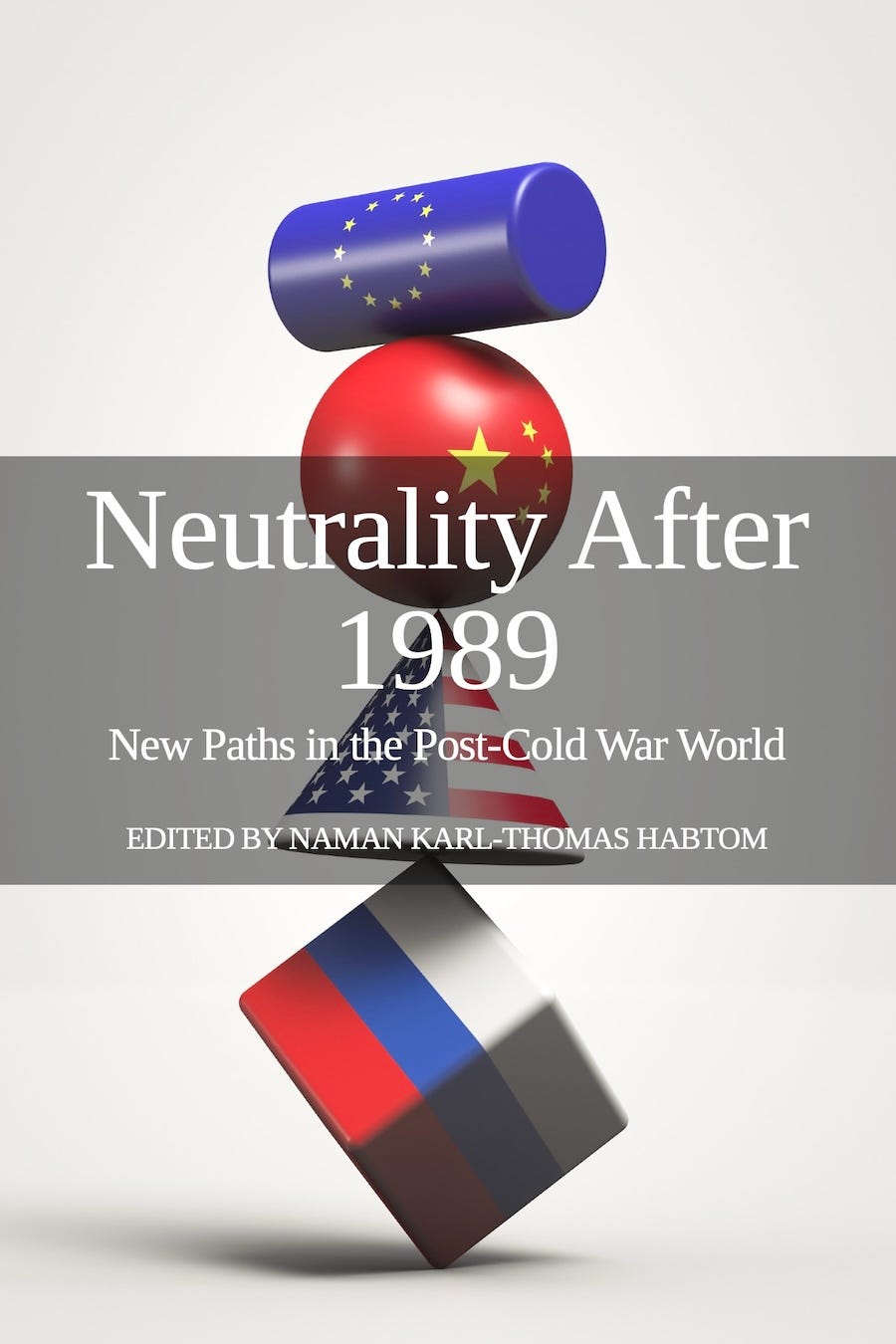
Download the book free of charge (below) or buy a paperback version on Amazon and in all good book stores.

Following the collapse of the Soviet Union and the emergence of the United States as the world’s sole superpower, neutrality was seen by many as a relic of the Cold War. However, the arrival of rising powers on the scene and the gradual shift towards multipolarity as countries like Russia and China assert their influence and challenge the US-dominated international order has in turn revived neutrality in its various forms. This book begins with a range of chapters examining the ‘old neutrals’ of Europe via contemporary Austrian and Swiss neutrality, the decline and end of Swedish and Finnish neutrality, and the resilience of Irish neutrality. Later chapters deal with the emergence of ‘new neutrals’ via examinations of Vietnamese ‘bamboo diplomacy,’ Israel’s efforts to balance its relations with Washington and Moscow, and Oman’s non-interventionist foreign policy. As the range of chapters show, the role of neutrality – and its perception or misperceptions – remain vital in understanding contemporary geopolitics and international relations.
Get E-International Relations delivered to your inbox, free. As you sign up, consider becoming a paid subscriber, or make a donation, to support our work.
Contributors: Roby C. Barrett, Karen Devine, Pascal Lottaz, Nguyen Khac Giang, Erik Noreen, Jussi Pakkasvirta, Liudmila Samarskaia, Roxanna Sjöstedt, Leah Sherwood, Hanna Tuominen.
Neutrality is particularly interesting when viewed not as the absence of alignment, but as a strategy for preserving freedom of action.
The post-Cold War environment shows that smaller and middle powers can use neutrality, non-alignment, selective engagement, or strategic balancing to preserve room for maneuver in an increasingly competitive international system.
From a field-informed perspective, the key question is not simply whether a state is formally neutral, but whether its policy actually preserves strategic options when circumstances change.
That makes neutrality less a fixed status than a continuing calculation involving geography, capabilities, dependencies, interests, and time.
— Wahidullah Noorzai (NIDA)
Former Senior ANCOP Officer | Field Strategist | Military & Security Analyst