

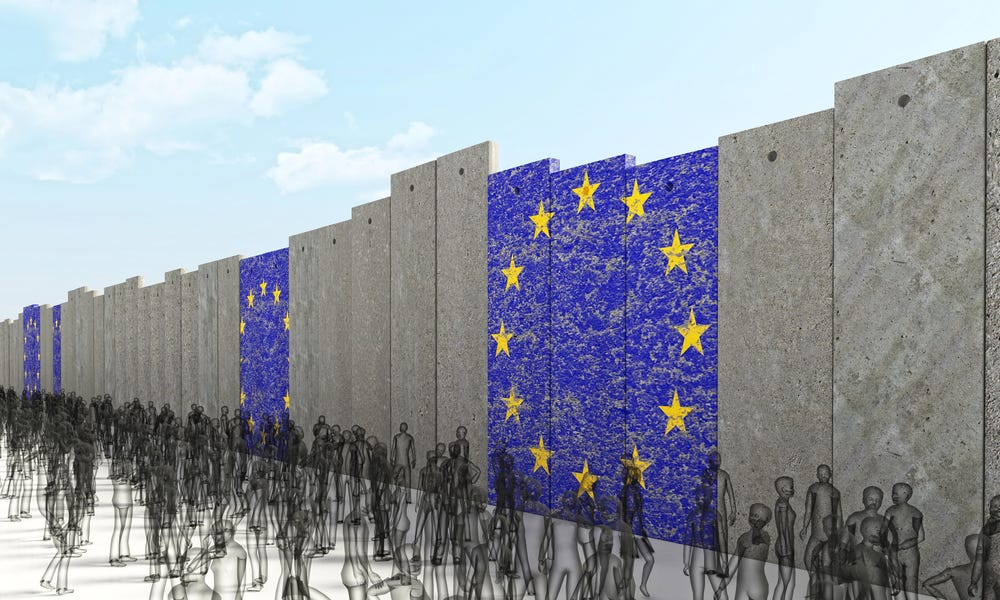
On 30 July 2026 Spanish authorities estimated that more than 50,000 people had crossed irregularly from Morocco into Ceuta. By 3 August, Spain said that about 69,500 had returned and 3,000 to 5,000 remained. Together those figures imply between 72,500 and 74,500 arrivals excluding deaths, although no reconciled total had been published. The toll was also unsettled: Reuters reported 72 deaths on the Spanish side and 11 on the Moroccan side; La Nación reported 88 bodies in Ceuta’s improvised morgue, plus the eleven recovered by Morocco. In May 2021, close to 8,000 entered over two days. July was on another scale. The sharpest response came from Rome, as European governments quarrelled before the origin of the shock or the risk of onward movement was clear.
Get E-International Relations delivered to your inbox, free of charge. As you sign up, consider becoming a paid subscriber to support our work.
The causes remain disputed. Reuters traced the mobilisation to online videos, misleading readings of a court ruling, economic hardship and calm seas; specialists asked whether Moroccan authorities had looked the other way. A Moroccan parliamentary figure denied political motive, while Madrid called bilateral relations excellent. On 3 August, an El País and Cadena SER account relayed by Reuters said Spanish intelligence believed Morocco had not planned the crossing but had allowed it and benefited politically. The account relied on unidentified officials. A separate report said intelligence had flagged a possible mass entry around Throne Day. Grande-Marlaska said he received no CNI warning; Defence would not discuss classified reports. Morocco’s Interior Ministry blamed misinformation, trafficking and misreadings of the ruling, without addressing deliberate non-prevention. Prevention remains open. The public record does not show that Morocco engineered the flow to coerce Spain.
September 2024 offers a limited comparison. Faced with similar calls, Moroccan police blocked hundreds of people, arrested sixty and reported preventing over 11,300 attempts the previous month. In July 2026 tens of thousands reached the border. Riot police used batons and tear gas, and water cannon trucks were deployed, but the frontier was overwhelmed. Monthly prevention and containing tens of thousands in one night are different tasks. The comparison asks why prevention failed; it does not answer it.
The online claims distorted judgment 814/2026, of 29 June. It held that summary rejection at the Ceuta and Melilla borders does not reach people intercepted at sea, who overcome no physical barrier, although it could apply if containment elements were installed in the water. Ordinary return remains available after an individual procedure with guarantees. Online, this became a supposed route to staying in Spain. Spain has since installed a 500-metre floating barrier at El Tarajal.
The conceptual threshold matters. Kelly Greenhill describes coercive engineered migration as the deliberate creation or manipulation of cross-border movements to induce concessions. Fiona Adamson and Gerasimos Tsourapas place the management of mobility within interstate bargaining. Both require purposeful conduct. The EU Agency for Fundamental Rights adds a specific threshold: an actor must encourage or facilitate movement with the aim of destabilising the Union or a member state in a manner liable to put essential state functions at risk.
If the El País account is accurate, deliberate non-prevention could be read as facilitation, or bring the case close to that threshold. Purpose remains missing. Nothing in the public record establishes that the border was relaxed to destabilise Spain or the Union. Instrumentalisation therefore remains one hypothesis among several. The damage examined here came out of the European quarrel: temporary internal checks, a diplomatic rupture, and the idea of excluding a Schengen partner entering ordinary political debate.
On 30 July Giorgia Meloni said she was weighing extraordinary measures, Spain’s suspension among them. The next day Italy reintroduced controls at its air and sea borders with Spain for one month, a step the Code permits in principle, and described it as suspending the Schengen agreement with Spain, which the Code does not provide for. Rome said the measure meant targeted checks on non-EU nationals arriving by air or sea. EU citizens were unaffected. Madrid summoned the Italian ambassador.
The operational link between Ceuta and that measure was thin. Ceuta and Melilla have a special regime within Schengen: entry gives no unchecked access to mainland Spain, and exit controls remained in force, as the European Commission confirmed. No onward movement had been reported. The local burden was real: between 3,000 and 5,000 people remained, both reception centres had collapsed and the city was processing 862 migrant minors. Reuters reported that Meloni’s coalition faced pressure from Roberto Vannacci’s far-right party; opponents saw the checks as meant for home consumption. Motive remains unproven, though research on Austria, Germany and Switzerland found that radical-right parties drove mainstream attention to immigration during the 2015 crisis.
The Schengen Borders Code allows urgent temporary internal controls under Article 25a, subject to notification, necessity, proportionality and last resort. Under Article 29 the Council may recommend controls where persistent external-border deficiencies put the whole area at risk. Neither provision suspends or removes a member state. Public reporting did not show whether Italy had met the relevant conditions, and the announced suspension of Spain had no basis in either.
The danger to Schengen lies in accumulated exceptions. Stefan Salomon and Jorrit Rijpma argue that abolishing internal controls created a shared spatial experience of European citizenship. Two months before Ceuta the Commission urged nine Schengen states to phase out controls that had run beyond twelve months. The Code anticipates reintroduced controls. Late July went further: governments said that excluding a partner was on the table.
On 1 August twenty-two heads of state and government signed an Italian-Danish letter calling for an emergency meeting, stronger external-border coordination and action against pull factors, including regularisation. It supported Spain while criticising its policy; exclusion was absent. The signatories split over suspension. A country-by-country review records six governments treating it as legitimate, while Germany, Belgium and Slovakia rejected that logic. France and Portugal declined to sign and ruled it out, though both reinforced their borders with Spain. Austria’s Christian Stocker framed suspension as an instrument available at his country’s own borders. The precedent mattered beyond Spain.
No public concession from Madrid can be identified. Most of those who crossed returned to Morocco, many voluntarily, citing hunger, exhaustion, hostility and no route towards the mainland. Things changed in Spain even so. A physical barrier now stands where the court found none, and twenty-two governments have placed Spanish regularisation policy on the European agenda. The episode also produced a dispute between member states and brought temporary exclusion of a Schengen partner into mainstream debate. Migrants and border communities paid the immediate price.
More Frontex staff, surveillance and barriers will not address that vulnerability alone. The Commission’s 2026 State of Schengen Report records a 26 per cent fall in irregular crossings in 2025 and the launch of the Entry/Exit System. Border management had already intensified. On 3 August, von der Leyen’s response to Sánchez captured the ambiguity. She praised Spain and Morocco for preventing onward movement, urged surveillance and barriers, and proposed early-warning arrangements, support for Morocco and Frontex reinforcements. She also rejected the use of migration as pressure against a member state, without identifying an actor. The Commission invoked instrumentalisation while leaving attribution open.
At the time of writing, the emergency video conference of interior ministers scheduled for 4 August offered an immediate test. Von der Leyen proposed cooperation with partners, stronger borders, early-warning systems, action against smugglers and more effective returns. None addresses member-state conduct before attribution and onward risk are established. A protocol for shocks of uncertain origin should pair immediate support with a rapid Commission-led assessment and a presumption against punitive internal controls where no onward risk is shown. Once sponsorship is established, measures should fall on whoever is responsible. The Agency for Fundamental Rights lists sanctions, visa restrictions and action against state-sponsored smuggling, while insisting that fundamental rights continue to apply.
The evidence does not show that Morocco engineered the July crossings, and the lesson turns on that. Established authorship gives the response an external target. After Belarus organised migrant transit towards Lithuania, Latvia and Poland in 2021, the Council widened its sanctions over instrumentalisation. In Ceuta, unresolved attribution redirected the quarrel inwards. Whether or not the crossing was an operation, uncertainty magnified its effects: governments imposed costs on one another while the origin remained contested. That is the strategic vulnerability. To damage Europe there is no need to defeat its border. It may be enough to touch it, leave no signature, and let the Europeans do the rest.
Nicolás Ezequiel Salvoni holds a Master’s degree in International Studies from Universidad del CEMA and a Bachelor’s degree in Development Economics from Universidad Nacional de Quilmes. He is a Professor at Universidad Argentina de la Empresa (UADE) and Universidad de Ciencias Empresariales y Sociales (UCES), and a researcher at Universidad Nacional de Quilmes. He previously wrote for E-International Relations on migration as an instrument of coercion.
What makes this interview particularly important to me is the way it challenges us to examine the human consequences behind concepts that are often presented as inherently positive: security, peace, democracy, human rights, foreign aid and international intervention.
From the perspective of someone who has worked inside a security institution in a conflict-affected country, I find one question especially difficult to ignore: when external actors provide security assistance, who ultimately defines the meaning of security, and whose risks are being measured?
Foreign assistance is rarely only technical. Training, equipment, intelligence, logistics, institutional advice and financial support can strengthen state capacity, but they can also create forms of dependency, reshape institutional priorities and influence how national security problems are defined and addressed.
This does not mean that foreign assistance is inherently harmful. Nor does it mean that domestic actors are simply passive recipients of external influence. The more difficult analytical task is to examine the interaction between external resources and domestic institutions: who controls them, how they are localized, what incentives they create, and what happens when external support is reduced or withdrawn.
Afghanistan provides a particularly important case in this regard. Years of international investment created significant security capabilities, but the eventual collapse of the security system also demonstrated the difference between building capacity and building sustainable institutional autonomy.
This is where I strongly agree with the interview’s insistence that scholars should reflect on their own position in the debates they study. For those of us who have experienced conflict and international security assistance from within the institutions receiving it, the questions look different from those asked from a distance.
Perhaps the central question is therefore not simply whether intervention works, or whether aid is good or bad.
The deeper question is: what kind of political and institutional order does external assistance produce, for whom, and with what consequences after the external actor leaves?
That question deserves to remain at the centre of contemporary International Relations.
Wahidullah Noorzai
Former Senior ANP/ANCOP Officer | Strategic & Security Analyst