


On 2 November 2026, the United Kingdom’s Home Office published the document ‘A fairer path to settlement’ which is the government’s response to a consultation that took place a year prior. The document sets the new rules to the UK’s immigration policy which remain largely unchanged despite reactions from non-governmental organisations, campaigners as well as members of the Labour government. Under the new rules, which will go into place in January 2027, migrants will have to earn their settlement in the UK through ‘contribution and good character’. Earning indefinite leave to remain, which allows migrants to live in the UK without restrictions, will become harsher, will have to be earned through financial contributions and by meeting certain conditions to which people must adhere. The government’s plan places people into different categories based on their earnings, types of visas, employment sector, family connections, immigration rule breaking and access to public funds. Highest earners will only wait three years until they can apply for settlement whereas others could wait 20 years until they become eligible. Four character related criteria are non-negotiable: ‘one would have to have a spotless criminal record, English spoken to a high standard, no debt owed to the taxpayer, and record of sustained National Insurance contributions’. These rules, however, mean that people would have to join a race for proving they are worthy of living in a country that considers them unworthy.
Get E-International Relations delivered to your inbox, free. As you sign up, consider becoming a paid subscriber, or make a donation, to support our work.
The British government’s rules are not surprising; they follow a global pattern of placing migration into the epicentre of political debate during the last decade. On 16 June 2016, Nigel Farage, current leader of Reform, a political party that could be placed in the far right of the political spectrum, released the so called ‘Breaking Point poster’. The date that this poster was published was not coincidental as it was a week before the referendum for Brexit. The poster depicted thousands of migrants walking and three layers of text that said: ‘Breaking Point’ in capital red letters, ‘The EU has failed us all’ and ‘We must break free of the EU and take back control of our border’. The photo was taken at the Slovenian-Croatia borders in October 2015 during the peak of what was framed as Europe’s ‘refugee crisis’ and those walking were framed as a homogenous crowd. As soon as the poster was released, Farage was accused of inciting racist hatred while Brexit campaigners distanced themselves from him. The poster implied that the EU’s freedom of movement is responsible for the UK losing control of its borders as those depicted in the poster would eventually migrate to the UK. This form of migrant vilification served Farage’s far right, anti-migrant narrative: ‘the EU has made a fundamental error that risks the security of everybody’ as he proclaimed. For Farage, the British politics was at a breaking point due to the EU’s migration politics.
Despite reactions to Farage’s anti-migrant campaign, migration and migrants have been used by both the British left and right for political gains. What has been framed as a ‘small boat crisis’ is at the centre of the political debate in the UK. The use of small boats by migrants to cross the English Channel was not common before 2015; people on the move were crossing by hiding into lorries that crossed the Eurochannel. However, increased security at ports as well as France’s crackdown on migration led to sea crossings. By 2018 the number of people increased as the sea crossing became more popular. Due to the use of small boats, the framing of a small boat crisis was normalised and in 2023 then Home Secretary Suella Braverman introduced the ‘Illegal Migration Bill’ by associating ‘small boats’ to a wider global migration crisis. As a result, the ‘small boat’ has been discursively transformed into a crisis which shapes British politics and determines which Prime Minister is capable enough to solve it and ‘take back control’ of the British border. Such framing, however, has serious implications as the border becomes a spectacle and the migrant is illegalised.
Labour’s recent rules strengthen the border spectacle and contribute to the migrant’s illegalisation by creating societal dichotomies of worthy vs unworthy and good vs bad migrants. For migrants who seek asylum the implications are severe. Those who enter the UK through ‘Safe and Legal Routes’ such as the UK’s Resettlement Scheme are favoured and be able to settle in the UK after five years. Those, however, who enter the UK in any other way other than ‘Safe and Legal Routes’ will face a 20-year waiting period. This means that migrants who arrive in the UK in small boats will not be worthy of full protection and settlement that others will have.
In the past decade subsequent British governments have vilified the migrant and presented them as the monstrous other: not British enough, not rich enough, a classless vagabond stealing jobs and claiming benefits. Small boats arriving at the British shores become a spectacle at the British border in a similar way that boats arriving in the coasts of Italy and Greece became a border spectacle in 2015 onwards. In both instances, from the viewpoint of the state, the illegalised migrant threatens state sovereignty and liberal democracy. For Nicholas DeGenova, migrant illegality is produced legally through the state’s legal processes and the border spectacle contributes to that.
In both the European and British ‘crises’ the border needs to be fortified and secured because the migrant is seen as a threat. In the UK, as in the European Union, those arriving at borders led the state to an emergency which resulted in the creation of a border crisis. Staying true to the ideals of a liberal democracy the state cannot deny migrants the right to apply for asylum, for it will mean it will violate international law. It can, however, deny them the right to settle and the right to belong rendering them undeserving of equal rights to other migrants. This way the migrant becomes deportable at any moment, and in the British case, those who will have to wait for 20 years to settle, they will leave under the fear of being deported at any given moment. It needs to be noted, however, that such practices are racialised and conceal a form of racialised border violence. Isakjee, Davies, Obradovic-Wochnik and Augustová describe this as liberal violence which obscures and conceals violences against the racialised migrant other while upholding the European ideals of liberal democracy.
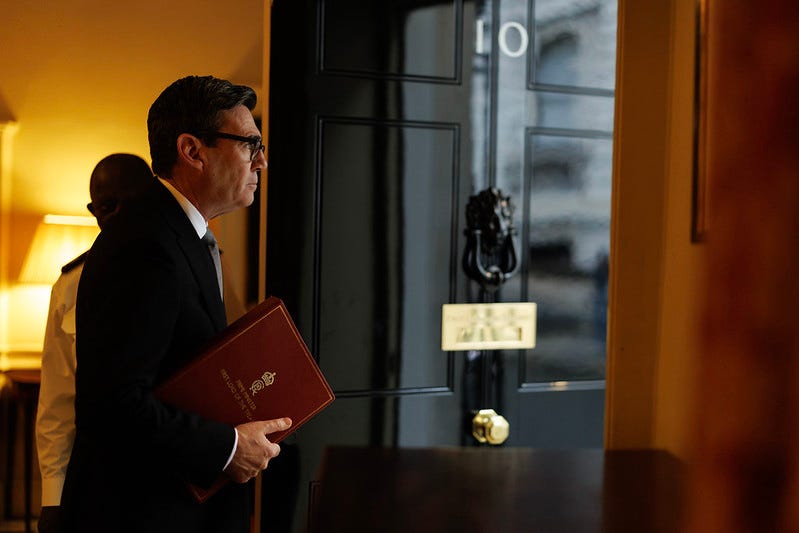
The announcement of the British government’s migration rules was accompanied by the UK Prime Minister Andy Burnham’s comments who said that previous governments ‘lost control of immigration’ and continued that, ‘[p]eople want to see an immigration system based on control, contribution, and which rewards those who play by the rules’. It is not clear what a system based on control would look like under Andy Burnham’s premiership. Stopping small boats is a task that will inevitably fail as human movement cannot be stopped through restrictive policies and new routes will emerge. If the new immigration plan will bring the system under control then it only the state’s liberal imagination and contributes to liberal violence beyond the border. The new rules compliment the government’s efforts to end the ‘small boat crisis’ by stopping the boats which include further securitisation and militarisation of the English Channel. In September, following the Coast Guard’s failure to intercept two vessels that arrived on Kent’s coast, Andy Burnham claimed that he will be ‘relentless’ in his efforts to end channel crossings. Consequently, the Labour government removes people’s right to belong and settle and renders them invisible within the society which is a form of non-recognition and erasure.
At the same time, playing by the rules does not guarantee settlement as rules can change any time without any warning. The new rules do not only affect migrants who seek asylum but also those who have been living in the UK for years but have not received permanent settlement yet. This would affect workers from migrant backgrounds who have temporary types of visas such as student and graduate visas, as time spent on these would no longer count towards permanent settlement. However, this comes in contrast with the contribution-based system that the UK government wants to implement and impacts those who work in continuous precarious short-term contracts such as early career scholars in higher education.
Andy Burnham’s government does not do anything different to what previous governments have done in terms of migration policy. The new rules follow the same conservative pattern that British governments followed for the past decade. The Home Secretary, Shabana Mahmood may not use as blatantly dehumanising language as her predecessors, nevertheless, her immigration rules are equally dehumanising to migrants. The British government follows a nationalist migration policy that instrumentalises an obscure and vague version of Britishness in order to appease the socially conservative voter. Yet they essentially categorise people based on their financial contribution, render them disposable, invisible and unworthy. Similarly, migrants need to constantly prove their right to belong and earn their living in a state that does not want them, without knowing when the next set of rules will take away their rights again.
Marianna Karakoulaki is a researcher and a journalist. She is a PhD researcher in Political Science and International Studies at the University of Birmingham where she examines borders, forced migration and death in the EUropean borderscape. She is E-IR’s Managing Editor and Co-Editor-in-Chief and host of the Thinking Borders by the Thinking Global Podcast.