

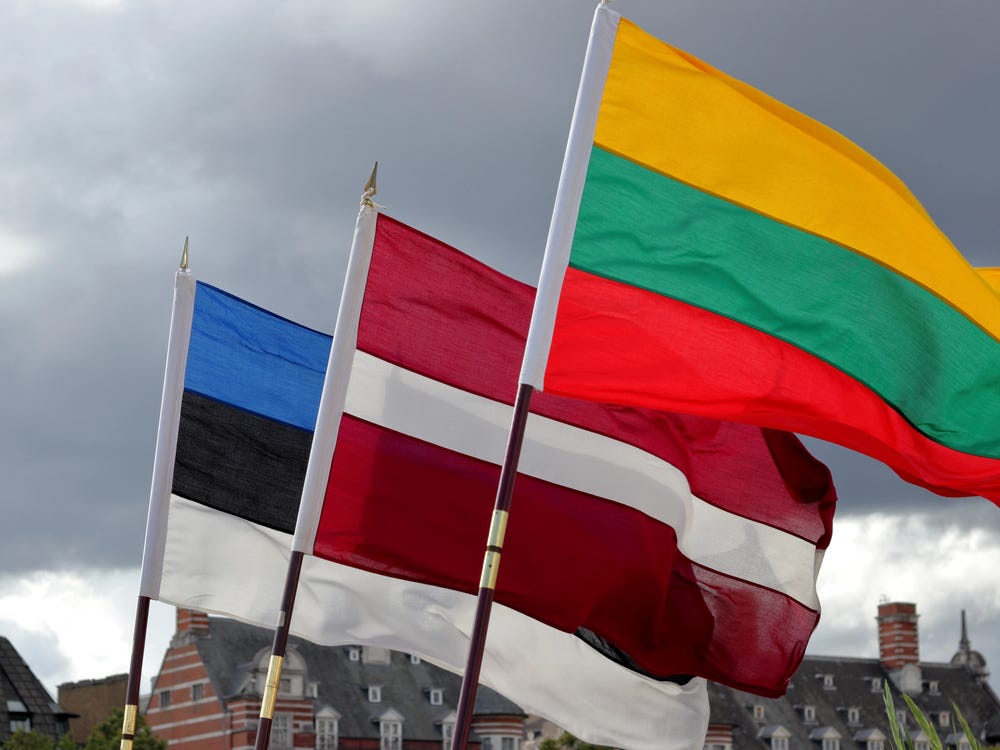
The Baltic states of Estonia, Latvia, and Lithuania are no stranger to being caught between the ambitions of larger outside powers while trying to forge their own path. For many years they have been criticised as being too hawkish on Russia and even Russo-phobic, often to the detriment of stronger relations between the EU and NATO and Russia. They have been told this by both American leaders and European ones, notably former French President Nicolas Sarkozy, who is quoted by the Russia scholar Keir Giles in his book Russia’s War on Everybody, as telling the Baltic states to ‘let history be history. I understand that you have had a hard history, and I am very sorry for it’, Sarkozy says, adding ‘we are talking about the future, and the future is Russia at our side as our partner.’
Get E-International Relations delivered to your inbox, free. As you sign up, consider becoming a paid subscriber, or make a donation, to support our work.
Much has changed since Sarkozy’s quote at the 2010 NATO Summit in Lisbon, but the Baltic states still fall victim far too often to being portrayed as burdensome post-Soviet states that represent a problem for the alliance rather than a solution. Now, in 2026, it is America’s turn to revisit the historical lesson as Pentagon officials have reportedly urged the Baltic states to tone down their hawkish rhetoric towards Russia so that more cordial relations can be reached.
While the Baltic states have good reason to be sceptical of Russia’s intentions given their history of Soviet occupation, that history has never served as a straitjacket to their wider ambitions and tremendous progress as sovereign, democratic states. Rather, their history is often used as a tool to alert others, and if they are given a history lesson by their friends in Western Europe or the US, it is usually because they are viewed as a hurdle on the path to potentially historic progress. From the Baltic states’ perspective, this progress seeks to whitewash the elements of Russian and Soviet history that are so prescient in order to deal effectively with Moscow. For the Baltic states remember their history, but they do not live in their history. They are not held captive by it, but they are often caught in someone else’s perception of what a new history, and a new historic relationship, can be between the West and Russia.
Since Russia’s full-scale invasion of Ukraine in February 2022, the Baltic states have been proven right in many respects, and several Western European leaders have come to more strongly respect their history and strategic position, one that is shared by other states in Central and Northern Europe. The UK plays a leading role in Baltic Sea security through the Joint Expeditionary Force, and for the first time since the Second World War, Germany has a permanent combat-ready brigade stationed outside of its borders in Lithuania. The Baltic states have developed critical defence links with the Nordic region and Poland, and along with Ukraine have some of the most innovative startup companies for drone technology and other defence tech. This makes them invaluable to the NATO alliance and formidable opponents should Russia dare to make any military incursions on their territory.
Heading into 2027, there are more Russia-friendly voices present across the NATO alliance, notably in the Trump administration but also Marine Le Pen’s National Rally in France, and the Alternative for Germany. As Estonia’s former President Toomas Hendrik Ilves remarked at this year’s Warsaw Security Forum, ‘the further West you go, the more Russia is winning.’ So long as President Trump remains in office, the Baltic states will unfortunately continue to be viewed as a nuisance and seen as throttling transactional relations between Washington and Moscow that may deliver any material value or legitimacy to the Kremlin.
This is also recently witnessed in Lithuania, which has reportedly been pressured by the White House to reopen its port of Klaipeda to sanctioned Belarusian potash in an effort to ease costs in the US. As Lithuania takes over the rotating EU presidency in 2027, it will play a key role in coordinating EU sanctions and migrant policy, meaning Washington is likely to continue to pressure the Baltics in order to gain more leverage in its negotiations with Moscow.
The Baltic states don’t make things easy; they remind other alliance members that the historic path to forming relations with Moscow is filled with a continuous stream of empty promises and betrayals. They insist at every opportunity that there is no room for appeasement, something Estonian Prime Minister Kristen Michal echoed after the Pentagon issued its warning by saying ‘appeasing dictators brings only humiliation.’
Now, the Baltic states have earned too great a place on the map of Europe to simply be quiet and to not cause trouble. They command too much respect to let their voices be drowned out by the agendas of other more powerful nations seeking to escape from history by not fully recognising it. Most importantly, their position on the strategic map of Europe is only going to grow, and in a time of rapid upheaval there is a strategic stability to the Baltic states that is comforting. Much more comforting than any short-term gains resulting from appeasement that the leaders and citizens of the Baltic states know will only whet the aggressor’s appetite for more destruction.
Alexander Brotman is a political risk and intelligence analyst with a focus on EU politics and security developments. He has written for several political risk publications, including Global Risk Insights, Foreign Brief, and Geopolitical Monitor, and has provided direct research support to a leading scholar of Russia and Eurasia in Washington. Alexander received his MSc. in International Relations from The University of Edinburgh. He is currently based in Washington DC. He writes in a personal capacity and not with any professional affiliation.