

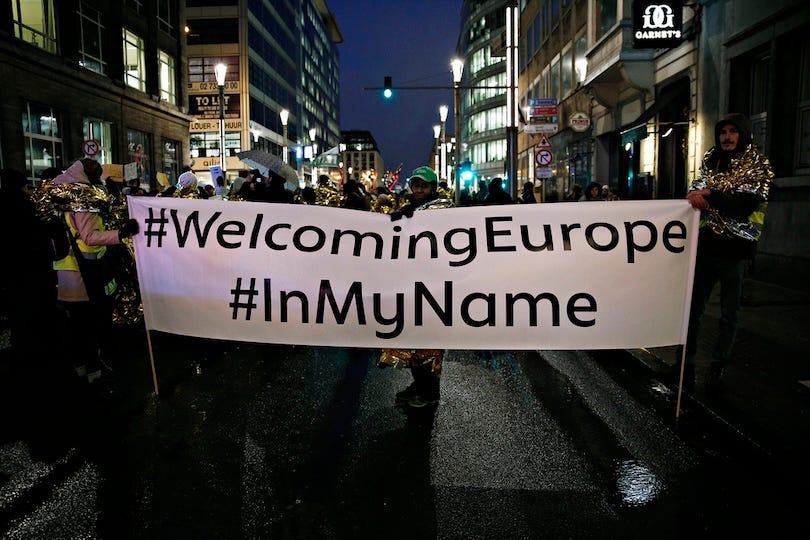
Across Europe, the rise of exclusionary and anti-migrant politics is reshaping how migrants’ integration, belonging and citizenship should be negotiated in public life. These political narratives are shifting the debates of civic integration to the ‘othering’ of specific cultural groups by reducing their social membership through the restrictive and selective lens of cultural compatibility. These dynamics have pushed migrants’ freedom of cultural expression to a political test of conditional inclusion, blurring the meaning of inclusion in modern democratic societies. The core characteristics of human-right based democratic societies (recognition, visibility, agency, and participation) are compromised by the restricted acceptance and conditional belonging.
Get E-International Relations delivered to your inbox, free. As you sign up, consider becoming a paid subscriber, or make a donation, to support our work.
This shift in European politics is an important turning point that may have serious consequences for democracy. Particularly, it is a challenge for the countries that claim a foundational commitment to multiculturalism, human rights, and pluralistic governance. When political narratives target cultural differences to frame distinct identities and cultural expressions as threats to national identity, the notion of inclusion no longer functions as a democratic commitment. Instead, it becomes an assimilationist mandate to disregard migrants’ visibility, regardless of their formal integration through language proficiency, education, and employment. Subsequently, the politicization of visibility (by problematizing cultural differences) calls belonging into question. This risks stripping ‘inclusion’ of its democratic value and transforming it into a political device for exclusion.
In this article, I argue that to reclaim the democratic meaning of inclusion, we must rethink the fundamentals of the concept, emphasizing its core value and essence. I present the idea of “inclusive inclusion” insisting that inclusion is genuinely inclusive rather than defined by conditionality, conformity, or compliance. Inclusive inclusion neither penalizes religious or cultural visibility, nor reduces belonging to mere assimilation. Instead, it restores inclusion as a democratic commitment to equal participation, recognition, and lived belonging, connecting democracy and human rights in both theory and practice.
Visible cultural expressions (such as a cultural dress codes or religious symbols) have become boundary markers of national identity. They are used to construct binary judgments of migrants’ inclusion as “integrated” or “failed”, oversimplifying the complex identities into a narrow divide between acceptance and rejection. Although hijab controversies have been central to pre‑election campaigns by Swedish right‑wing parties, this dynamic is not confined to Sweden. It reflects a rise in right‑wing European political discourses on migration, which politicize cultural visibility to magnify perceived differences and frame inclusion as conditional acceptance, thereby legitimizing exclusionary politics.
Besides acquiring formal rights, migrants experience democracy through everyday encounters with institutions, civil society, political narratives, and media portrayals that continuously shape their sense of belonging and inclusion. When political narratives or media portray migrants as social problems or social threats, their belonging becomes contested or rendered incompatible with national identity, regardless of their residence status or citizenship. Such representations of migrants shape public attitudes towards migrants, narrowing their democratic space as active participants in public life.
In the context of migration, human rights are often anchored in political debates to defend democratic values (such as equality, gender rights, and neutrality). However, these debates are now frequently instrumentalizing the language of human rights and inclusion to advance exclusionary politics. This assumed inclusion questions migrants’ cultural existence in European societies, marking it structurally incompatible with European culture, and demanding conditional inclusion upon cultural submission.
This idea of inclusion simultaneously contradicts with European human rights-based frameworks, the EU Charter of Fundamental Rights and Sweden’s Discrimination Act. The migrants who meet all formal integration markers to be considered member of society, face conditional acceptance and cultural judgement in the public spheres. This paradox reveals the fragility of belonging and its precarious status when cultural visibility becomes a site to test or compromise democratic ideals of inclusion.
Recently, the hijab (the religious of cultural practice of veiling among woman) has once again gained significance in political debate across Sweden and across other European countries. This is a striking example of how political narratives problematize cultural visibility when negotiating migrants’ inclusion. Across Europe, migrant’s visibility (e.g. religious symbols, linguistic differences, skin color, and cultural expressions and practices) in public spaces are framed as indicators of incompatibility, leading to ‘failed’ integration. Neutrality policies, workplace dress codes, and political rhetoric demand that visible differences be concealed, reinforcing an exclusionary interpretation of belonging, disregarding cultural diversity. Instead of strengthening democratic inclusion, neutrality in this context seems to mask or legitimize policies that indirectly discriminate against minorities and risk their legal and social protections.
Within these debates, inclusion appears to be framed as assimilation, forcing migrants to “melt down” into the majority culture by concealing or erasing visible differences. In my interviews with young adult migrants, participants described this tension as “wrong integration,” referring it to ‘melting pot’ integration, a process that strips away cultural distinctions to fulfil demands for total compliance. They contrasted this with “right integration” which recognizes diversity as a vital resource for social cohesion in a democratic society.
The metaphors of the melting pot and salad bowl capture two contrasting model of social integration. The melting pot model represents assimilationist perspective, theorizing integration as a one‑way process in which migrants are expected conform to the host culture and suspend their distinctive identities and cultural practices in public spaces. In contrast, the salad bowl model represents social integration through coexistence, acknowledging diversity as valuable, respected, and woven into the collective fabric of society. These competing perspectives of integration are highly relevant, as political rhetoric across Europe is shifting toward assimilationist expectations.
Migrants finds belonging through social networks, active participation, visibility, and mutual recognition. They, despite having achieved citizenship status, struggle to maintain their cultural existence, while navigating their social membership. When political and media discourses frame inclusion as assimilation, the pressures of cultural compliance risk stigmatizing cultural and religious diversity, pushing belonging into precarity. These exclusionary politics then silently delegitimize the cultural presence of migrants within society (as seen in the problematization of the hijab), exposing a systematic stripping of both visible faith and democratic agency. This subtle form of exclusion blurs the meaning of inclusion, which demands that individuals be recognized as active, dignified participants in democratic life and public spaces.
The term “inclusive inclusion” may appear linguistically redundant, and that is precisely the point to reimagine inclusion in democratic practice. While standard policy language uses “inclusion” to describe human right-based commitments, exclusionary politics increasingly frame inclusion to mask demands for cultural conformity and compliance. The redundancy here is intentional that signals that not all inclusion is genuinely inclusive. Inclusive inclusion:
does not require cultural conformity
does not reduce belonging to policy checkboxes
does not treat migrants as “becomings” who must earn membership
does not equate neutrality with erasure of difference
Instead, inclusive inclusion restores the democratic meaning of inclusion by protecting substantive participation, everyday legitimacy, and lived belonging. It aligns with human rights‑based integration and resonates belonging that enable people to participate without concealing who they are. The notion of inclusive inclusion stands in opposition to conditional acceptance, assimilationist demands, and visibility‑based inclusion. It challenges the assumption that equality requires sameness and insists that democratic belonging accommodates cultural difference.
The politics of visibility is not limited to cultural dress codes, skin color, or cultural practices. It is central to the true meanings of inclusion and democracy that serve as foundation of living conditions that nourish a genuine sense of belonging and social membership. Therefore, the challenge is not to defend equality by erasing differences and forcing cultural compliance. Instead, the real task is to practice equality by embracing inclusion in its totality and counting all as members of the autonomous society. It is a democratic commitment to recognize diversity as a foundation for collective resilience and solidarity. With the notion of ‘inclusive inclusion’, I seek to reclaim the transformative power of inclusion, revisiting integration not as a demand for sameness, but as a shared responsibility to build a society where people can participate, be heard, and belong without having to justify their existence.
Azher Hameed Qamar (he/him) is a Postdoctoral Researcher at the COFUND MDC “Migration, Diaspora, Citizenship” program at the University of Münster, and a Guest Researcher at the Malmö Institute for Migration Studies (MIM). His research analyzes migration, social resilience, and democratic belonging. He is the author of the study, young adult migrants’ social experiences in Sweden: ‘Melting pot’ and ‘Salad bowl’ perspectives on social integration, published in Children & Society, and Conceptualizing social resilience in the context of migrants’ lived experiences, published in Geoforum. You can follow him on LinkedIn.