

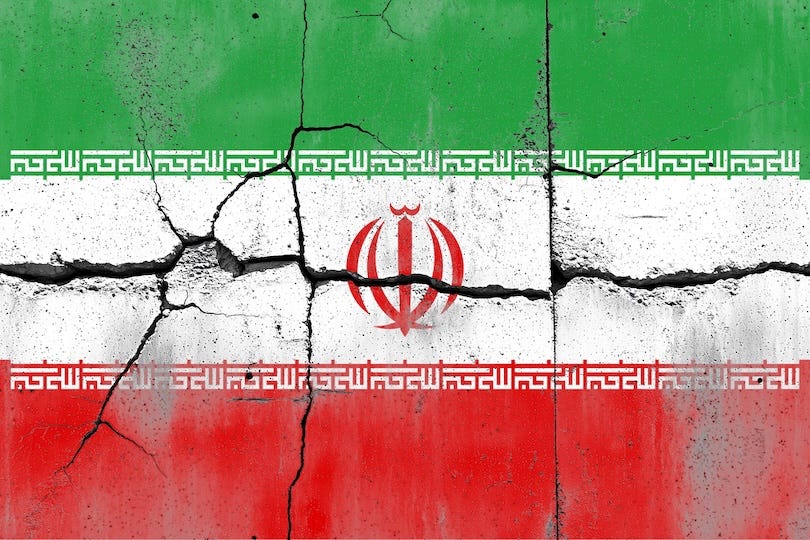
The U.S.-Iran memorandum of understanding (MOU) is not a sign of the Islamic Republic’s resilience. It is a measure of its vulnerability. The agreement may reduce the risk of foreign war or foreign military confrontation, and any reduction in that danger should be welcomed. But it does not resolve Iran’s central struggle. It exposes it. Tehran remains a regime capable of negotiating abroad while repressing at home, speaking the language of diplomacy while filling prisons, executing dissidents, censoring the internet, and threatening citizens who organize for change. If the regime violates the MOU, it will confirm its bad faith. If it fully complies, it risks weakening one of the central instruments it has used for survival: its nuclear weapons program. Either way, the agreement cannot resolve the regime’s underlying contradictions. The Islamic Republic’s crisis is not primarily diplomatic. It is political, social, and existential.
E-International Relations will always be free to read on our website and on substack. We rely on reader support to make this possible.
The regime’s political, institutional, and social conditions reveal a system under mounting strain. Internal divisions between the Islamic Revolutionary Guard Corps (IRGC) power structure and the Pezeshkian faction are likely to deepen, while unelected institutions continue to control the levers of coercion. The leadership itself faces growing challenges: the supreme leader is absent from public life, authority is dispersed among competing centers of power, and officials appear more concerned with preserving the system than projecting confidence.
Diplomatic agreements can reduce immediate tensions, but diplomacy with Tehran must not be confused with political stability inside Iran. The central struggle in Iran is not between Tehran and Washington. It is between the Iranian people and a clerical dictatorship sustained by repression, executions, corruption, nuclear blackmail, and organized violence. That distinction matters. If Iran watchers interpret the MOU as evidence that the regime has regained control, they will misread the country it concerns. The Islamic Republic is not negotiating from strength. It is negotiating from vulnerability, factional division, economic decay, and, more importantly, fear of another national uprising.
To understand why, the current moment must be placed in historical context. June 20 carries deep significance in Iran’s modern political history. On June 20, 1981, more than 500,000 Iranians marched peacefully through Tehran. They carried no weapons. They demanded the freedoms promised by the 1979 revolution, freedoms already being stripped away by the new theocracy. At the head of the march stood the People’s Mojahedin Organization of Iran (PMOI), which had emerged from the Shah’s prisons with only a few hundred members and grown into the country’s largest organized political force.
Ayatollah Khomeini answered peaceful assembly with gunfire. Revolutionary Guards opened fire on the crowd. Dozens were killed, hundreds were wounded, and more than a thousand people were taken to Evin Prison. Within days, teenagers were sent before firing squads. The generation of IRGC commanders shaped by that repression did not disappear. It rose. One of its most prominent figures is Mohammad Bagher Ghalibaf, Iran’s current parliament speaker, former IRGC Air Force commander, former national police chief, and former mayor of Tehran. According to Reuters reporting on the U.S.-Iran MOU, U.S. officials identified Ghalibaf as Iran’s chief negotiator and said he signed the digital agreement on Tehran’s behalf. His career embodies the continuity between the regime’s founding violence, its present-day security state, and its diplomacy abroad.
On June 20, 1981, the PMOI faced a choice no political movement seeks. It could accept the regime’s monopoly on violence and dissolve, betraying the ideals for which its founders had endured torture under the Shah, or it could resist through the only means the regime had left available. Its decision was not driven by militarism or a desire for armed conflict. It was the consequence of a theocracy that had machine-gunned peaceful demonstrators for demanding freedom. This history is not incidental. It is essential to understanding the structure of power in Iran today. From its earliest years, the Islamic Republic closed political space, criminalized organized opposition, and treated independent civic life as an existential threat. Repression was not a temporary excess of revolutionary consolidation. It became a governing method.
That method remains visible today. The agreement was signed by Masoud Pezeshkian, a president produced by the lowest-turnout presidential election in the Islamic Republic’s history, even by the regime’s own managed standards. He does not represent the Iranian people. He represents a fractured ruling system trying to buy time. The regime’s political architecture also limits any claim that Pezeshkian can fundamentally alter Iran’s trajectory. Unelected institutions continue to dominate the military, intelligence services, prisons, judiciary, and regional proxy networks. The regime’s survival relies heavily on executions, torture, forced confessions, disappearances, and lengthy prison sentences to suppress dissent. Far from demonstrating stability, these practices reveal a regime deeply insecure about its hold on power. A government that must execute prisoners to project authority is not displaying strength. It is exposing its fear.
The same weakness is visible in the regime’s corruption and dysfunction. The Islamic Republic has no credible plan to address poverty, unemployment, environmental decline, inflation, social unrest, or the collapse of public trust. Its institutions operate less as organs of national governance than as networks of patronage, coercion, and ideological control. Mafia-style governance has hollowed out the state while enriching those loyal to the system. Even the nuclear program must be understood in this context. For decades, Tehran has used nuclear escalation to extract concessions, deter accountability, and present itself as indispensable in regional security calculations. Nuclear blackmail is not a sign of strategic confidence. It is a tool of regime preservation.
The policy debate should not be framed as a choice between foreign war and appeasement. Both approaches have failed when they ignore the decisive actor: the Iranian people. Foreign military confrontation can give Tehran the external enemy it needs to justify repression. In just four days, from Saturday, June 13, to Tuesday, June 16, at least 31 prisoners were sent to the gallows, averaging one execution every three hours. Appeasement can give the regime resources and time. Neither addresses the root cause of instability: the existence of a clerical dictatorship ruling over a society that has repeatedly rejected it.
Against this backdrop, the significance of June 20 extends beyond remembrance. More than 100,000 Iranians and supporters of freedom are gathering in Paris not for foreign war, not for appeasement, and not for another recycled dictatorship, whether the son of the Shah or the son of the dead supreme leader, but for a democratic, secular republic in Iran. That message reflects a political alternative grounded in popular sovereignty, separation of religion and state, gender equality, abolition of the death penalty, minority rights, and a non-nuclear Iran, as reflected in Maryam Rajavi’s ten-point plan.
The international community should listen carefully. Iranians are not asking the world to impose a leader, engineer a transition, or choose among authoritarian alternatives. They are asking it to stop rescuing the regime from the consequences of its own illegitimacy. They are asking democratic governments to stand with the people of Iran, hold human rights abusers accountable, support internet freedom, demand an end to executions, and recognize the legitimacy of the Iranian people’s struggle to confront the IRGC and establish a free republic. Ultimately, the MOU may pause an external crisis, but it cannot resolve the regime’s internal crisis of legitimacy. The Iranian people, not any memorandum, are the decisive force in Iran. Their organized resistance, their demand for freedom, and their refusal to accept dictatorship remain the central facts that policymakers must recognize.
Ramesh Sepehrrad, PhD (she/her), is a Visiting Fellow at the Jimmy and Rosalynn Carter School for Peace and Conflict Resolution at George Mason University and a scholar-practitioner working at the intersection of conflict analysis, governance, technology, and security. She is the author of Cyberspace, Social Conflict, and Humanity and writes on Iran, democratic transition, and digital influence. LinkedIn.