

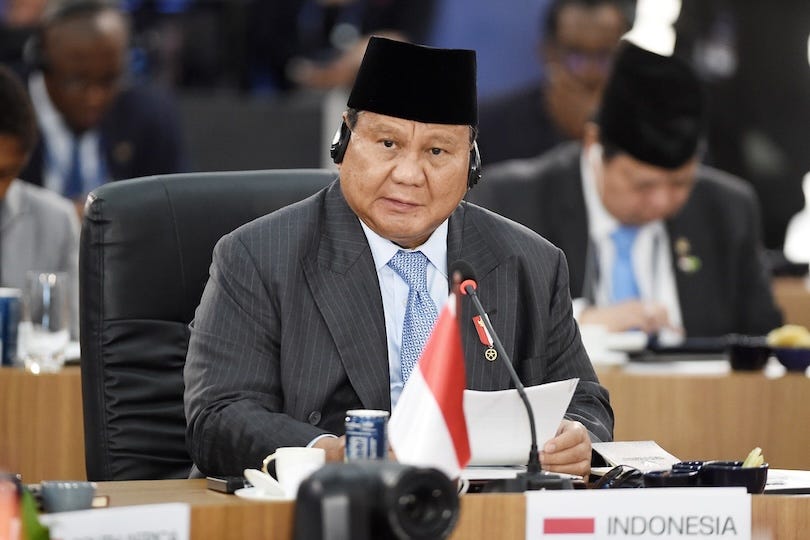
The Board of Peace (BoP) is an international body established at the initiative of US President Donald Trump and formalised through United Nations Security Council (UNSC) Resolution 2803. Its mandate covers oversight of the Gaza peace process and the channelling of reconstruction funds through the National Committee for the Administration of Gaza. When Indonesian President Prabowo Subianto signed the BoP charter on the sidelines of the World Economic Forum in Davos on 22 January 2026, the domestic reaction was swift and sharp. Within days, Indonesia's most influential Islamic leaders had split into openly competing camps, with the Palestinian question — as it so often does in Indonesian public life — providing the fault line. Twelve days later, Prabowo invited 16 Islamic organisations to the Presidential Palace for a closed-door session, and the wave of opposition that had looked formidable largely receded. That meeting was a carefully staged exercise in legitimacy management, one that reveals how deeply Prabowo's foreign policy calculus depends on harnessing the moral authority of faith-based organisations (FBOs) to absorb domestic pressure.
E-International Relations will always be free to read on our website and on substack. We rely on reader support to make this possible. Please consider subscribing to support our mission.
Member states were required to contribute USD 1 billion as an entry fee to the charter — a figure that carries fiscal weight given the budgetary strain Prabowo's administration faces from its domestic spending commitments. Indonesia joined alongside Qatar, Pakistan, Turkey, and Saudi Arabia. Major Western powers — the United Kingdom, Canada, Australia, and France — declined membership, citing the risk that the BoP might sideline the United Nations. Human Rights Watch cautioned in March 2026 that Indonesia needed to ensure its participation remained narrowly focused on reconstruction, not on lending credibility to a broader geopolitical architecture — a concern made more pointed by Indonesia's role as deputy commander of the International Stabilisation Force (ISF) operating in Gaza.
The initial backlash from Indonesia's Islamic community was organised and substantive. The Deputy Chairman of the Indonesian Ulema Council (Majelis Ulama Indonesia, MUI), Sudarnoto Abdul Hakim, expressed pointed scepticism, arguing that the BoP's leadership was dominated by actors with a long and troubling record on Palestine. Another MUI figure, Cholil Nafis, called for Indonesia to withdraw. Meanwhile, survey data cited in a March 2026 policy report from the School of International Studies (RSIS) found that 14.6 per cent of informed respondents viewed the BoP as an American and Israeli instrument to consolidate control over Gaza — a figure that understates the depth of popular unease among those who followed the issue closely.
Nahdlatul Ulama (NU) and Muhammadiyah are organisations with tens of millions of members reaching from pesantren (Islamic boarding schools) in East Java to religious study circles in Papua. On questions touching on Islamic identity – and Palestine sits at the very centre of that – these organisations can mobilise or contain significant public opinion. Their endorsement does not just manage public sentiment; it confers theological legitimacy on decisions that would otherwise remain contested on religious grounds. Tufan Kutay Boran observed that Prabowo has shown consistent sensitivity to domestic reactions when navigating foreign policy choices, recognising that his international standing depends on the stability of consensus at home. Without FBO cover, Indonesia's participation in the BoP would have continued generating the kind of popular resistance that undermines a government's negotiating credibility abroad. The meeting on 3 February delivered that cover with remarkable efficiency. NU Chairman Yahya Cholil Staquf, Muhammadiyah Secretary-General Abdul Mu'ti, and MUI Chairman Anwar Iskandar issued a joint statement of conditional support.
Researchers from the ISEAS–Yusof Ishak Institute described what followed as conditional acquiescence – an endorsement driven by structural pressure and pragmatic calculation rather than genuine conviction. That distinction matters, both for understanding the limits of what the meeting actually achieved and for assessing the durability of the consensus it produced. The framing that accompanied the announcement was carefully engineered. Minister of Religious Affairs Nasaruddin Umar drew a direct analogy between Prabowo's BoP decision and the Treaty of Hudaybiyyah — the agreement that early Muslims initially viewed as a humiliating compromise but which ultimately served the expansion of the faith. That comparison was designed to translate a politically contentious decision into the language of Islamic historical precedent, offering religious leaders a theologically respectable frame for supporting a choice that many of their constituents still found troubling.
FBO leaders did not simply absorb the government's framing, they actively produced alternative narratives tailored to their own constituencies. NU's Yahya Cholil Staquf argued that Indonesia's presence inside the BoP gave it real leverage to push for genuine de-escalation. Muhammadiyah's Muhadjir Effendy characterised Prabowo's strategy as "struggle from within" – a framing that recast Indonesian participation from compliance with American preferences into an act of tactical resistance. Both narratives served the same function, which are making engagement with the BoP intelligible, and morally defensible, to mass audiences who remained instinctively suspicious of the forum's origins. This dynamic reveals that the organisations are not passive recipients of government communication – they are active co-producers of legitimating narratives, with reach into social layers the state cannot access through normal channels. In the BoP episode, that capacity was deployed to convert a crisis of public trust into a manageable, if still unresolved, political debate. With virtually all major political parties absorbed into Prabowo's governing coalition, formal opposition channels are largely closed. FBOs represent one of the few remaining arenas where critical voices can be expressed – and also managed. The government's interest in keeping FBOs onside is therefore focused on maintaining the one institutional space where dissent retains social legitimacy, precisely because that space can also be shaped.
Reading the official FBO endorsement as evidence of genuine consensus, however, requires a selective reading of the evidence. The shift in posture occurred at the level of organisational leadership; below that level, unease persisted and continues to surface through informal channels. Din Syamsuddin, who served as Muhammadiyah Chairman from 2005 to 2015, refused to join the emerging consensus and publicly characterised the BoP as a form of "neo-colonialism and new imperialism." He went further, describing it as a "camouflage scenario" designed ultimately to benefit Israel, and called for Indonesia's immediate withdrawal. Followers of the late Abdurrahman Wahid, known as Gus Dur, organised under the Gusdurian network and argued that Indonesian involvement would only "legitimise the interests of global powers and prolong the suffering of the Palestinian people."
The official support from NU, Muhammadiyah, and MUI cannot be separated from a pattern of deepening institutional dependency on the Prabowo administration. Several senior figures from both organisations hold cabinet positions. Some have faced legal proceedings that the executive retains discretion over. Prabowo reportedly used presidential pardon authority to release certain convicted figures, including a senior Muhammadiyah official. Accumulated dependencies of this kind gradually narrow the operational space available to FBOs when they might otherwise choose to perform a genuinely critical function. The RSIS report identified what it called a significant legitimacy gap: public trust in the BoP's mission remained low even after elite religious leaders declared their support. That gap between official FBO posture and grassroots sentiment places the organisations in an analytically awkward position — formally aligned with government, but unable to fully bring their mass base to the same point. Over time, that gap carries reputational risk for the organisations.
When Indonesia sent its delegation to the BoP's inaugural Washington session on 19 February 2026, Prabowo arrived with formal endorsements from nearly every major Islamic organisation in the country. As a piece of political management, that represented a substantial achievement given how rapidly the opposition had mobilised in the preceding weeks. Prabowo also made explicit, in statements reported in March 2026, that Indonesia would withdraw from the BoP if it failed to produce a credible path to Palestinian sovereignty – a declaration that reassured domestic constituencies and acknowledged, without quite saying so, that the government itself harboured doubts about where the forum was heading. The harder question – whether the BoP can actually produce the Palestinian self-determination that Indonesia has treated as a historical commitment since the Bandung era – remains open. Critics from outside Indonesia, including Human Rights Watch, have argued that the forum's architecture reflects American and Israeli preferences more than Palestinian ones. Indonesian critics like Din Syamsuddin reach the same conclusion from a different direction, questioning whether engagement is structurally capable of changing those preferences or whether it merely legitimises them.
What the BoP episode shows is the changed character of the FBO-state relationship under Prabowo. These organisations have become integral components of a foreign policy legitimation process that are mobilised when political decisions require religious cover, relied upon to translate elite choices into mass-digestible narratives, and held in line through a combination of institutional access and structural dependency. Whether this arrangement deepens the influence of FBOs or quietly hollows it out is something that Indonesian civil society will be addressing for years. The trajectory of the Gaza peace process, and the extent to which Indonesia's participation produces anything meaningful for Palestinians, will do much to determine whether the organisations that staked their credibility on Prabowo's BoP gamble come to regard that choice as wisdom, or as the costly precedent critics warned it would be.
Estalia Rona Ratu Roy is a Master’s student in Asian Studies at the Social Sciences University of Ankara and a graduate of International Relations from Universitas Diponegoro. Her research interests include Indonesia’s foreign policy, Faith-based Diplomacy, Area Studies, and Human Rights. She has experience in academic publishing and policy-related research, including work with the Indonesian Perspective Journal. She is the awardee of the Turkey burslari scholarship 2024.