

Uploaded to YouTube on March 7th, 2022 Khrystyna Soloviy’s song “Ukraïns’ka liut’” (Ukrainian Fury) was among the first Ukrainian songs praising Ukraine’s successful resistance following Russia’s full-scale invasion on February 24th, 2022. In addition to the soldiers serving in the Territorial Defence Forces and the Ukrainian army the Ukrainian singer highlights the anti-tank weapon FGM-148 Javelin as well as the Baykar Bayraktar TB2 drone, both which became early symbols of Ukraine’s defiance (Andrianova 2024; Naterer 2024):
V Ter-oboroni naikrashchi khloptsi / The Territorial Defences have the best lads
Sami heroï voiuiut’ u nashykh ZSU! / Only the heroes fight in the Army of Ukraine.
I dzhaveliny, i bairaktary / Javelin launchers, Bayraktar fliers
Za Ukraïnu b’iut’ rusniu! / Fight for Ukraine and beat Roosnia
(Soloviy’s translation)
Get E-International Relations delivered to your inbox, free. As you sign up, consider becoming a paid subscriber, or make a donation, to support our work.
Based on the melody of the song “Bella ciao” Soloviy’s rendition draws on a tune which not only has its roots in the Second World War Italian antifascist partisan movement, but which since has become a global hymn for people fighting for freedom (Tomatis 2023, 64ff). Soloviy places her song in this history of fighting for freedom. She also rebuts Russia’s official narrative of fighting Ukrainian fascist by using an antifascist hymn and thus implying that not Ukraine, but Russia are the fascists. “Ukraïns’ka liut’” is just one example of how popular music has accompanied this war, negotiating narratives of belonging, resistance as well as celebrating military achievements and weapon systems (e.g. Andrianova 2024; Biasioli and Drew 2024; Glew 2026; Hansen et al. 2019; Helbig 2024; Naterer 2024; Rogatchevski 2025; Schwenck and Bondarenko 2025; Wickström 2024; Wickström 2026).
While it escalated dramatically with Russia’s full-scale invasion in 2022 Russia’s war on Ukraine arguably started with the annexation of Crimea in 2014. Considering both the Russian Empire’s and Soviet Union’s (with the Russian Soviet Federative Socialist Republic as the center of power) conquest and domination of the area as a form of colonization – a point already raised by David Chioni Moore in 2001 – this war should be seen as post-colonial. The conflict is accompanied by two dominating narratives or, in Bohdan Kordan’s (2022, 164) words, “stories” centering around belonging: story one which sees Ukraine as a part of Europe and in which Ukraine strives for statehood as a sovereign state within the Westphalian system. Story two is from the perspective of Russia, where Ukraine is part of a Russian imperial (and colonial) project, not a sovereign state. In this logic “[t]he war [...] is not a war but a ‘special operation,’ since Russia cannot wage war against Ukraine when, conceptually, Ukraine does not exist.” (Kordan 2022, 168). As I have previously argued (Wickström 2014; 2016, 2026) this second narrative is not only present on the political level but is shared by many in Russia (as well as among the Russian-speaking diaspora communities) too. This mindset reflects the fact that the Russian Empire and the Soviet Union (forcefully) incorporated and colonized neighboring countries and through Russification and (later) Sovietization imposed language, economic and administrative systems as well as official culture where a Russian perspective dominates. Hence Russia’s full-scale invasion can and should also be seen as a postcolonial power struggle. Due to music’s polysemic nature these discourses surrounding the mentioned narratives are also intertwined with the reception of songs.
Not only Ukrainian artists like Soloviy, but also Russian artists support Ukraine in this war. Taking the now New York based Russian band Nogu Svelo!’s pro-Ukrainian anthem “Ukraina” as a point of departure this article explores some of the discourses linked to these two stories. After giving some context on Nogu Svelo! and discussing two possible readings of the song “Ukraina” I focus on how these readings link to gendered debates around Ukraine. As Nagel (1998) highlights, ideas of nation are gendered and here Ukraine is read as a (young) woman who is either seen as the mythological mother of Russia, a prostitute currying favors for the West and thus in Russia’s eyes worth raping (which is mirrored in the sexual violence committed in the war) or a (young) woman fighting Russia.
Ukraina
The origins of Max Pokrovskiy’s (Maksim Pokrovskii) artistic work and his band Nogu Svelo! date back to the Soviet Union. Founded in 1987, the band was particularly successful in the 1990s and 2000s. In 2016, Pokrovskiy moved to New York and commuted between Moscow and New York until Russia’s full-scale invasion of Ukraine in 2022. Remaining apolitical until 2018 his artistic work was shaped politically by two turning points marked by several events (Pokrovskiy 2023): First, during the COVID-19 pandemic through the activities of the Russian opposition politician Alexey Navalny (Aleksei Naval’nyi) and his poisoning on August 20, 2020 as well as the disputed elections in Belarus on August 9, 2020. During this period Pokrovskiy’s first political songs were released. They touched on the protests in Russia 2018 and in Belarus 2020 as well as were inspired by the COVID-pandemic reflecting on the fleetingness of humanity and the cyclical nature of history. This includes not questioning what is happening around (Covid, Protests) and where people instead indulge in social media. Starting in the spring of 2021, Pokrovskiy began to encounter problems with his performances in Russia.
The second turning point began with Russia’s full-scale invasion of Ukraine. This is when Nogu Svelo! transformed from a protest band that had supported Navalny into a group that took a clear stand against the war. The first song released after the full-scale invasion was the anti-war song “Nam ne nuzhna voina!” (We don’t need war) which Pokrovskiy wanted to release in collaboration with other Russian musicians. His aim was to show that there were Russian musicians who were in solidarity with Ukraine and their plight and thus against the war. Unfortunately, according to Pokrovskiy, there was no unity among Russian artists after the war began and he was thus unable to create a community of anti-war musicians. This, for him, was a great disappointment and he went on to release subsequent songs on his own. When I asked him who the songs he released were for, he said:
Ah, that was a nightmare question to me before the war started. I just write songs, it’s like kind of I want do something I want [to] do music. Now it’s pretty clear, so, of course, Ukraine is for Ukrainians, and the rest of the songs for Russians.(Pokrovskiy 2023)
Most of the songs are aimed at a Russian audience, but he wrote the song “Ukraina” for Ukrainians. Sung in Russian it was uploaded to YouTube on June 12, 2022. Wearing a small cross around his neck and dressed in white, Pokrovskiy opens the song serenely with the chorus:
Ukraina! / Ukraine!
Moia vtoraia polovina! / My other half!
S nebes smertel’naia lavina, / A deadly avalanche from heaven,
Soidet po prikhoti strastei. / Will come down at the whim of obsessions/passion.
Ukraina! / Ukraine!
Pust’ ot Dnepra i do Berlina / From the Dnieper to Berlin
Letaiut angely nezrimo, / Let angels fly unseen,
Khrania v puti tvoikh detei. / Keeping your children safe along the way.
The song starts with Pokrovskiy singing the first four lines of the chorus accompanied by a steel-string acoustic guitar. At the end of the fourth line, after the word “strastei” [passion], an electric guitar plays a short riff. Starting with the chorus’ fifth line, an oscillating background pattern is added which adds an unsettling element to the arrangement (the sound could be an imitation of helicopter rotors or some other motor-driven noise) which brings in an acoustic element of the war (military helicopters). Adding to the ballad’s slow build the drums enter during the first verse (“Synok, ne boisia […]” – Son, don’t be scared), and the bass during the second verse (“Ne boisia, dochka […]” – don’t be scared, daughter). The oscillating background pattern is also a foreboding that despite the protagonists soothing words starting the verses not to be afraid there is good reason to be frightened of being killed by bombs, missiles and bullets or of running out of fuel as mentioned in the song’s verses. This is underlined by Pokrovskiy’s singing becoming more forced and desperate. The song reaches its climax when asking where the Third Rome (Moscow, seeing itself as the heir to Orthodox Christianity succeeding Rome and the second Rome, Constantinople), Hitler’s Third Reich and the city Pompeii (destroyed by a volcano eruption in 79 CE) is. In other words, implying that they are all gone (or, in the case of the Third Rome, that Moscow lost its religious legitimacy) and that Russia’s relevance will decline. This is followed by highlighting and namechecking the Ukrainian cities Odessa, Kyiv, Kharkiv, Mariupol and Bucha – with Bucha, the site of one of the first civilian massacres conducted by Russian soldiers during the full-scale invasion, repeated and accompanied by the sound of a missile and a caesura. Through the dramatic build and the caesura after Bucha the music underlines the lyrics’ pro-Ukrainian stance and at the same time denounces Russia’s senseless aggressions.
Terpi moia krasavitsa [Endure it, my beauty]
What sounds like support for Ukraine at first glance can seem ambiguous upon closer inspection: “Ukraina! Moia vtoraia polovina” refers to another / different half. During our interview Pokrovskiy explained that line by saying that his mother is Ukrainian (but, reflecting (post-)Soviet realities, with a Russian passport). As a result, he is half Ukrainian and feels a sense of belonging to Ukraine (Pokrovskiy 2023).
Anyone unaware of this might, however, interpret it as a reference to Pokrovskiy’s partner or wife. According to this interpretation, Pokrovskiy would be male and Russian, and his partner female and Ukrainian. This implies Ukraine belonging to Russia and was the interpretation of a Ukrainian studies lecturer present during a talk I attended by the music critic Artemy Troitsky (Artemii Troitskii) on Russian anti-war songs at Columbia University (New York, March 6, 2023). Criticizing the song the lecturer argued that this phrase not only feeds into Russia’s narrative of Ukraine as part of Russia (Kordan’s story 2), but this association also relates, in the context of the song, to the fact that Ukraine is often portrayed as a woman who from a Russian perspective is seen as both inferior and weak. This gendering is often linked with the implication that she is confused and/or afraid and therefore needs male assistance from Russia (Hansen et al. 2019, 100).
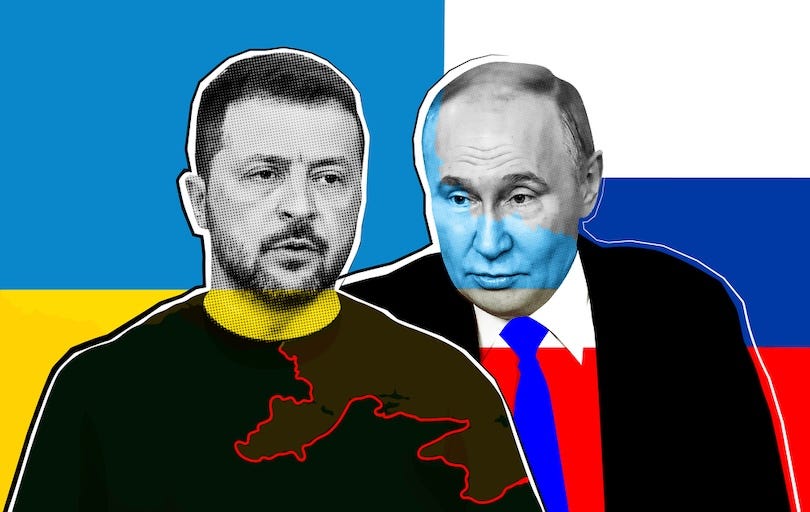
Vladimir Putin used this female interpretation shortly before the start of the full-scale invasion as a rebuttal against Zelenskyy and (from Putin’s perspective) Ukraine’s failure to implement the Minsk Agreements (negotiated in 2014 and 2015 the agreements were aimed to stop the war in Eastern Ukraine following Russia’s annexation of Crimea in 2014):
The current president [Zelenskyy] recently said that he didn’t like any aspect of the Minsk agreements. Yet ‘like it or not, endure it/take it, my beauty’ [Nravitsia, ne nravitsia – terpi moia krasavitsa]. You have to comply.
The origin of the phrase “Nravitsia, ne nravitsia – terpi moia krasavitsa” is not quite certain, but it has been used at least since the 1970s as a colloquial chastushka (a quatrain with roots in folklore) and also appears as a phrase in different songs since then.
The word “terpi” comes from “terpet’”, which means “suffer”, “endure”, “tolerate”, “bear” and “stand”. The word can also be perceived as offensive, especially when used in reference to women, as many people interpret it as a metaphor for “rape”.
As Gaufman writes, this feminization of Ukraine follows a common gendered hierarchy between Russia and Ukraine:
This obscene rape joke [terpi moia krasavitsa] was supposed to reference the fact that Ukraine had to accept the terms of the Minsk agreements whether it liked it or not, but it was not the first time that Ukraine and Russia were placed in a gendered hierarchy in Russian foreign policy discourse. (Gaufman 2023, 516)
Kyiv’s role from Russia’s point of view is ambiguous: either as the mother and founding site of the Kyivan Rus’, a medieval city-state which serves as the foundation myth for the modern-day nation-states Ukraine, Belarus and Russia, or as a prostitute who curries favor with the West for money (Kulick 2022, 193). The latter, portraying enemy women as sexual promiscuous and available, is as Nagel (1998, 257-258) points out also a common trope within military discourse when depicting the enemy.
Gaufman argues further that Russia’s strategy of feminizing Ukraine is to show that Ukraine lacks the capacity to act on its own and is dependent on Russia:
Hence the prominence of feminizing rhetoric in the context of Russia’s invasion of Ukraine in 2022, either referring to it as a Western colony or as ‘beauty’ that ‘has to take it’. By feminizing Ukraine in this way, Russian politicians deny it its agency and construct a hierarchical relationship, where Russia is superior to Ukraine. (Gaufman 2023, 528)
This portrayal is not merely rhetorical; sexualized violence is also a central component of the Russian military’s war of aggression against Ukraine, aimed at terrorizing the population through rape, humiliating men (since they are unable to protect their wives and children), and inflicting lasting trauma on Ukrainian society:
These rapes are ‘an expression of contempt’ against Ukraine and its people, a series of public humiliations to sow terror among the populace, and a way of communicating to civilians their complete and total vulnerability. […] All these traumas are ticking time bombs planted violently within families, communities, and the nation in an attempt to destroy them all – to shred the ties that bind people to one another, the social fabric that holds community together. (Kulick 2022, 197)
At the same time, the metaphor of a young woman is also used in Ukraine as a self-representation – including during the Euromaidan in 2013–14 where Ukraine was portrayed as a young woman through songs like Okean El’zy’s “Vstavai” (Rise up) and IarmaK and Tof’s “22” (Hansen et al. 2019, 74f). While “Vstavai” is “in the form of an appeal to a young woman [Ukraine] to rise up and make demands” (Hansen et al. 2019, 56) “22” is “about a pretty and good-hearted 22-year-old girl who is exploited, beaten up, and mugged. Whilst she is lying bruised, her supporters whisper her name: ‘Ukraine’.” (Hansen et al. 2019, 63). The age refers to the years since Ukraine’s independence from the USSR in 1991.
This metaphor of Ukraine as a young female also appears during Russia’s ongoing war of aggression. As mentioned in the introduction many songs released after the full-scale invasion such as Soloviy’s “Ukraïns’ka liut’” namecheck weapon systems and some also pick up on this gendered metaphor: Naterer (2024, 115-120, 125) writes that in songs about the Javelin anti-tank weapon, Ukraine is often portrayed as a young, strong woman (sometimes named Javelina) fighting against Russia. An image inspired by an Orthodox icon, titled “St. Javelina,” depicting a woman holding the Javelin missile, has gone viral as a meme and has also been turned into war-merchandise such as stickers, patches and clothes portraying St. Javelina.
In his response Zelenskyy reaffirmed (in Russian so that Putin can understand) Ukraine as a beauty, but not Putin’s:
‘like it or not, endure it, my beauty’, [This quote], without a doubt, contains something you can’t argue about with the president of the Russian Federation. Ukraine is a beauty, indeed. Yet saying ‘my’ [for his part] is a little too much, it seems. […] Ukraine is very enduring [or patient] because it is wise [to be so].
Following the Putin and Zelenskyy exchange the visual artist Andrei Ermolenko picked up on the quote and published two combined drawings, one of a pistol pointed at a young girl with the (Russian) text “We have to come to an agreement” (Nuzhno Dogovarivat’sia) and the year 2014 and the other with the now grown-up woman pointing a pistol at a person resembling Putin and saying in Ukrainian “I am not your beauty” (Ia tobi ne krasavitsa) and the year 2022 added.
This gendered discourse was, however, not on Pokrovskiy’s mind when writing the song. When I asked him about the Ukrainian language instructor’s criticism of “Ukraina”, and how he deals with such comments he answered:
And I just talk to these people, because they all know that I am half Ukrainian; this is my song about my feelings, the only thing I did, I just released this song and that’s it; if they want me to explain I don’t mind explaining. (Pokrovskiy 2023)
For him, the song is not only an expression of his solidarity, but also of his sense of belonging.
The song is in Russian, and at the time of the release he was uncomfortable with a Ukrainian translation since he does not speak the language. Following the release of the first version Pokrovskiy was sent a Ukrainian translation of the song. After some deliberation with family and friends (also making sure the translation he was sent worked as the original Russian lyrics intended) he decided in a new version of the song to include the last chorus sung in Ukrainian (with the translation credited to Valera Bortnik). The first of two revisions was released on the first anniversary of the war in 2023. He wanted to create a more solemn arrangement, and the revision was intended to commemorate the start of the war (Pokrovskiy 2023). This version features a different instrumentation (church organ, acoustic guitar, drums, tuba, euphonium, trumpet) and the performance takes place in a church in New York. He added that with the last chorus in Ukrainian “Ukrainians are happy. And I’m happy to make them happy.” (Pokrovskiy 2023)
During our conversation which was right after the release of the revised version, he also mentioned that since he had now included a chorus in Ukrainian which was well received the next step would be to sing the entire song in Ukrainian. But since this would be the final revision of the song he needed some distance between the versions. This second (and, so far, final) revision was released a year and a half after the start of the full-scale invasion and is entirely in Ukrainian (translated by Valera Bortnyk [sic] and Max Lyakhovetskyi). This version follows the original 2022 instrumentation with some changes to the arrangement (including the addition of a choir). The video features images of the war of aggression, alternating with images of Pokrovskiy and a female and male choir. At the end, the Ukrainian flag and a field of sunflowers are shown. A national symbol of Ukraine, sunflowers also became a pro-Ukrainian meme after the full-scale invasion. This was triggered by a conversation between a Ukrainian woman and a Russian soldier, in which the woman in Ukrainian called him a fascist and occupier. She tells him to place sunflower seeds in his pocket so that, when he dies in Ukraine, sunflowers will grow in the place of his corpse. Interpreted as an active act of resistance in the first days of the full-scale invasion in which an unarmed woman confronts an armed Russian soldier the video of this conversation went viral online. While the ambiguity criticized by the lecturer is not eliminated these revisions through language strengthen the song’s sense of belonging towards Ukraine.
Conclusion
Popular music is deliberately employed by both sides as a means to both negotiate and foster a sense of belonging in Russia’s ongoing war of aggression against Ukraine. Due to the polysemic nature of music a sense of belonging, however, remains complex and is not always – as in the case of the song “Ukraina” – immediately apparent. Depending on the song’s interpretation and the listening person’s background, traces of imperial ideas can also be read into the song. Popular music can thus through the listener’s interpretive moves both consciously as well as unconsciously perpetuate outdated and colonial notions of Russian belonging.
However, the sense of belonging that people have and develop is also part of the war. Through forced Russification in the occupied territories of Ukraine, Russia is attempting to integrate the residents into the russkii mir (Russian world) and thereby shift their sense of belonging and eradicate their Ukrainian identity. At the same time, the war has brought the people of Ukraine closer together and helped push Russian out as one of the country’s lingua franca. Many Ukrainian artists who sang or wrote in Russian before the war of aggression now use the Ukrainian language (Orobchuk 2024).
This war has also raised critical questions outside of Ukraine and Russia about what topics, languages and regions dominate the academic discourse. What role should Russia and the Russian language play within Slavic studies? Until the war Russian had been a central (partially mandatory) component in the curriculum in many institutions and was often used as a common lingua franca. Learning a specific language, however, also entails learning about the country’s culture and history which in the case of Russian puts the focus on Russia and the Soviet Union. By shifting language requirements away from Russian other countries’ languages and cultures are foregrounded which re- (or de-)centers the discourses within the academic field.
Related to this is also the question if it makes sense to continue referring to the former Soviet republics as “post-Soviet”? Is their identity today more than 30 years after the dissolution of the Soviet Union still so strongly tied to the Soviet Union or to Russia, or are there no other, stronger connections (e.g. to Europe as in Ukraine’s case and/or the EU - Kordan’s story one)? This touches on societal as well as economic realities. While Sagatienė suggests “desovietizing” or “former Sovietized countries” placing a focus on the process of separation and transition away from the Soviet imperial project other options would be to use geographical labels (Eastern European, Baltic States) and thus focus on the common (shared) histories and economic developments in the countries’ region (e.g. Ukraine as a part of Central or Eastern Europe which besides Russia and Belarus also includes historical ties to Poland, Slovakia, Hungary, Austria and Romania or the Baltic States and their relationship to Finland, Sweden and Germany).
Within musicology, a critical re-examination of the historiographies of “Russian” and Soviet music is also in order: Can we really speak of “Russian” art music in survey works such as Dorothea Redepennings’ (1994) “Geschichte der russischen und der sowjetischen Musik – Das 19. Jahrhundert” or Richard Taruskin’s (1997) “Defining Russia Musically – Historical and Hermeneutical Essays”? Are all the composers discussed in those books from the geographical territory now referred to as Russia? What composers were not included in the canon because they were not considered Russian and/or not fitting within a Russian or Soviet music history (this also includes the marginalization of female composers which is a general issue within musicology and popular music studies). What other identities or regional ties were overlooked in the historiography. The history of Soviet popular music is also strongly focused on the Russian Soviet Federative Socialist Republic and the cities Leningrad and Moscow. Only recently has there been an effort to look at other regions and styles (e.g. Günther and Schäfer 2021). This also pertains to the research following the collapse of the Soviet Union 1991 which has mainly focused on Russian popular music and, following the Orange Revolution and Revolution of Dignity, also Ukrainian popular music. One reason for this Russocentric focus is the hegemony of Russian language and culture within Slavic studies which is why a decentering of Russian will hopefully open up for other languages and regions!
References
Andrianova, Anastassiya. 2024. Not your ordinary drone: odes to the Bayraktar in the Russia–Ukraine war. Popular Music 42 (4): 395-415.
Biasioli, Marco, and Thomas Drew. 2024. Ukrainian Popular Music in Times of War: National Identity, Transnational Projections and the Musician as Grassroots Ambassador. IASPM Journal 14 (2): 6-29.
Gaufman, Elizaveta. 2023. Damsels in distress: Fragile masculinity in digital war. Media, War & Conflict 16 (4): 516-33.
Glew, Anna. 2026. Ukrainian popular music after Russia’s 2022 full-scale invasion - Narrating trauma in times of war. Popular Music History 17 (2): 169-88.
Günther, Clemens, and Christiane Schäfer. 2021. An Open Invitation: VIA as a Field of Research. Apparatus 13 (Putting the Empire to Music. The Phenomenon of Vocal-Instrumental Ensembles (VIA): 1-4, https://doi.org/10.17892/app.2021.00013.277 (accessed 14.01.2022).
Hansen, Arve, Andrei Rogatchevski, Yngvar Steinholt, and David-Emil Wickström. 2019. A War of Songs – Popular Music and Recent Russia-Ukraine Relations. Stuttgart: ibidem Press.
Helbig, Adriana. 2024. Roma Agency and Ukrainian Popular Music During Russia‘s War in Ukraine. Music & Minorities 3: 1-13.
Kordan, Bohdan. 2022. Russia’s war against Ukraine: historical narratives, geopolitics, and peace. Canadian Slavonic Papers 64 (2-3): 162-72.
Kulick, Orysia. 2022. Gender and violence in Ukraine: changing how we bear witness to war. Canadian Slavonic Papers 64 (2-3): 190-206.
Moore, David Chioni. 2001. Is the Post- in Postcolonial the Post- in Post-Soviet? Toward a Global Postcolonial Critique. PMLA 116 (1): 111-28.
Nagel, Joane. 1998. Masculinity and nationalism: gender and sexuality in the making of nations. Ethnic and Racial Studies 21 (2): 242-69.
Naterer, Andrej. 2024. Songs of Resistance and the Power of Images: An Anthropological Analysis of the Use of Weapons as Elements of Popular Culture During the 2022 Russian Invasion of Ukraine. In Words, Music and Propaganda, edited by Tjaša Mohar, and Victor Kennedy, 106-31. Newcastle upon Tyne: Cambridge Scholars Publishing.
Orobchuk, Dariia. 2024. Charting language shift through Ukraine’s social media actors. Canadian Slavonic Papers 66 (3-4): 431-55.
Pokrovskiy, Maxim. 08.03.2023. New York. Interviewed by David-Emil Wickström.
Redepenning, Dorothea. 1994. Geschichte der russischen und der sowjetischen Musik - Das 19. Jahrhundert. Vol. 1, Laaber: Laaber-Verlag.
Rogatchevski, Andrei. 2025. Looking for Patterns in a Random Dataset: An Annotated Russo-Ukrainian Playlist (24 February 2022 – 24 February 2024). Slovo 64: 25-72.
Schwenck, Anna, and Anastasia Bondarenko. 2025. Performing homeland and the de-/legitimation of war. A multimodal analysis of music videos. Baltic Worlds 18 (3): 32-42.
Taruskin, Richard. 1997. Defining Russia Musically - Historical and Hermeneutical Essays. Princeton, Oxford: Princeton University Press.
Tomatis, Jacopo. 2023. Nuovo Canzoniere Italiano’s Bella Ciao. New York: Bloomsbury Academic.
Wickström, David-Emil. 2014. Rocking St. Petersburg: Transcultural Flows and Identity Politics in Post-Soviet Popular Music. 2nd revised and expanded ed. Stuttgart: ibidem Press.
Wickström, David-Emil. 2016. ‘Ukro-Ska-Punk’ – Band Identity, Surzhik and Language in Post-Soviet Russia. In Unsichtbare Landschaften – Populäre Musik und Räumlichkeit, edited by Giacomo Bottà, 127-43. Münster, New York: Waxmann.
Wickström, David-Emil. 2024. Songs of War – The Russian war on Ukraine, popular music and social media. IASPM Journal 14 (2): 52-74.
Wickström, David-Emil. 2026. Ukraine, meine zweite Hälfte. Musik, Zugehörigkeit und der russische Angriffskrieg auf die Ukraine. In Zugehören – Musik der Gegenwart und soziale Herausforderungen, edited by Christa Brüstle, Karolin Schmitt-Weidmann, Marie-Anne Kohl, and Robin Hoffmann, 29-46. Mainz: Schott.
David-Emil Wickström studied Scandinavian studies, musicology and ethnomusicology at the Humboldt-Universität zu Berlin, University of Bergen and University of Copenhagen. His areas of research include the revival of Norwegian traditional vocal music, Ukrainian, Belarusian, Russian and German popular music, as well as higher music education and power relations. Currently employed as a professor of popular music history at the Popakademie Baden-Württemberg he is also a member of the research group “Pax Slavica in Flux (PSIF)” at UiT Noregs arktiske universitet. In addition, he is an editorial board member of the journal “Popular Music History”. His publications include: Rocking St. Petersburg: Transcultural Flows and Identity Politics in Post-Soviet Popular Music; A War of Songs – Popular Music and Recent Russia-Ukraine Relations (with Arve Hansen, Andrei Rogatchevski, Yngvar Steinholt); Songs of War – The Russian war on Ukraine, popular music and social media; Slushai Bat’ku! Popular music, politics and the legacy of Belarusian VIAs; Ukraine, meine zweite Hälfte. Musik, Zugehörigkeit und der russische Angriffskrieg auf die Ukraine (in Zugehören – Musik der Gegenwart und soziale Herausforderungen, edited by Christa Brüstle, Karolin Schmitt-Weidmann, Marie-Anne Kohl, and Robin Hoffmann). His website can be found here.