

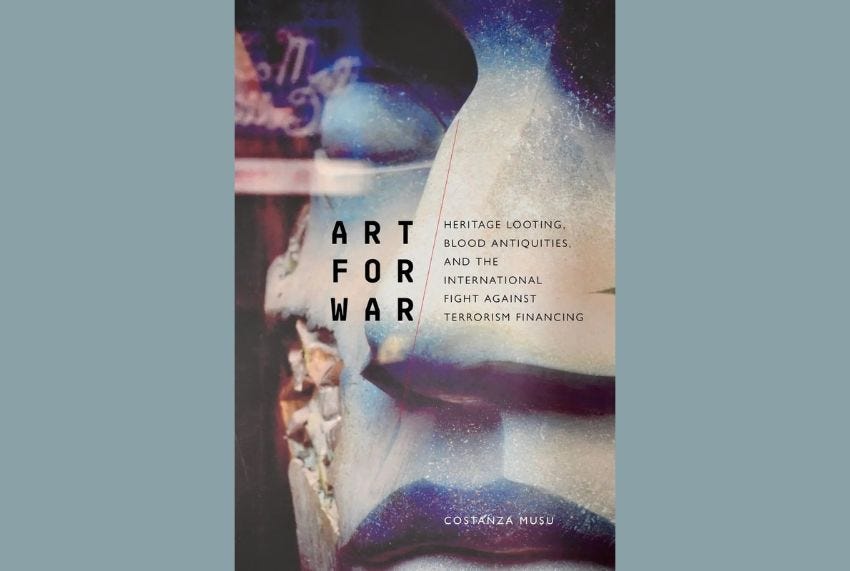
Art for War: Heritage Looting, Blood Antiquities, and the International Fight against Terrorism Financing
By Constanza Musu
Stanford University Press (2026)
This important new book dissects the fate of physical heritage during periods of armed conflict, social upheaval or as a result of “terrorism-networks”. Ostensibly this may seem a relatively novel IR subject in IR, but pondering more, it is apparent that challenges to cultural patrimony are as old as IR itself. From the moment the first colonial explorer invaded foreign soil or tangled with the customs of indigenous peoples, acts of witting or unwitting cultural degradation swiftly followed. Even within the discipline of IR, colonisation and the de-colonization of museums are at least a sub-specialism for students. The most recent manifestation of that niche speciality is our concentration on the implications for “terrorist-proliferation”. Like many things in life, when we look forensically for the “financial-empire”, cultural antiquities lead us to the “money-trail” causing global insecurity (pp. 3-15.)
Get E-International Relations delivered to your inbox, free. As you sign up, consider becoming a paid subscriber, or make a donation, to support our work.
Costanza Musu examines how global perceptions of cultural heritage shifted from a purely archaeological concern to a core issue of international security and counterterrorism. Its core themes dissect how the purportedly cultural is enmeshed in the formidable structures of global “terrorism-financing”. Musu traces the “securitization” of heritage protection—how illegal trade in looted artifacts (often simplified as “blood antiquities”) from conflict zones, end up as crucial staples of the terrorist “money-tree” (pp. 2-25.) We are accustomed to the “blood diamonds” controversies which plagued West Africa. Musu places the focus particularly on the Middle East where she shows that mis-appropriation of cultural heritage has been directly linked to funding terrorist groups, perpetuating further violence (pp. 16-33.) Musu first sets out the historical scene in how artworks/antiquities came to be part of terror funding.
There are five substantial and well-researched chapters. The first examines the looting and trafficking of antiquities. It offers a detailed resume of a familiar subject and includes something of a potted history of looting. Its refreshing novelty is Musu’s emphasis on the emerging contemporary threat, changing dynamically in response to “terrorist-financing” demands. When one anatomizes the financial experience of armed conflicts or “societal-breakdown” in counties in the past, we often identified a pattern of opportunistic exploitation through individualistic or modest-scale organized art thefts. Musu shows how this phenomenon has now metamorphosed into an industry- a key financing of terror networks.
The second chapter then plots the evolution of terrorism financing. It shows a pattern of criminal diversification in funding of regional and international terror networks as fund-sourcing has increasingly shifted from bank and post office robberies, financial exploitation, to systematic plundering of art and cultural artefacts. Illicit antiquities are now integral to the financing of localized and global terrorism.
Chapter three shows the dramatic pattern of change of the last decade. In particular it explores how when one looked at past opportunistic acts of cultural theft, it was difficult to detect any tangible pattern in the confiscation of valuable heritage. It was opportunistic, ill-organized and spasmodic. Today’s experience is of systemic, well-managed exploitation of weaknesses in the museological supply-chain. In that journey, terrorism has played an increasingly significant role, often based on sophisticated intelligence of site and museum-vulnerabilities. What had once been a challenge of localized heritage preservation, has become a component of a broader fight for human security.
In chapter four, “Stepping up the fight” (pp. 97-141) Musu shows how the increasingly rigor of policing and criminal intelligence services have mounted a challenge to the diverse skills of terror networks. In particular, there has been an increasingly impressive implementation of national and international policies since 9/11, As soon as American and other counter-terror expertise were able to validate the financial roots of terror spending (in the delivery of one of the world’s largest acts of mass terror), it was possible to step up the targeting of “art for war”. The likelihood that overseas intelligence-monitoring will isolate the funding trail of future Bin Ladens had been substantially enhanced. We now understand much more about how art theft percolates down to arms and technical purchasing, and to the delivery of terror-operations on a global scale.
These points are then explored at a field-level in chapter five, as Musu examines the instruments at the disposal of global crime-surveillance, and (conversely) the counter-resilience of terror networks. It is obvious that there remain numerous challenges to the effective implementation of anti-terror operations, not least the increasing efficacy of terrorist groups, in concealing their financial footprint. Not only do terror networks have access to a growing legal supply of vehicles of financial concealment, the world of “burner-financing” and of crypto-currency had so anonymised terror, that as fast as intelligence operations disclose the money trail, new subterfuge methods of financing are invented. Terrorists often host and exploit a sophisticated chain of legitimate sources of money with the end-users often being virtually impossible to trace. It is “terror-money” hiding in plain sight. The biggest enemy in this process is time. When police intelligence has disclosed the money tree, the chain of finance has been replanted and is blossoming somewhere else outside the forensic or jurisdictional reach of the authorities. Thus while we now have a plethora of instruments in the struggle against “art for war”, terror networks are equally developing circumventive methods, challenging police-effectiveness.
This leads Musu to conclude that policy towards the protection of cultural heritage has evolved through three distinct phases, each in turn modulated by altering international priorities and norms. Firstly, and notably during the 1990s, the prevailing ethos among the authorities was that the world’s heritage merited safeguarding primarily as a universal asset. The wholesale devastation of archaeological sites documented in popular movies like the 2014, The Monuments Men demonstrated the repercussions of systematic looting, as shown by the likes of Hitler’s and Stalin’s forces. This deeply traumatic experience galvanised post-war resolve to codify “cultural-property” safeguarding. This paved the way for foundational international conventions. Organisations like UNESCO were at the vanguard of a “protection and preservation first” stance, asserting the intrinsic heritage of cultural heritage and spawning genuinely effective methods of international cooperation and “heritage-listing”.
Secondly, and especially in the wake of ex-Yugoslavia, “human-security” infiltrated “heritage-protection” discourse, creating an increasingly expansive dimension of “cultural-property” protection. Thus the “collective-identity” of communities came to the fore, and was increasingly recognised as an impediment to societal post-conflict recovery. The destruction of religious and regional sites was utilised in ex-Yugoslavia as an effort to erode the cultural fabric of opposing groups. The intangible dimensions of memory and tradition got recognition in conceptualising our human security framework.
Thirdly, from the early 2000’s in the wake of 9/11 and ISIS, cultural preservation became increasingly integral to traditional “hard-security” priorities. Antiquities were recognised as a revenue-source for extremists, such as in the mounting evidence that ISIS have been systematically exploiting heritage sites. Inevitably, cultural heritage has had to be prioritised, not just for its intrinsic value or community salience, but also as a domain for counter-terrorism and national security. Thus in our current phase, the cultural or human priories have most likely been enhanced by our preoccupation with broader security strategy. Thus, Musu deftly exploits concepts borrowed from “securitization theory” (pp. 170-180) which will be familiar to IR students and scholars from our wider security-analysis frameworks.
Ultimately, Musu reveals this emergent, increasingly sophisticated challenge, threatens all three domains, namely the cultural integrity of artefacts, the preservation of “community-identity” and future global insecurity in the wake of ever-more evasive, terror-financing subterfuge. Way beyond the obvious financial incentives for criminal groups, the potential erasure of “cultural-identity” may devastate the very existence of integral communities, already damaged by atavistic conflict or societal destruction. Perhaps there is enough material there for several future books and this is both the minor weakness but also the future potential of this study. At times I wished there was less narrative-context and more original data. This aside, Musu offers a significant monograph. As she concludes:
preserving heritage is not a mere cultural or academic concern; it is also a question of global security, historical accountability, and respect for the shared narrative that binds communities together. (p. 180)
Alongside “terror-financing” through “blood antiquities”, Musu shows the insidious impact of “art for war” and how it devastates our physical and cultural footprint. Her third domain is highly original and exceptionally well-researched. The author agrees with the counter extremism expert, Hans-Jakob Schindler, that it is “both an analysis and a warning.” By tracking how cultural heritage trafficking intersects with terrorism financing, Musu’s work is highly relevant given the resurgence of groups like Al-Qaida and ISIS. As Donna Yates observes, Musu captures a critical turning point—the moment “heritage under threat became heritage as threat”—an under-researched area demonstrating the lasting policy and political consequences of pushing cultural heritage into the security landscape. Likewise as Giuseppe De Magistris suggests, it also contributes to our fight against antiquities trafficking that exploits regulatory gaps and threatens national and cultural identities. This wide-ranging analysis is a welcome addition to analyses of heritage protection.