

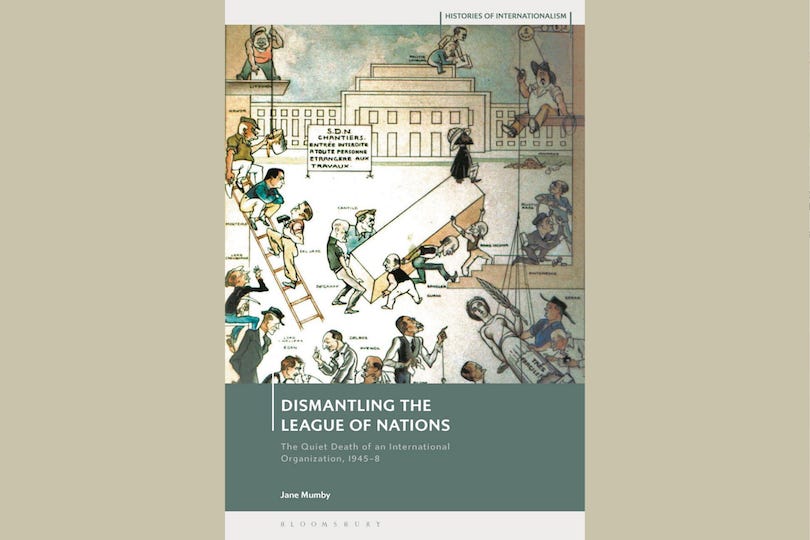
Dismantling the League of Nations: The Quiet Death of an International Organization, 1945-8
By Jane Mumby
Bloomsbury, 2023
Dismantling the League of Nations carefully traces the final chapter of the international organization, focusing on the complex process of its dissolution from 1945 to 1948. Mumby’s work is distinguished by its detailed archival research, pulling from official documents, personal correspondences, and interviews with key figures involved in the liquidation process. It offers an innovative perspective by emphasizing the human agency and bureaucratic intricacies involved, challenging the simplistic view that the League simply faded away. Instead, Mumby illustrates that the liquidation was a drawn-out, contested, and politically charged process, often marked by delays, internal conflicts, and strategic miscalculations.
E-International Relations will always be free to read on our website and on substack. We rely on reader support to make this possible. Please consider subscribing to support our mission.
Mumby’s core thesis posits that the dissolution of the League was neither swift nor straightforward but was an “elaborate and contested process,” shaped by both institutional inertia and individual agency. She contends that understanding this process offers vital lessons for contemporary international organizations, especially regarding organizational resilience, bureaucratic culture, and diplomatic negotiation.
Methodologically, Mumby employs a micro-historical approach, combining detailed archival research with oral histories and personal testimonies. This qualitative methodology offers a granular view of the liquidation process, revealing how bureaucrats, diplomats, and political leaders navigated the transition. Her approach challenges conventional narratives that focus solely on the political or legal dimensions, instead highlighting the mundane, often overlooked, bureaucratic realities that shape international institutional change.
This innovative methodology has broader implications for the discipline of international relations and institutional studies. By foregrounding human agency within bureaucratic processes, Mumby advances a nuanced understanding of organizational decay and transition, which can be applied to contemporary cases such as the United Nations (UN) reform or the European Union's (EU) institutional evolution. Her approach underscores the importance of detailed process-tracing and actor-centered analysis, pushing scholars beyond normative debates to examine the messy realities of institutional change.
The strength of Mumby’s work lies in its detailed contextualization and the ability to humanize a largely bureaucratic process. Several chapters exemplify this. Chapter 1: Build-Up to the End (p. 23–44), offers a compelling narrative of the League’s waning influence during WWII, emphasizing the internal struggles and external pressures that set the stage for its dissolution. Mumby’s use of personal correspondence and internal memos reveals a tension between bureaucratic inertia and the political will to end the organization, highlighting how decisions were often driven by individual actors rather than institutional mandates. Chapter 3: Geneva and New York (p. 75–96), vividly describes the logistical challenges of transferring assets from Geneva to New York, illustrating how organizational routines persisted amid chaos. Mumby’s detailed account of the negotiations and delays exposes the fragility of inter-organizational cooperation, offering a nuanced picture of institutional decay. In Chapter 5: The Many Endings of the League (p. 133–162), Mumby challenges the notion of a single, definitive end-date for the League, instead arguing that various elements physical assets, legal structures, personnel ceased functioning at different times. This insight underscores the complexity of institutional liquidation and has broad implications for understanding organizational death.
Despite its strengths, the book has some limitations. First, its heavy reliance on bureaucratic documents and personal testimonies may limit its engagement with broader theoretical debates on international organization theory. While Mumby offers a rich narrative, there is less integration with contemporary IR theories such as constructivism or institutionalism, which could have enriched her analysis. Second, the focus on the United Kingdom (UK) and United States' (US) actors, given their central roles in the liquidation process, somewhat under-represents the perspectives of other member states or non-Western actors. This limits the book’s applicability to a truly global understanding of institutional dissolution, especially in a post-colonial context. Finally, the book’s detailed focus on bureaucratic procedures might be less accessible to readers unfamiliar with diplomatic history or organizational studies, potentially limiting its readership outside academia.
Mumby’s detailed account makes a significant contribution to understanding organizational decay and transition, shedding light on the often-overlooked bureaucratic and human dimensions. It advances the field by demonstrating that the end of an international organization is a protracted, contested process, influenced heavily by individual agency and institutional routines. This perspective challenges simplistic narratives of organizational failure, emphasizing that dismantling is as complex and politically fraught as founding or reforming institutions.
Furthermore, the book’s insights are relevant beyond international relations, informing organizational theory, bureaucratic studies, and political history. Its methodological emphasis on process-tracing and actor analysis can serve as a blueprint for scholars studying the end-of-life phases of other international organizations, such as the UN, World Trade Organization (WTO), or regional bodies.
This book primarily targets scholars and students of international relations, diplomatic history, and organizational studies. Its detailed archival work and nuanced analysis make it ideal for advanced researchers interested in institutional change, bureaucratic politics, or the history of international organizations. Policymakers involved in organizational reform or dissolution may also find its lessons valuable, particularly regarding managing complex transitions.
Jane Mumby’s Dismantling the League of Nations is a meticulously researched, richly detailed account of the final chapter of one of the 20th century’s most ambitious international organizations. Its emphasis on human agency, bureaucratic routines, and institutional complexity offers a fresh perspective on organizational death, challenging simplistic narratives of failure. While its methodological focus may limit accessibility to some readers, its contribution to understanding the nuanced, contested process of institutional liquidation is invaluable. It not only enhances our historical understanding but also provides vital lessons for contemporary efforts to reform or dissolve international organizations in an increasingly complex global order.
Fanga Agbor Martial is an interdisciplinary scholar with experience in higher education, research, and academic leadership across social sciences, African/African American Studies, history, journalism, political science, communication, and sociology. His publications include Book Review: The Rise of State Capitalism: Transforming Markets and International Politics 2023. Canadian Journal of Political Science, Imperialistic Politics in Francophone Africa: The Franco-Cameroonian Economic Accord under Ahmadou Ahidjo, Journal of African Political Economy and Development, and Book Review: Rethinking civil-military relations in Africa: Beyond the coup d’état. Armed Forces & Society.
Editorial Credit: Ridipt Singh