

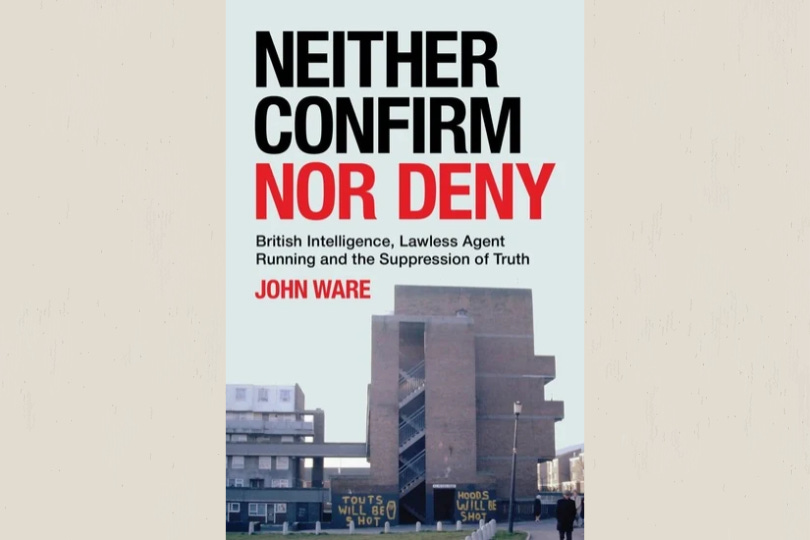
Neither Confirm Nor Deny: British Intelligence, Lawless Agent Running and the Suppression of Truth
By John Ware
Merrion Press, 2026
This is an invaluable book for those interested in evidence-based analysis of contemporary conflict in Northern Ireland, and elsewhere. Reviewers often struggle to keep pace with this relentless output on conflict from academics, journalists and disciplinary specialists. In the midst of this prodigious volume of material, John Ware is both morally compelling and forensically impressive. Perhaps this is because, as a veteran investigative journalist of the Troubles, John combines both an impressive longevity of journalistic practice, but is also meticulously careful in his field-research. The topic is highly controversial and had typically been subject of “securitate denial”, (ix-xii) but the book is so comprehensively evidenced that it stands as a searing indictment of the British security establishment’s conduct.
Get E-International Relations delivered to your inbox, free. As you sign up, consider becoming a paid subscriber, or make a donation, to support our work.
Such is its impact, this reader compares it positively with previously acclaimed works like Keefe’s Say Nothing and Moloney’s A Secret History of the IRA. The primary focus is state collusion (1-16). Critics have generally highlighted how Ware details the British Army’s Force Research Unit (FRU) and MI5 policies, focusing on high-level agents like Freddie Scappaticci (Stake-knife) and Brian Nelson. Ware has accessed previously barred material and somehow managed to circumvent intelligence gate-posts. Where he has not been able to document his findings with time-barred or state-shuttered documents, he was able to augment interviews of such quality, he has generally been able to corroborate his findings, even where there is a documentary vacuum (17-30).
The core of Ware’s book is a careful dissection of the status of the neither confirm nor deny doctrine, analysis of which has for long been impossible because of intense levels of state secrecy, denial and the existence of “on-going” clandestine security force operations (205–224). Ware effectively dissects how the doctrine has been cynically and repeatedly deployed to shield institutions from embarrassment, prevent criminal accountability, and block closure for victims’ families (205–291). In so many cases, the possibility of psychological or legal closure has been cruelly denied, just to maintain a policy of secrecy. So often the grisly and macabre atrocities of the conflict are not permitted closure (precisely) in order to maintain the principle of non-disclosure and to protect a raggedy collection of past and (in some cases) fresh informers.
It is therefore a book which is punctuated by moral and legal dilemmas, and like other reviewers, one generally finds that state apparatchiks demonstrate no hesitation in consistently putting non-disclosure ahead of natural justice, or considerations of providing relief (or indeed well-deserved compensation) for collateral victims. It forces a hard look at grim trade-offs of the conflict-balancing arguments that high-level intelligence penetration saved lives, against the reality of state-licensed murder, corrupted policing, judicial mis-processes etc.
The starting-point for Ware’s tour-de-force of intelligence, agent-running, collusion and truth-suppression comes from a most surprising source (1-3): former UK Prime Minister, Tony Blair himself. It was Blair’s chilling words, “the state is assassinating people” (attributed to his 1999 cabinet note) which summarised the consequences of Britain’s decades-long intelligence war in Northern Ireland (58). It is quite beyond ambiguity of interpretation that Blair’s words show he was deeply concerned that state forces had frequently crossed a line. Indeed, his cabinet note was meticulously guided by a secret state review (on-going since 1980) which quietly rewired Britain’s role in the conflict, effectively placing intelligence-gathering above the law-courts (58, 233–34).
Thus, via a myriad of state files, murder reports, coronial summations, and interviews, Ware documents the creation of a vast, covert “agent-running” apparatus. This state machine, utterly lawless and with very limited accountability, was at arm’s-length to central security authority. Often crucial life-and-death decisions were made “on the hoof” at local level with the minimum of consultation or information even being relayed to headquarters. On the positive side, these clandestine operations penetrated loyalist and republican organisations such that intelligence leaked like the proverbial sieve (121).
Viewed if not positively, less morosely, one could say that this un-declared and covert policy ultimately saved lives and was the handmaid of the Good Friday Agreement (244–57). More negatively, we cannot also deny that it issued state-licence for ruthless and unnecessary murders, it largely subverted any semblance of justice and it thus also corrupted procedures of policing beyond any possible restitution. While, it may have saved lives and perhaps contributed indirectly to a peace process, these operations lacked morality, killed many who effectively received a state-sanctioned death-penalty, and has denigrated the status both of state-security operations and local policing alike. Thus, in every respect, what Ware describes is a fundamental loss of moral compass.
This is a substantial book with a vast index of source material and copious referencing. It is also based on such wide-reading that one might be inclined to ponder if there is any key book on the conflict of the past fifty years which the author has not carefully consulted. There are eighteen substantial chapters, a preface and epilogue. The acknowledgements pages alone are testimony to how well-entangled Ware is among Ireland’s academic, political and community expertise (313–20). Ware’s multi-disciplinary merger is probably the only way to fully understand a conflict of such longevity and atavistic nomenclature.
Among the key personalities is agent 6137 (Brian Nelson) a thirty-six-year-old skip driver, seeking excitement from the dull routine of his life, and who phoned the British Army and was quickly recruited as a spy for British military intelligence (1-5). Lord Justice Kelly of Nelson’s legal counsel asked at his sentencing hearing in 1992: “What did he really achieve at the end of the day? Did he save lives?”
Lord Justice Kelly’s question cut through the trial like a knife (184-5). The answer proved to be a mere three, but those sadly offset by so many other unnecessary deaths, “while materially increasing the UDA’s capacity to target republicans they deemed deserved to die”. Nelson’s security minders at all costs spared a fourth life, a Forces Research Unit (FRU) agent, at the top of the PIRA (167-8).
Thus we meet agent 6126, oftentimes known as Stake-knife, (Freddie Scappaticci). He was given behavioural immunity by the IRA to shield them from British army agents. Ironically, he simultaneously operated as a British Army agent, receiving protection from the state despite his involvement in serious crimes. As Ware shows, Scappaticci proved precisely the unwritten rule that security operatives and the state had consistently applied, unrelenting backing even of our own monster (200-226). The custodians of a dirty intelligence legacy resisted sharing the details of even the worst atrocities which Scappaticci perpetrated from the relatives of its victims or the wider public.
This is the gruesome sequel to the substantive conclusion of this insightful study, namely that “neither confirm nor deny” had become, “the anchor that holds Northern Ireland back”. Only truth can set a post-conflict society free. Nowhere was this more convincingly shown than in the humiliation experienced by Jon Boutcher and his Operation Kenova colleagues as they faced Westminster on 23 April 2024. Having given MI5 the benefit of the doubt they were only to realise on that day, that they had been systematically double-crossed. While MI5 had previously assured Kenova that “their disclosure process was complete”, MI5 had in fact been sitting on an enormous legacy archive at their Thames House stores (91–116). Thus, when Boutcher and Livingstone sat down to be quizzed by the Northern Ireland Select Committee, they were quietly furious.
Ware’s bleak but principal conclusion is that families wanting to know about the state’s involvement in their relatives’ murder will continue to be constrained by MI5’s purist interpretation of national security, severely limiting knowledge about their loved ones dating back decades (313-320). Nothing from the Historical Enquiries Team (HET) to Independent Commission for Reconciliation and Information Recovery (ICRIR) or to the proposed Legacy Commission (with new and greatly amended legislation before parliament) is likely to affect the state’s retention of control of the conflict’s historical narrative. Above all the state’s agents and mandarins are supremos in preserving the reputation of the state. Where so often this sad crisis is relayed in miscellaneous vignettes and hearsay, Ware has assembled an armoury of facts. He adds greatly to the scholarly literature on this most sensitive of intelligence terrain.
Martin Duffy has participated in more than two hundred international election and human rights assignments since beginning his career in Africa and Asia in the 1980s. He has served with a wide range of international organizations and has frequently been decorated for field service, among them UN (United Nations) Peacekeeping Citations and the Badge of Honour of the International Red Cross Movement. He has also held several academic positions in Ireland, UK, USA and elsewhere. He is a proponent of experiential learning and holds awards from Dublin, Oxford, Harvard, and several other institutions including the Diploma in International Relations at the University of Cambridge.
**When State Secrecy Becomes a Shield Against Accountability**
The doctrine of “neither confirm nor deny” raises a fundamental question: at what point does the protection of legitimate state interests become the protection of institutions from accountability?
National security and confidentiality may justify certain restrictions on disclosure. But secrecy must never become an automatic substitute for legal reasoning, independent scrutiny or effective remedies.
This problem extends beyond intelligence services and historical conflicts.
In my independent legal research concerning judicial proceedings and property enforcement in Latvia, I examine a related concern: what happens when procedural decisions, delayed protection and institutional responses leave citizens without an effective remedy before irreversible consequences occur?
The situations are legally different, but the underlying question deserves examination:
**Who holds an institution accountable when its own procedures prevent meaningful scrutiny of its decisions?**
Article 13 of the European Convention on Human Rights and Article 47 of the EU Charter of Fundamental Rights, where applicable, provide important legal foundations for examining effective remedies and judicial protection.
The rule of law cannot be measured solely by whether institutions follow procedures. It must also be measured by whether those procedures genuinely protect the rights they were created to serve.
I invite researchers, legal professionals and journalists examining institutional accountability to consider my related publication:
**When Institutions Fear Their Own Mistakes**
https://medium.com/@diks.ancveirs/when-institutions-fear-their-own-mistakes-bef76d6f34b3
**A democratic state should not fear the discovery of its mistakes. It should fear becoming incapable of correcting them.**
Because justice delayed until the consequences become irreversible risks becoming justice that exists only on paper.