

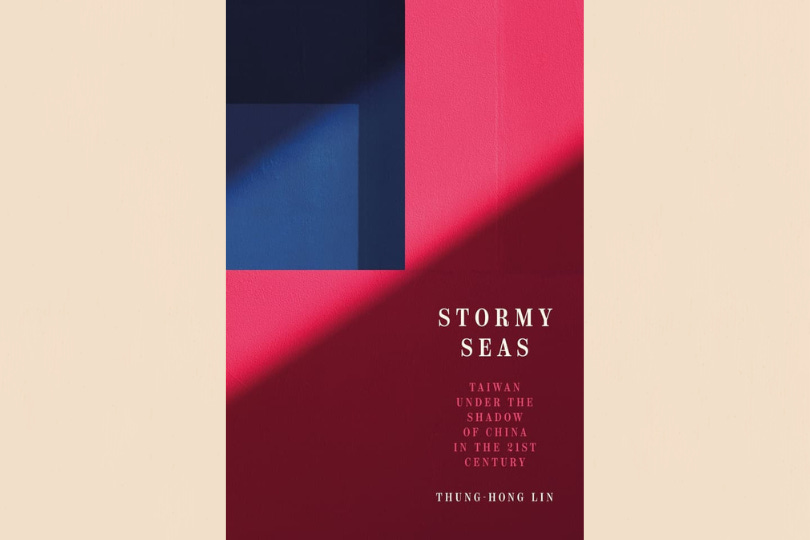
Stormy Seas: Taiwan Under the Shadow of China in the 21st Century
By Thung-Hong Lin
Stanford University Press, 2026
Taiwan’s turbulent place in global society is a perennial feature of the IR curriculum and a valuable case-study for the discussion of geo-political asymmetry. This new volume by Thung-Hong Lin, from Taiwan’s Academia Sinica and former Fulbright Fellow, is a model of diligent research and measured discussion. As an observer of Taiwan for more than thirty years, the singular dilemma of Taiwan’s international position remains its “David and Goliath” relationship with China. With the prepotency of the People’s Republic (PRC) in the past three decades, Taiwan has appeared increasingly precarious. A cynical commentator might well place Taiwan’s destiny in the hands of the USA. Taiwan occupies a unique status in the potential protection it enjoys from the US. This security has seen high-points in recent years, not only in the USA’s flexing of its military muscle in the region, but notably in the visit of former House Speaker, Nancy Pelosi.
The opening words of this substantial volume are among the most prescient of the book:
On August 2nd, 2022, a US military aircraft with the call sign SPAR19 took off from Kuala Lumpur. The plane’s primary passenger was Nancy Pelosi … (the plane’s) evasive path drew massive global attention, with over 2.9 million people tracking the flight. When the plane landed safely in Taipei, crowds near the runway broke into tears.
Pelosi’s visit created enormous diplomatic discussion and felt as much a provocation as (implicitly) a diplomatic body-blow to Beijing’s senior mandarins. Shortly after arrival, Pelosi took to social media to note, “America’s solidarity with the 23 million people of Taiwan is more important today than ever, as the world faces a choice between autocracy and democracy”. She went on to stress: “America’s continued opposition to any unilateral changes to the status quo”. In so many ways, the sentiments demonstrated by Pelosi and the contested landscape of the Formosa Strait, are at the very core of this book. Lin goes on to tell this story with a range of source-material seldom assembled so impressively, in one study.
If Lin’s introduction was not such an impressive synthesis of the Taiwan imbroglio, and the eight chapters a formidable analysis of the Sturm und Drang of Taiwanese political experience, the conclusion cuts to the real point of his thesis. Taiwan’s “stormy seas” intimately concern all of global society. We read (for example) of Taiwan volunteers among the international brigades facing Russian assaults in the Ukraine. On November 2, 2022, volunteer soldier Tseng Sheng-guang, was killed by shrapnel during the battle for Krasnyi Lyman, “making him the first East Asian and Taiwanese soldier to sacrifice his life in the Ukraine war”. His colleague, Chen Hsi, (who returned to Taiwan in May 2023, severely injured) wrote in his memoirs of the battlefield, “In memory of those who were willing to sacrifice for the justice they believed in”. For me, Dr Lin’s section “Democracies in the Shadow of War” is (thus) the most salient of the book. It shows poignantly that, in an era of global democratic decline, the survival of any small democracy threatened by authoritarian neighbours, is arduous.
Modern Taiwan faces obstacles in transitioning from democratization to genuine democratic consolidation. Threats abound, regionally and internationally- the global capitalist crisis, social polarization, elite corruption and emergent populism. Potential transnational influence from authoritarian powers remain spectres of uncertainty. As Lin argues, authoritarian sharp-power can exacerbate political polarization and fuel violent social populism, thus retarding and degrading (for example) the political dynamics of Ukraine under the shadow of Russia; and of Taiwan under the shadow of China.
Survival and resilience are at the heart of this volume. Authoritarian power evolves to denigrate democratic alliances and exploit political cleavages. In particular, under Xi Jinping’s personalized dictatorship, China’s civil society is immiserated, threatening any possibility of a democratic transition akin to Taiwan. Indeed, with the CCP regime’s mounting economic crisis, invasion might offer a strategic bonus of deflecting internal pressure. Thus amidst geopolitical conflict, Taiwan risks metamorphizing into the next Hong Kong or Ukraine.
Resilience and aspiration are key features which come to mind when summing up Taiwanese foreign policy, and Lin dissects these qualities comprehensively. As he shows, these forces have allowed grassroots Taiwan not only to survive but, in many ways, to flourish. Now, well into his second term as USA President, even the volatile rolling of the Trumpian diplomatic dice, has not that much further imperilled a nation which punches way beyond its modest weight on the world stage. I recall disagreeing with an academic colleague who saw in the failing numbers of Taiwan’s diplomatic recognizers the litmus-test of demise.
It is true, and as Lin demonstrates in detail, numerically the stakes have been consistently against this tiny Asian nation. After the ROC government retreated to the island in 1949, its diplomatic allies were at a peak of over 70. UN Resolution 2758 then shifted global recognition to the PRC; official recognition fell, leaving the modern state in 2026 with just 12 backers, and none of them packing much of a diplomatic punch. Having lost its UN seat in 1971, commentators might be inclined to see the Taiwanese political trajectory as entirely downwards. However (and as Lin shows in detailed research) this is far from being the whole story.
Alongside all those torturous public and covert struggles with the PRC, there is a less well-told narrative. In juxtaposition to diplomatic retreat, modern Taiwan has acquired a moral standing in international affairs which is often overlooked. It is an authentic Asian democracy, a politically and socially progressive nation, a shrewd wielder of “soft power”, a generous supporter in aid and disaster response. Just as the diplomatic numbers have fallen, respect for Taiwan’s international contribution increases. Dr Lin could actually dwell more extensively on the fine detail of this contrast, which Taiwan has shown, to the forces of autocracy demonstrated by the PRC. However, beneath his painstaking dissection of ROC realpolitik, a new Taiwan has emerged, deserving of global support, and in so many ways a model for its less progressive neighbours. This deserves another book.
Lin’s study is exhaustively footnoted. Its eight chapters trace the history of modern Taiwan from its evolution after 1949 as it battled its own internal struggles, and reaching its unenviable position in the sights of a resurgent Beijing. From its own political and domestic tragedies, to the sunflower movement, and the lens of Hong Kong handover. Lin traces this experience with formidable statistics, reams of cabinet dossiers, unique interviews, and a consistent analysis of a small democracy’s resistance. Lin shows how Taiwan’s civil society, its civic networks, and social movements became an engine of democratic resilience against Beijing. At the same time, he delineates Taiwan’s internal identity/generational cleavages, and argues that broader US-China geopolitical pressures all merit careful further study. Lin (thus) shows the need for yet more research.
Taiwan is often praised for its economic achievements and peaceful transition to democracy. Nevertheless, it faces substantial challenges; from painful internal political divisions and powerful external geopolitical pressures. As Stormy Seas demonstrates, Taiwan’s political landscape is moulded by significant cleavages. It confronts national identity and ethnic disparities, economic inequality and class conflict, and generational and cultural differences. The greatest challenge to Taiwan’s democracy comes from China, which has exploited these cleavages through economic leverage, propaganda, and political interference. There is insufficient space for Lin to say more on these subjects.
With Beijing’s meddling, Taiwan’s democracy faces further threats of regression. Whenever China escalates its tactics, Taiwan’s civil society has mobilized in response, playing a crucial role in defending democratic institutions. Thus, Lin’s case studies of the Sunflower Movement, Hong Kong protests, and Taiwanese social movements (mentioned above)- all demonstrate how Taiwan’s vibrant civil society is a key source of democratic resilience. Stormy Seas also situates Taiwan’s struggle within the broader context of US-China relations, showing how global geopolitics over the past half-century has shaped the island’s destiny.
In sum, this is one of the best-researched volumes on contemporary Taiwan of the last decade. Well-referenced across academic and literary circles—including fulsome notes of praise in publications like the Asian Review of Books, Global Asia, it is endorsed by scholars at Harvard, National Taiwan University, and the Center for Asia-Pacific Resilience. The greatest strength of the book is its imaginative use of political sources. A future volume might match this with vignettes of a resilient Taiwanese civil society. If there is a weakness, it may be that more could have been said about the genuine strength and plurality of Taiwanese community groups. Ultimately the greatest resonance of this book, is, as its author concludes, its global relevance:
Taiwan’s path through escalating authoritarian threats may offer a powerful model for how democracies can resist backsliding, safeguard collective security, and even, amid storms of war, keep the flame of freedom alive.
Martin Duffy has participated in more than two hundred international election and human rights assignments since beginning his career in Africa and Asia in the 1980s. He has served with a wide range of international organizations and has frequently been decorated for field service, among them UN (United Nations) Peacekeeping Citations and the Badge of Honour of the International Red Cross Movement. He has also held several academic positions in Ireland, UK, USA and elsewhere. He is a proponent of experiential learning and holds awards from Dublin, Oxford, Harvard, and several other institutions including the Diploma in International Relations at the University of Cambridge.