

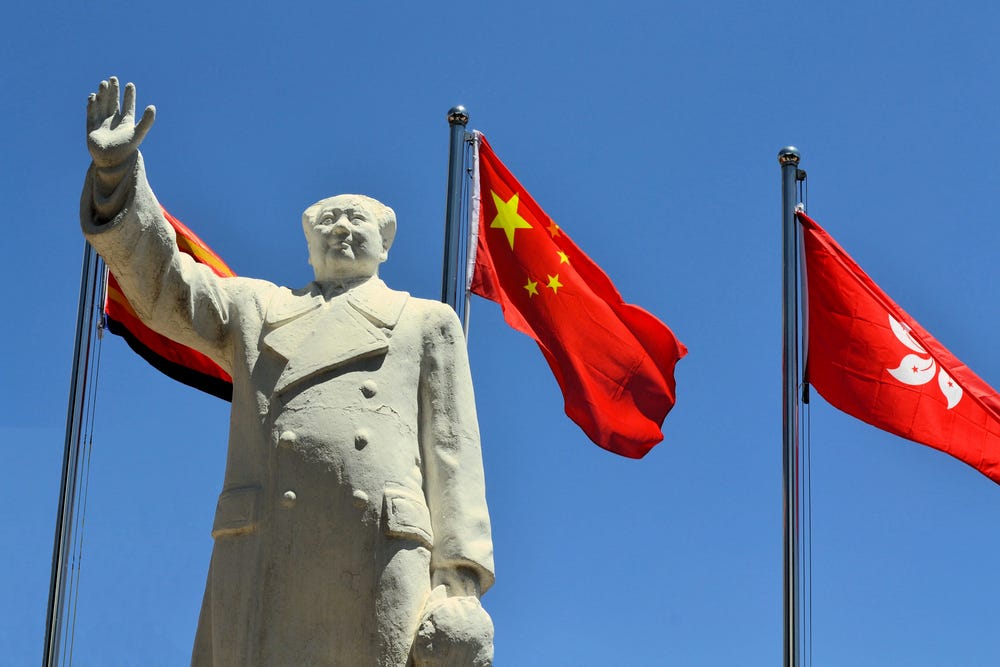
In his 1968 study Revolutionary Immortality: Mao Tse-tung and the Chinese Cultural Revolution, Yale social psychologist Robert Jay Lifton (1926-2025) speculated on the role that preoccupation with legacy played for Mao Zedong (1893-1976) in unleashing the Cultural Revolution in May 1966. Lifton distilled his hypothesis on Mao’s mindset in a single observation: “for a man in Mao’s position—of his age and special commitments—the affirmation of a sense of immortality becomes crucial. The overwhelming threat is not so much death itself as the suggestion that his ‘revolutionary works’ will not endure.” Fifty years on, if Mao retains any claim to immortality, it is largely owed to one of his lieutenants whom he marginalized and dismissed for harboring revisionist views. Deng Xiaoping (1904-1992) both loosened the reins and tightened them as circumstances required following his ascent to leadership in the years after Mao’s passing on September 9, 1976, recognizing Mao’s views and policies as having been “seventy percent correct.”
Get E-International Relations delivered to your inbox, free. As you sign up, consider becoming a paid subscriber, or make a donation, to support our work.
How Beijing manages Mao’s legacy has never been a domestic issue alone; it is also reflected in China’s approach to foreign policy. Mao’s late opening to the West in his final years was not a break with the revolution but an effort to preserve it—a strategic decision that Deng and his successors inherited and fine-tuned. Foreign policy under President Xi, however, has undergone a radical shift that defies the foreign policy positions that resulted from Mao’s outreach to the United States and other Western powers.
In the seven years prior to his death, supported by Premier and consummate diplomat Zhou Enlai (1898-1976), Mao opened China’s path to re-engagement with the West after two decades of isolation. The relationship with Moscow had been uneasy from the start: as Adam Ulam recounts, Mao came away from his first meeting with Stalin in December 1949 feeling slighted—received less as the leader of a great revolution than as a junior supplicant. Ties deteriorated further over the decade and a half that followed, notably exacerbated by Nikita Khrushchev’s 1956 “secret speech” on Stalin to the Twentieth Congress of the CPSU where he denounced the former Soviet Leader for the cult of personality that surrounded him and his persistent purges. Mao denounced Khrushchev for the Twentieth Congress speech and the revisionist course it invited.
Tensions heightened with China’s official denunciation of Khrushchev in June 1960 at the Bucharest Conference of Communist and Workers’ Parties. This was further exacerbated with the CCP Central Committee’s July 1964 letter “On Khrushchev’s Phoney Communism and Its Historical Lessons for the World: An Open letter of the Central Committee to the CPSU.” Mao’s explicit animus continued with the onset of the Cultural Revolution, where PRC President Liu Shaoqi (1898-1969) and other alleged opponents to Mao were branded “Chinese Khrushchevs,” a lingering pejorative still in use two years after the Soviet leader had been forced out of office.
In March 1969, a border clash took place between Chinese and Soviet forces for what China decried as an intrusion into Chinese territory by Soviets patrolling Zhenbao Island, located in the Ussuri River along China’s northeastern border with the USSR — territory the Soviets also claimed as theirs and called Damansky Island. The Chinese ambushed the Soviet patrol, killing about a dozen troops. As tensions rose in the year that followed, Mao, with the essential support of Zhou Enlai, began to reach out to the United States that responded, in accord with the Sanskrit dictum “the enemy of my enemy is my friend.” Deng would build on that foundation in the post-Mao era, establishing the defense, economic, and trade ties that opened China’s path to becoming a major world power and a state with which others could credibly engage. Where Mao had dismissed the United States as “a paper tiger,” Deng’s strategy going forward was to “hide our capacities and bide our time.”
The Passing of the Great Helmsman
Mao survived more than a decade beyond a January 1965 interview with journalist Edgar Snow where he anticipated his death telling Snow that he was “getting ready to see God very soon.” Afflicted with Parkinson’s disease, Mao’s health steadily diminished and, following a heart attack, he died on September 9, 1976. On September 18, 1976, before a throng estimated at between 750,000 and one million mourners, Hua Guofeng, Premier of the People’s Republic of China (PRC) and Mao’s designated heir, delivered the eulogy. A few paragraphs in, Hua extolled Mao for his leadership role in the protracted war against Japan, followed by his resounding defeat of the Kuomintang of Chiang Kai-shek (1887-1975), reminding mourners that Mao had “long ago put forward the famous thesis that political power grows out of the barrel of a gun.” Hua’s eulogy also included two discrete denunciations of Deng Xiaoping: Hua first branded him, alongside Liu Shaoqi and Lin Biao (1907-1971)—both eliminated during the Cultural Revolution—as the leaders of a “counterrevolutionary deviationist line” that Mao had silenced. He singled out Deng once more toward the end of the eulogy, blaming him for “the right deviationist attempt to reverse” the “victories of the Great Proletarian Cultural Revolution.”
The New York Times report on the ceremony noted that the image on screen during the eulogy fixed on Hua and on Wang Hongwen (1935-1992), the second-ranking member of the Communist Party. Mao’s widow, Jiang Qing (1914-1991), also figured prominently, described by the New York Times as “grief-stricken, though she maintained the composure that she had displayed all week.” Vice Premier Zhang Chunqiao (1917–2005) and de facto propaganda chief and politburo member Yao Wenyuan (1931–2005), both members of the Funeral Committee, likewise stood near Wang Hongwen on the stage. Less than three weeks later, Hua ordered the arrest of Jiang Qing, Wang Hongwen, Zhang Chunqiao, and Yao Wenyuan—the so-called “Gang of Four”—for the excesses and abuses of the Cultural Revolution.
Immediately after Mao’s death, Hua laid claim to the key positions of power in the PRC: Chairman of the Communist Party, Chairman of the Central Military Commission, and Premier. Yet, as James Carter observed, “Though he held formal power, Hua had little support beneath the surface, in part because his power was built on a fundamental contradiction.” Hua alienated those who hailed his arrest of the Gang of Four when he later aligned himself with the “Two Whatevers,” of a February 7, 1977 editorial published in the People’s Daily, Red Flag, and the Liberation Army Daily entitled “Study the Documents Well and Grasp the Key Link,” which contained a doctrinaire profession of faith in Mao: “We will resolutely uphold whatever policy decisions Chairman Mao made, and unswervingly follow whatever instructions Chairman Mao gave.”
The arrest of the Gang of Four cleared the way for the full rehabilitation of Deng Xiaoping—who, between 1978 and 1981 engineered Hua’s fall from power. Hua submitted to this, understanding that he lacked sufficient backing in the ranks to move forward as Premier and CCP Chair. Deng arranged the appointment of Zhao Ziyang (1919-2005) as Premier of the State Council and Hu Yaobang (1915-1989) as Chairman of the CCP, counting on them to drive the economic reforms that were viewed as critical in the aftermath of the Cultural Revolution. Deng secured and retained the roles of Chairman of the Central Military Commission and Chairman of the Central Advisory Commission and was recognized nationally and internationally as de facto maximum leader of China. Under Deng came a revival, with a slight revision in the cat colors of his July 1962 dictum on the need for flexibility in the economic model that China adopted: “it does not matter if it is a yellow cat or a black cat, as long as it catches mice.”
Deng inherited the country that Mao’s campaigns had left impoverished, terrorized, and marginalized. His decision to open China to the world over the next two decades led to epic transformations, even though the gap grew between China’s economic and political development, as the spring 1989 events in Tiananmen would make plain. Deng stood solidly behind his loyal Hu and Zhao, while navigating radical challenges to Mao’s worldview. On December 7, 1984, an editorial in the Renmin Ribao declared that “one cannot expect the works of Marx and Lenin written in their time to solve today’s problems,” hastily corrected to read “to solve all of today’s problems.” The New York Times took this critical statement on Marxism to reflect Deng’s views, though Time Magazine attributed it to Party General Secretary Hu Yaobang.
Deng adopted a conciliatory yet firm approach in his rapprochement with Western powers. In the December 1984 Sino-British Joint Declaration, even while he insisted that Britain had no choice but to surrender sovereignty, Deng’s government gave written assurances that “the current social and economic systems in Hong Kong would remain unchanged, along with its lifestyle, and that rights and freedoms—of the person, of speech, of the press, of assembly, of association, of travel, of correspondence, of strike, of occupation, of academic research, and of religious belief—would be ensured by law in the Hong Kong Special Administrative Region.”
Deng at Tiananmen
On Mao’s legacy, Deng remained resolute. In his 1980 interview with Oriana Fallaci (1929-2006), he told her: “Write this down: we will never do to Mao Zedong what Khrushchev did to Stalin at the twentieth Congress of the CPSU.” In spite of Mao’s record during his Great Leap Forward alone (1958-1962) where “at least 45 million people were worked, starved or beaten to death in China,” Deng still scored Mao’s performance as Chairman at seventy percent correct and thirty percent wrong. Interestingly this was the same assessment that Mao and his Central Committee had made of Stalin’s rule: “It is the opinion of the Central Committee that Stalin’s mistakes amounted to only 30 per cent of the whole and his achievements to 70 per cent, and that all things considered, Stalin was nonetheless a great Marxist.” Deng told Oriana Fallaci that Mao had evaluated Deng’s own leadership performance 30% for his errors and 70% for his merits. Deng’s defense of Mao was not merely payback to the man who—by Deng’s own account—had recalled him to Beijing in 1973 and handed him the vice-premiership; it was also his defense of the legitimacy of the Party and the revolution itself.
Deng’s test before the international community came at Tiananmen. Following the April 15, 1989 death of Hu Yaobang, students pressed for reforms that would end the CCP’s monopoly on politics. General Secretary Zhao Ziyang, Hu’s successor and a key architect of Deng’s reforms, advocated in favor of dialogue with the student leaders of the demonstrations; hardliners held that need for the preservation of order mandated an immediate, decisive police action. By mid-May Deng was paying more attention to Premier Li Peng (1928-2019), a hardliner, than to Zhao. As the declaration of martial law became imminent, Zhao met the Tiananmen protesters on May 19, 1989, pleading with them to end a seven-day fast and to disperse, hinting that if they did not, a crackdown would follow. The students empathized with Zhao—but they did not heed his counsel and remained adamantly at Tiananmen. Zhao was placed under house arrest following his visit to Tiananmen and would remain so for the remaining sixteen years of his life.
On June 2, 1989, on the eve of the People’s Liberation Army crackdown, protest leaders announced a new seventy-two-hour fast. Their statement singled out Li Peng, whose hardline stance, they felt, provoked the impasse and the declaration of martial law on May 20, 1989. In the clampdown that followed, New York Times correspondent Nicholas Kristof, who reported there in real time, estimated the dead at four hundred to eight hundred. The U.S. State Department historian notes Beijing’s claim of two hundred dead, adding that Western sources were “skeptical” of the official figure and most often cite hundreds or even thousands killed. A secret British diplomatic cable estimated the death toll at 10,000.
Where Deng stood on the handling of Tiananmen remained unclear—hardliner, moderate, or something between? He outlined his position in his June 9, 1989 address to the officers commanding the martial-law troops. He opened expressing his condolences for the “officers and men of the People’s Liberation Army, the People’s Armed Police Force and the Public Security Police who have died heroically in this struggle.” He claimed that “a handful of bad people were mingled with so many young students and crowds of onlookers,” so that “for the moment we were not able to distinguish between innocent and guilty.” Those bad people, he said, had “two basic slogans: overthrow the Communist Party and demolish the socialist system,” their goal being “to establish a bourgeois republic, an out-and-out vassal of the West.”
Deng closed his talk to the officers by reaffirming the Four Cardinal Principles he had set out on March 30, 1979: keep to the socialist road; uphold the dictatorship of the proletariat; uphold the leadership of the Communist Party; and uphold Marxism-Leninism and Mao Zedong Thought. The fourth principle was the mandate to preserve Mao’s legacy—and Deng had defended his commitment to that before the army. Nonetheless, Deng tapped Jiang Zemin (1926-2022), Party Chief in Shanghai, rather than Premier Li Peng, to assume the role of General Secretary of the CCP. Jiang, as Party Chief in Shanghai, had managed to engage the demonstrators and disperse the June 1989 Shanghai mass protests without involvement of the military or reliance on the repressive methods resorted to in Beijing.
The Legacy of Mao in the Post-Deng Era
The tough stance taken by Deng at Tiananmen kept Mao’s revolution intact as the centerpiece of China’s identity, and Deng’s blueprint for China’s future was inherited by the two successors he installed. Jiang Zemin was chosen after Tiananmen to replace the disgraced Zhao Ziyang, who had put Mao’s legacy at risk; Hu Jintao was tapped by Deng in 1992 as a potential successor to Jiang and only arose to his intended role in 2003, six years after Deng’s passing. Like Deng, Jiang Zemin, and Hu Jintao preserved Mao’s centrality while letting ideology quietly recede and the economy surge, and by 2010, China had become the world’s second-largest economy.
The same collective-leadership model that disciplined succession at home also set China’s tempo abroad: Jiang held to Deng’s patient, low-profile course, and Hu dressed it up in the reassuring language of the “peaceful rise of China” and the pursuit of a “harmonious world.” Yet the restraint was never on China’s ambition to rise as a player on the world scene. What Deng’s collective leadership model actually restrained was the ruler—fixed terms, managed succession, a check on any single man aspiring to seize absolute control. That, and not any softening of aims, was Deng’s addition to Mao’s bequest. So long as it held, so did Mao as the People’s Republic of China’s undisputed founder and inspiration for its policies at home and abroad.
The Xi Jinping Era and the End of Collective Leadership
In 2013 Xi Jinping came to power, and, as Susan L. Shirk observed in 2018, Xi ended Deng’s emphasis on collective leadership, designated succession, and fixed terms of office. Xi, as she puts it, “grasped all the levers of power in the Party and the state (including the military and police).” Where Marxism had held its place in the Deng era with an unspoken understanding of its practical limitations—serving, nevertheless, as the pretense for continued one-party rule during the socialist stage of PRC’s development—Xi, unlike his post-Mao predecessors once again moved ideology front and center, posturing himself as the foremost expert on Marxism and “socialism with Chinese characteristics;” leading to the enshrinement of “Xi Jinping Thought on Socialism with Chinese Characteristics for a New Era” in the 2018 Constitution on a par with Mao Zedong Thought. At China’s grandiose May 2018 celebration of the two-hundredth anniversary of Karl Marx’s birth, Xi called Marx “the greatest thinker of the modern era” and signaled through his one hour address that he knew his Marxism, intimating his role not only as chief executive but as exegete-in-chief.
In 2023, Xi visited Mao’s Mausoleum on the one hundred thirtieth anniversary of Mao’s birth and delivered a long, laudatory address on Mao’s contributions to China. The homage was genuine, but so was its symbolism. Guarding Mao’s reputation is not necessarily the same as protecting his revolutionary immortality by recognizing his singular role in China’s past, present, and future. For his part, Xi has shown himself willing to keep Mao’s portrait on the wall while deftly increasing the size and the importance of his own portrait.
The Resolution on the Major Achievements and Historical Experience of the Party over the Past Century, written under Xi and adopted in November 2021—the first such resolution since Mao’s in 1945 and Deng’s in 1981—is a telling document. The Spectator wrote at the time that the resolution largely commemorates the Mao years, lays out the ambitions of the Xi era but grants Deng little more than a nod for initiating reforms and the opening of China. In the official text, Xi Jinping is named twenty-two times, Mao eighteen, and Deng only six; strip away the eponymous doctrines—Mao Zedong Thought, Deng Xiaoping Theory, Xi Jinping Thought—and Deng the man appears just three times, against eleven for Mao and seventeen for Xi.
The diminishment of Deng was deliberate and calculated. As he prepared his mausoleum visit, Radio Free Asia reported that state media had produced a documentary earlier that month crediting Xi’s father, Xi Zhongxun, a key leader under Mao, with playing a leading role in launching China’s free economic zones that stimulated international investment and tourism. Indeed, Xi Zhongxun did deserve credit for the leading role that he played in pioneering the establishment of the Shenzhen free economic zone in 1979 as well as two other zones in the Guangdong region where he served at the time as first secretary of the Guangdong Provincial Committee; however, the notion of him being a competitor to Deng is a novel and self-serving one, retrofitted more than four decades after Deng’s pioneering of the opening of China in a PRC-controlled CCTV documentary meant to highlight Xi’s father and Xi himself. Deng, an effective and candid communicator who won a significant measure of trust and engagement both abroad and at home, is being written out of or at least greatly diminished in the changing historical narrative of China, and that has consequences.
Hide Capacities and Bide Time or Not?
The through-line of Deng’s statecraft was to “hide our capacities and bide our time;” a patient, low-profile course his successors held to for two decades. Xi has largely traded it in for brinkmanship and military build-ups. Where Deng in April 1988 urged Philippine President Corazon Aquino (1933-2009) to set aside the Spratly Islands dispute and “take the approach of pursuing joint development,” Xi has militarized artificial islands across those same contested waters while tightening pressure on Taiwan. Fifty years after Mao’s death, Deng Xiaoping’s star has waned in the small war on legacy; Deng’s collective leadership model that kept Mao’s leading historical role in place for decades has evaporated, leaving Xi alone to determine Mao’s place in history, to weigh it against his own, and to define, adjust, and deliver his “China Dream” in ways that will impact us all.
The sharpest measure of that shift lies in China’s own founding word to the world. On April 10, 1974, Deng Xiaoping—then a vice premier, heading the first PRC delegation to address the Sixth Special Session of the U.N. General Assembly after the restoration of China’s seat—spoke on behalf of Chairman Mao, laying out China’s place among nations in Mao’s own anti-hegemonic voice:
If one day China should change her color and turn into a superpower, if she too should play the tyrant in the world, and everywhere subject others to her bullying, aggression and exploitation, the people of the world should identify her as social-imperialism, expose it, oppose it and work together with the Chinese people to overthrow it.
The warning was Mao’s as much as Deng’s. Xi appears ready to set the caution aside. What becomes of Mao’s revolutionary immortality now falls to a single heir who venerates the founder in the abstract but has reserved to himself alone the judgment that Deng, in 1974, was prepared to leave to the people of the world.
Thomas J. Ward is Distinguished Dean Emeritus of the University of Bridgeport’s College of Public and International Affairs and currently serves as Professor of Peace and Development Studies at HJ International Graduate School for Peace and Public Leadership in Manhattan, New York. A Fulbright Alumnus and a Taiwan Ministry of Foreign Affairs former Visiting Research Fellow, Ward’s work has been published by E-International Relations, Cambridge University Press, East Asia Quarterly, Small Wars Journal, among other venues.