

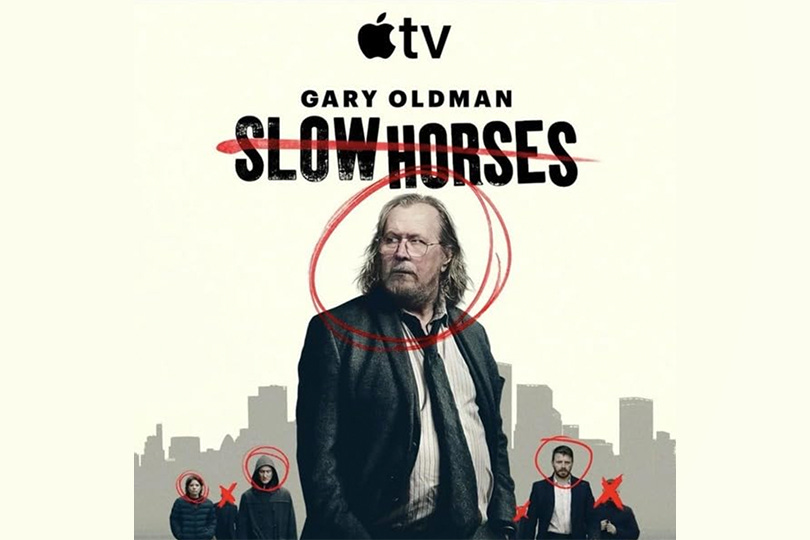
If any ongoing TV series has captured the question “Was the Cold War ever over?”, it must be Slow Horses. Jackson Lamb, played by Gary Oldman, is the embodiment of the MI5 intelligence officer. His decaying, worm-like old body raises the question: why is he still there? Why is he still alive? Why is he working with the band of losers, known as the Slow Horses, who are sent to Slough House because they made career-ending mistakes in the field? The question has come closer in this sixth season, in which the killing of old spies has become a cycle of retaliation between Russia and the head of MI5. This short article focuses on the remnants of the Cold War: how spies on both the Russian and British sides, through these slow and invisible bodies, so often raise the question of the Cold War’s continuation – as if it were never over.
Get E-International Relations delivered to your inbox, free. As you sign up, consider becoming a paid subscriber, or make a donation, to support our work.
In recent years many have raised a parallel question in the form of the Cold War analogy: that the technological race between China and the US mirrors, to some extent, the US–Soviet arms race of the last century, and that the two may eventually confront each other. What would that look like? This is the utopian imagination, the very legacy of the Cold War. Of course, many question the analogy, arguing that this is simply a different scenario and that we need a better imagination of world politics (Jo and Weiss 2026; Zarakol 2026).
What we, as scholars or lay people, are unaware of and so often neglect are spies – people like Jackson Lamb. How is he alive? Why is he alive? Why hasn’t he been shot dead like his old friend, or developed dementia like his colleague, so that he no longer remembers those brutal histories, or, worse, become paranoid? His very existence and his robust health despite a bad diet, constant smoking and drinking, poor hygiene, a deliberately worm-like appearance day and night, and, not least, a nasty personality symbolize the slow decay of the long-forgotten but still-living body of the Cold War spy. As the MI5 director herself says of him, “he will be important for us because he has several years of field experience.” The intelligence service has made use of him, and often, but he has also used it in return.
MI5 has twice tried to kill its own people, the second time this season: for having seen classified information in previous seasons, and for “getting in the way” of “killing a Russian agent on Russian soil.” This might be dismissed as bureaucratic error, or however people choose to box it, as if there is always something wrong and evil within that sort of institution. That may be so. But the most interesting thing Slow Horses never fails to deliver is how intelligence services are always part and parcel of the race between great powers. The US was the only one able to identify who was developing the bomb during the intense nuclear race of the 1960s. Spying is delicate work and requires constant technological improvement. So when it comes to intelligence services, we have to look more closely at this very old war, the Cold War, which no one remembers now, yet from which we constantly draw analogies at the level of the big picture, but never at the level of the slow and invisible bodies, both living and dead.
This political thriller, with its good humor, bad mentoring, and one-sided bromance, traces legacies that are still very much alive. Most of the seasons features at least one Russian, or someone connected to Russia. It is as if the author of the Slough House novels, on which the series is based, has some connection to this part of history, or simply that lay people like me have no idea what goes on in Britain’s security world. This Russian link is never initiated by the Russian side; it usually looks like retaliation against something the UK has done, a misunderstanding, or part of some bigger money business. In any case, viewers get the sense that the UK has only one neighbor, a very big one, and that everything in between, the vast landmass of Europe, Germany and France included, has completely disappeared and been forgotten, as on a Cold War political map (with France disagreeing with the US and UK on nuclear issues, and Germany simply in shambles).
In season 4, there is a character who trains mass killers in France from a very young age, and you will see him in later seasons up to at least season 6. But even he is American: a former CIA officer turned contract killer. A bad American. This forgetfulness, this playing with Europe’s popular enemy while forgetting your old friends from the old war, seems a perfect fit for the Cold War analogy: two men running a masculine race against each other, often with advanced techniques and often behind the curtain. It is thus no coincidence that the series fits poorly with Europe after the open war and clean break with Russia since 2022, and fits well with the last century, when the huge landmass separating Russia and the UK (socialist allied states, even half of Germany) was not worth naming. France, too, seems unnamable. It should be named, and so it is, but only in the form of gatekeeping. Indeed, the series’ ill fit with post–Cold War Europe’s distribution of power so often raises the question: how are they alive? How is Jackson Lamb alive?
When I wonder how he is alive, I mean precisely how he is alive: alive, fresh, and able to think through more scenarios than anyone else in the UK’s security service, including assessing and pointing out the “bad decisions” of the head of MI5, and forgiving and forgetting her mistakes simply because they have a big bargain to strike. This is why the slow decay of the Cold War is so often visible in Slow Horses. This may well be the central question that Russia, the UK, and everyone else have to answer: which game are we playing? Is this a new war, or the old war, now out in the open? But one has to acknowledge that being neutral on the Russia-Ukraine war is itself siding with the old war’s playbook. If it’s done, it’s done. As Ayşe Zarakol’s recent essay (like much of her scholarly work) captures, claiming past goods in the present does not remove the issue from politics; the essay urges us to be mindful of old Cold War imaginaries.
Slow Horses has been highly focused on the slow decay of MI5 as an institutional holdover that plays by the old Cold War playbook but now faces the risks of privatized security (especially emphasized this season), whilst often flirting with the idea of a Cold War truce with Russia. Then it returns to MI5, a new season begins, and it flirts once again with the slow decay of Cold War traces (as I anticipate in the coming season), killing old bodies but never eliminating its protagonist.
References
Jo, Eun A, and Jessica Chen Weiss. 2026. “The Ideology Trap: China and the Limits of Cold War Analogies.” International Security 50 (4): 7–35. https://doi.org/10.1162/ISEC.a.403.
Zarakol, Ayşe. 2026. “The Myth of Eurasia: Why Russia Can’t Shed Its Imperial Delusions.” Foreign Affairs 105 (5), September/October 2026.
Khaliun Enkhbaatar is a final year PhD student in International Politics at Fudan University. Her work has been previously published in Global Studies Quarterly. She is currently working on Sino-Soviet nuclear antagonism in the 1960s and how third states (Cuba, Mongolia, North Korea and North Vietnam) shifted alliances and managed rifts within the socialist alliance, proposing oscillation as a key technique. For this project, she has drawn on extensive multi-source archival research on the Cold War. She can be found on Linkedin.