

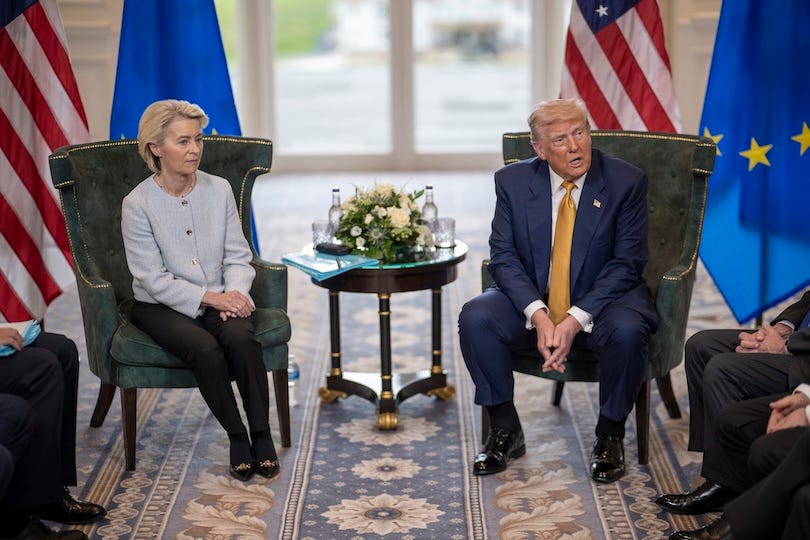
European Atlanticism is in crisis. For decades, it was the glue that combined Europe and the United States into a ‘security community’ – a group of allied states whose stated liberal values coincided to such a degree that ‘war’ had become unimaginable between them. Today, these shared values are disappearing, fast. The Trump administration has made its preference for a civilisational redefinition of a much looser transatlantic relationship clear; progressive liberalism is its enemy, at home and abroad – and it will spend millions in coming years to promote this idea among its ‘allies’. Mainstays of a liberal foreign policy – the ‘rules-based order’, liberal interventionism, liberal regime change and state-building – are out of the picture in Washington, DC; what is left is a naked Machtpolitik based on self-referential claims of personal, national and civilisational supremacy.
Get E-International Relations delivered to your inbox, free. As you sign up, consider becoming a paid subscriber, or make a donation, to support our work.
This has left Europe’s Atlanticists with a dilemma. Should they cling onto the assumptions they once shared with their US counterparts – on foreign policies clad in the moral imperatives of interventionism and democracy-promotion – and, therefore break with Trump’s United States; or should they prioritise the transatlantic relationship over and above the values it was – supposedly – based on since at least the end of the Cold War, and embrace a civilisational, nakedly power-political vision of ‘the West’?
This is, no doubt, a stark choice. It is also one that reveals the impasse faced by Euro-Atlanticism in the post-liberal 21st century. The first option – clinging onto an American-style liberal-interventionist messianism on one’s own – depends on illusions of power which Europe’s Atlanticists absorbed over decades of institutional and ideological enmeshment with their privileged American counterparts; the latter, civilisational option would mean Europe’s buy-in to a project which would lead to the abandonment of the liberal political and socio-economic values Atlanticists once claimed to champion, both abroad and, much more importantly, at home. Both options would, in effect, lead to the zombification of Euro-Atlanticism: its hollowing out through either its abandonment of the United States in favour of utopian values-based foreign policies burdening a slim economic and military base, or through a relinquishment of universalised values previously thought central to its very purpose in favour of a self-referential, supremacist civilisationism.
Until the end of the Cold War, Euro-Atlanticism was based on a shared threat: ‘keeping the Russians out, the Americans in and the Germans down’ was the glue that held both sides of the Atlantic together for decades. Its survival following the end of bipolarity was considered something of an anomaly: in the 1990s – buoyed by the dynamics surrounding European integration – many expected Europe to behave more independently from the United States within the emerging post-Cold War order. Quite the opposite occurred: NATO received a new lease of life as it enlarged eastward and expanded its purpose beyond article V, to include foreign intervention. Prevarications by those with a less Atlanticist bend – notably in the run-up to the 2003 Iraq war, and during the 2008 Bucharest summit – gradually faded away as elites on both sides of the Atlantic became institutionally and ideologically enmeshed in unprecedented ways.
Europe’s Atlanticist constituency - for whom the alliance with America was an unassailable given – gained the upper hand through its presence in Europe’s commentariat, its think-tanks, its parliaments and foreign ministries, not least because of NATO’s enlargement into Central and Eastern Europe. Its ‘Americanisation’ of Europe’s elite was visible in several ways: a move away from the quasi-instinctive restraint seen in previous decades; an increased deference to American unilateralism; a binary division of the world into ‘good’, pro-Western democracies and ‘evil’, anti-Western autocracies drawn from the neoconservative playbook; a geographically maximalist, global view of entangled European and American interests; and the idea that promoting regime change – in places from Libya to Belarus - should form part and parcel of a sound foreign policy. The conversion of Germany’s Greens to liberal interventionism was perhaps the best example of this change.
In the process, Europe’s Atlanticists came to take for granted the extent to which a stated dedication to ‘democracy and human rights’ was dependent on America’s hegemonic power and structural privileges – and, importantly, the extent to which Washington’s high-flying rhetoric also functioned as a device for translating inordinate power into a morally veiled foreign policy. Rhetorically dividing the world into ‘good’ democracies and ‘bad’ autocracies, and assuming that there is some kind of inevitable progression from autocracy to democracy was possible for both the unipole and its hangers-on at the height of the LIO – but only because the unipole’s hegemonic power was justified in terms of values they understood, and largely shared.
Euro-Atlanticists’ past care-free assumptions are now being put to the test. Washington is no longer ‘playing ball’ and speaking or acting according to these ideological templates. Its binary division of the world is no longer one between democracy and autocracy; it has no interest in promoting democratic regime change; it does not intervene for humanitarian purposes. Instead, it has adopted a civilisational worldview, combined with an unashamedly self-serving form of transactionalism unseen in modern times. If there is any coherence to be found in its worldview, its primary division is one between an endangered West, and a threatening Global South, where sycophantic dictators are openly preferred over genuinely representative leaders. To make things worse, Trump’s Washington has come full circle on America’s messianic impulse – only this time, exporting illiberalism to purported ‘allies’ inside and outside the West, with a revelling in parochial racial, ethnic, religious identities taking precedence over universal liberal values.
Some European Atlanticists might be tempted to react to this fundamental change by stubbornly clinging onto those liberal values now rejected by the United States and advocating the same kind of missionary zeal seen in previous decades – but on their own. Europe could thus continue to make relations with third countries subject to democratic conditionality, as in the halcyon days of the Liberal International Order; it could shy away from dealing pragmatically with China, and instead see it as an existential threat aiming to export authoritarianism worldwide – rather than a geo-political and -economic challenge moving up the value chain; and it could continue to studiously avoid diplomatic contacts with a dictatorial Russia lest they be seen as a sign of weakening resolve in advancing European values in Ukraine. For many, this latter point – divergence on Ukraine, and anger at America’s ‘betrayals’ of Kyiv and Europe – has already become a major motivator for a rethink in this directions.
These prescriptions would perhaps make sense if European states had the power to act on them; without that power, however, they end up clashing with the realities of the 21st century. And where European policymakers have taken this road, the results have been dismal. They include the blatant inconsistencies involved in approaches to ‘friendly’ and ‘unfriendly’ dictatorships; the transparent double standards separating approaches towards Ukraine on the one hand, and Israel/Palestine on the other; impotent attempts at global relevance – for instance, in the Indo-Pacific or Taiwan - based on defence budgets barely capable of addressing the Russian threat much closer to home; and a near-complete sidelining of Europe in negotiations over Ukraine’s – and its own – future.
This contrast of a relatively powerless Europe, and the American (and Chinese) juggernauts is compounded by the relative vulnerability of the continent: unlike the United States, it does not benefit from the relative safety provided by two oceans on either side. America’s only experience in modern inter-state warfare on its own soil remains the pinprick of Pearl Harbour. Its neighbours are Canada and Mexico, whereas Europe borders states and societies with a wide range of political, cultural and socio-economic conditions. The consequences of miscalculations and failure born of excessive Messianism the US was once warned about by the likes of Reinhold Niebuhr are, therefore, more immediate and profound: they risk the exhaustion of societies under the weight of an over-reaching idealism they cannot or will not bear. A rebellion of the malcontent – and the de-stabilisation of liberal societies Atlanticist claim to be protecting - is the predictable result.
Other Euro-Atlanticists could take the opposite route: they might just drop the cloak of morality to reveal a dogmatic dedication to America. To them, the transatlantic relationship would have to survive, values-based foreign policies be damned. This is not so far removed from Atlanticism’s liberal roots as it might seem, entangled as it has always been with the hegemony of the West over the rest. In a post-Liberal international order, it would just take a few linguistic tweaks to turn Atlanticism’s hegemonistic foundation – the ‘civilised world’s’ claim to a taken-for-granted right to command a ‘rules-based order’ - into something more brazenly supremacist: you would merely have to remove any talk of exporting universal ‘values’ from that equation.
For Europe to thus blindly follow a civilisational America’s lead would be problematic in three ways. Firstly, as in the case of liberal messianism, Europe lacks the American privileges which would insulate it from the blowback of imprudently self-serving American foreign policies. Secondly, the abandonment of values would not just pertain to foreign policy: the Trump administration has made it very clear that its aim is to further illiberal movements in Europe. Thirdly – and relatedly – this kind of ‘alliance’ would condemn Europe to a dependence and subordination even more pronounced than the one previously tolerated by their liberal predecessors.
The first point is clear enough: deferring to a United States ‘throwing its weight around’ without the constraints of either international law or a liberal universalism, based on a short-sighted view of its interests and its interests alone risks exposing the continent to danger. Europe’s relative geopolitical vulnerability was previously mentioned within the context of overly idealist foreign policies; it is even more relevant in case of an American-led ‘Western’ civilisationist foreign policy with a European buy-in. America can afford dabble in aggressive supremacism: the resulting chaos will hardly touch it. Eurasia is different: the kind of unrestrained power-politics resulting from a complete disdain for international law would result in very real consequences for Europe over the longer term. Shrugging at multilateral legal and institutional instruments and engaging in naked Machtpolitik is a uniquely hegemonic privilege, something those at the lower end of the global pecking order – and in more complicated regions – would do well to remember. Mistakes could be measured in terms of energy-driven cost-of-living crises, refugee flows, terrorist attacks, hybrid warfare, and the other select de-stabilisers of social order that have or might result from, for instance, Middle Eastern adventures.
The second risk emerges from the Trump administration’s aforementioned global reactionary ambitions, and its pledging of millions in dollars in funding towards organisations professing civilisational, and distinctly illiberal values in Europe. It is vehemently opposed to the continent’s current socio-economic model; its tech billionaires actively (ab)use their dominance of social media to openly push subversive narratives into the continent’s political debates; its ‘Christian’ nationalist churches adulterate Europe’s spiritual space with a materialist form of prejudice dressed as ‘religion’ – among others. Giving up on values-based Atlanticist foreign policies in favour of a civilisationist counterpart and appending oneself to this project would thus not merely be a pragmatic foreign-policy choice; it would imply an acceptance of the withering away of divergent, domestic values, as what makes European societies distinctly European is allowed to make place for supremacist schemes directed from Washington DC.
This is related to my third point. Indeed, clinging onto an unconstrained hegemon for old times’ sake may well result in something akin to vassalage. The Trump administration’s insistence that Europe spend its hard-earned defence budgets on American weapons is a case in point. So is his opposition to any attempt by Europeans to limit the ability of US tech giants to extract their rents from a captive audience, or institute industrial policies that avoid the kinds of dependencies engendered by decades of an ideologically driven neglect of the industries of the future. The price of a civilisationist Atlanticism would most likely be subordination to the United States: the freedom of Europe’s state and societies itself would become its quasi-inevitable victim.
And so, there is a real danger for Europe to cling onto an Atlanticism hollowed out by reality, by either clinging on to Messianic foreign policies outside its capability and purview, or by buying into the self-referential civilisationism of the Trump administration – transatlantic ties, no matter what. Both options - where outdated habits are maintained in a fundamentally changed world - are a road to nowhere. A pursuit of values without commensurate power results in either abject failure, or laughably transparent double standards. Civilisational supremacism, for its part, involves the projection of someone else’s power without values: a certain recipe for blowback, ideological and cultural evisceration, and, eventually, deepened structural subordination.
Of course, Europe’s Atlanticists might hold on to two shreds of hope. Firstly, they might argue that Trump is but one US administration, a ‘blip’ in a relationship spanning decades. But being re-elected twice in a decade can hardly be seen as an ‘accident’, and assuming Trumpism would disappear together with Trump is a dangerous bet to make. The rot at the other side of the Atlantic runs deeper than a single individual: it involves a political system which is polarised to the extreme, and a democracy which is under chronic pressure, and acute strain. No cautious policymaker should bet on the unpredictability it will probably continue engendering for years to come – or on the dream that, once resolved, things would go back to the way they once were.
The second lifeline for Euro-Atlanticists is Ukraine, and the idea that now, more than ever, Europe needs America in the face of the Russian challenge, in a partial return to the days of the Cold War. There are two problems with that line of thought. Firstly, the underlying assumption that the United States, under Trump, is a reliable ally, and that this particular president would risk, and expend, American life and limb to protect a Europe which, in his view, has not ‘paid its way’: quite the leap of faith in light of the transactional nature of this administration. Secondly, the meek acceptance of longer-term subservience and the destruction of once own social and political model – as documented above – would be a price worth paying for this uncertain commitment. Instead, the predicament they are using as an argument for continued transatlanticism should act as a call for action, and longer-term change towards greater self-reliance and policy independence – including on Ukraine’s survival as the age-defining issue for the continent’s security.
For those who prioritise progressive values at home and survival in a dangerous world over hegemonic pipedreams, the solution is clear: an abandonment of previously held assumptions, and a marginalisation of this outdated, Atlanticist mode of thought in European policymaking. What the continent needs in 2026 is an approach to foreign policy based on self-reliance, pragmatism and restraint – a Gaullism of the 21st century, if you will. Some may scoff at the idea; but such scoffing would not come without a readiness to either engage in liberal foreign-policy pipedreams in an illiberal world, or an acceptance of clientilisation to an increasingly illiberal power ready to export its illiberalism to purported ‘allies’ through blatant interference in their internal affairs.
Will Europe’s leaders, thinkers and commentators be up to the task? That remains, very much, the question. The challenges are formidable, and are, in no small part, the product of Euro-Atlanticism itself: the uncritical absorption by the continent’s elites of this ideology shaped by the American hegemon’s moral formulations of power and interest has led to today’s impasse. Others relate to the familiar question of the balance between state sovereignty, the need for unified or co-ordinated strategies, and the age-old collective action problem. But the first step in moving into this 21st century should be to look new realities in the eye and resist the temptation to rescue disparate elements of this undead mode of thought ‘for old times’ sake’. That would, at least, increase the chances of success compared to a lazy inertia founded on a nostalgia for past friendships.
Kevork Oskanian is a lecturer in International Relations at the University of Exeter, UK. He obtained his PhD at the London School of Economics’ Department of International Relations, and has previously taught at the LSE, as well as at the Universities of Westminster and Birmingham. His latest monograph, ‘Russian Exceptionalism between East and West: the Ambiguous Empire’ (Palgrave, 2021) – provides a longue-durée overview of modern Russia’s differentiated narratives towards its present and former imperial subalterns. His current research interests include the International Relations of Eurasia, alongside post-liberal approaches to International Order.