

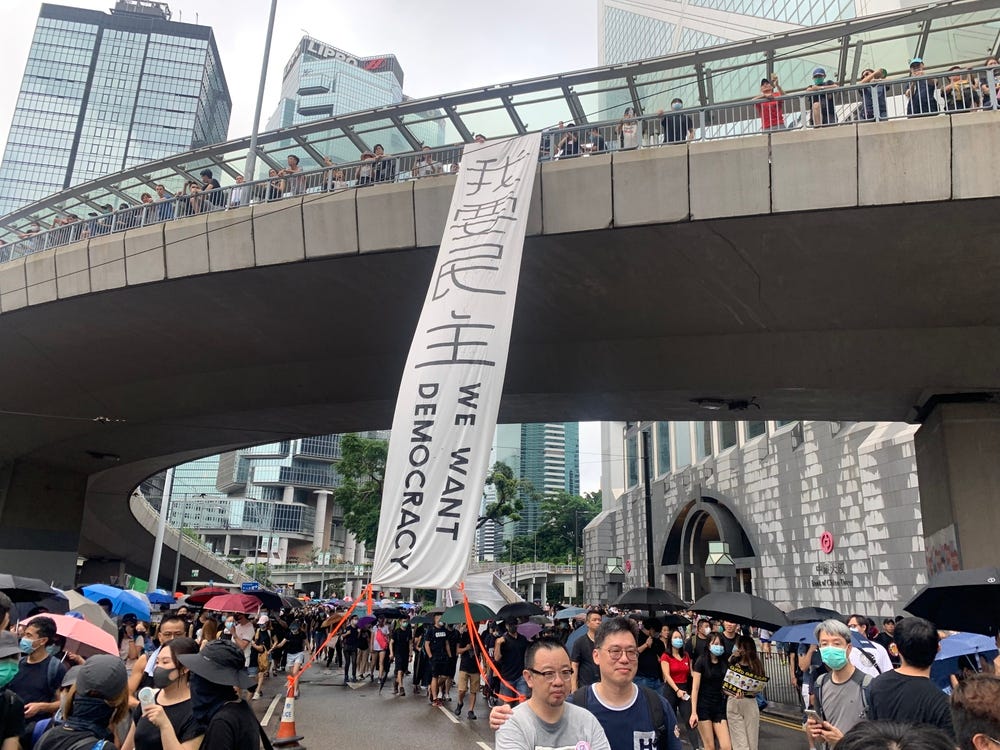
On 30 June 2020, the Chinese government imposed a National Security Law (NSL) on Hong Kong. This imposition violated the Sino-British Joint Declaration. In response to this violation, the British government has opened a bespoke pathway for holders of British National (Overseas) (BN(O)) status and their dependents to resettle in the United Kingdom and eventually gain full British citizenship. Adult children of BN(O) status holders can also independently apply by providing proof of their parentage. Over 500,000 people have left Hong Kong since the NSL’s imposition, among which 187,552 individuals have been granted BN(O) visa. Australia and Canada similarly offered immigration routes for the people of Hong Kong escaping China’s political repression.
Get E-International Relations delivered to your inbox, free. As you sign up, consider becoming a paid subscriber, or make a donation, to support our work.
But since China’s assault on Hong Kong, there has been increasing incidents of transnational repression not only in the UK but also in other parts of the world. A Hong Kong protester was beaten and violently dragged into the Manchester Chinese embassy. Letters offering a reward were sent to neighbours of Hong Kong activists to bring them to Chinese officials. Hong Kong Watch and its founder Benedict Rogers were threatened under the NSL. Jimmy Lai, a British citizen, received a 20-year sentence for exercising political expression. Former secretary-general of Demosistō Joshua Wong was similarly charged with collusion with foreign forces. My own PhD supervisor, Chongyi Feng, an Australian citizen, scholar-activist, and critic of the Chinese Communist Party (CCP), was issued an arrest warrant in 2025 for helping to set up the Hong Kong Parliament. Feng is no stranger to political persecution from the CCP. In 2017, he was detained by national security police for endangering national security during a research trip to China. These examples illustrate not only the increasing intensity of transnational repression, but that political repression extends beyond civil society to legitimate scholarly activities.
As associate professor and co-convener of the Asia-Pacific Research Group at the University of Technology Sydney, Feng hosted a conference on resistance against political repression, where I presented on this topic last year. I argue that the CCP targets Hong Kong dissidents to silence competing understandings of Hong Kong’s sovereignty. The CCP does this through discursive inversion. By reversing the roles of perpetrator and victim, the Chinese government seeks to maintain its legitimacy. This article will first outline the history of political repression in and beyond Hong Kong, then illustrate how the CCP uses the mechanism of discursive inversion to maintain its political survival, and finally, conclude with some recommendations for future political resistance against the CCP.
Hong Kong’s History of Political Repression
Hong Kong was an anomaly during British decolonisation in the twentieth century (Wong 2026). While other British colonies became independent, Hong Kong was the only colony that was transferred to another sovereign state without the people’s consent. Self-determination, in this sense, was not completed under the framework of UN’s decolonisation principles. Instead, Hong Kong’s self-determination was managed through the promise “Hong Kong people ruling Hong Kong”. This arrangement became known as “one country, two systems”, under which Hong Kong would have the autonomy to run its own affairs as an independent political entity for fifty years, with the exception of foreign affairs and defence, ministries which are managed by China on Hong Kong’s behalf. Under the Joint Declaration, the people of Hong Kong were promised a democratically elected local government and legislature.
But the Joint Declaration was China’s strategic deception. The document did not specify the method of election for the future democratic government. As Hong Kong was a British colony, it is not difficult to surmise that this future electoral system would have been widely understood as a Westminster-type system, with open and fair elections. Indeed, Chris Patten, the last British governor of Hong Kong, fully democratised the legislature in 1995. But at the 1997 handover, this fully elected legislature was dismantled by the CCP, which accused Patten of violating prior agreements, and replaced the elected legislature with a “provisional” legislature, itself a creation appointed in exile.
But perhaps the first significant repudiation on the Joint Declaration post-handover was the 2014 White Paper, which claimed China had “comprehensive jurisdiction” over Hong Kong. Its subsequent Decision Paper set out the framework for this democratisation: 2-3 candidates would be “nominated” by a pro-Beijing committee for the public to elect to the office of the Chief Executive. This was widely regarded as fake democracy and led to the 79-day Umbrella Movement. Hong Kong’s own legislature subsequently rejected the Beijing package in 2015. It was then that many localist and Hong Kong independence groups sprung up in Hong Kong’s political landscape in resistance to the totalitarian party-state’s interference with local affairs. In 2016, Nathan Law was elected as the youngest legislator in Hong Kong’s history. Demosistō, formed together with Joshua Wong, advocated self-determination of Hong Kong before the end of the fifty-year agreement.
But Beijing decided to silence him. The government disqualified Law a year later, with the official reason being his insincere oath. Xi Jinping came to Hong Kong first the first time in 2017, and told Hongkongers that they must not cross the “red line”. Xi did not specify what that meant at the time. In the ensuing years, advocating for self-determination became increasingly difficult, with these pro-democracy candidates not being allowed to run for election. When Hongkongers threw black paint at the PRC emblem on the night of 21 July 2019, the red line rhetoric intensified, and Beijing imposed the NSL on Hong Kong in 2020. Following this imposition, exile from Hong Kong was largely facilitated by the BN(O) scheme. Since then, many Hong Kong diasporic organisations have been established overseas, and the Hong Kong Parliament, an exile parliament, was globally elected in 2025.
From this history, we can see that the justification of political repression appears to rest, at its core, on China’s distorted narrative of Hong Kong’s sovereignty status, which the CCP tries to maintain through discursive hegemony, as illustrated by the CCP’s claim of comprehensive jurisdiction over Hong Kong. This distorted understanding effectively reinterpreted the original agreement, under which China would have its sovereignty restricted to areas of defence and foreign affairs. The claim is thus a direct contradiction of the promise of Hong Kong people ruling Hong Kong.
The Inverted Logic Behind China’s Transnational Repression
To silence competing understandings of Hong Kong’s sovereignty, China discursively maintains control of the distorted narrative that Hong Kong is an internal affair of China (Wong 2025). In pragmatics, if one repeats a contested phrase enough times, for instance “Hong Kong is an inalienable part of China”, it becomes naturalised (Flowerdew 2004). But what that claim has essentially done is to conflate “inalienability” – a concept that refers only to territory – with the political identity of the people living within the territory and beyond it. As Vice Minister Le Yucheng stated, in the context of Hong Kong’s sovereignty, that “Hong Kong compatriots are genuine Chinese people” [香港同胞是地地道道的中国人].
The derecognition of the BN(O) passport as an identity document in Hong Kong reveals this conflation. To illustrate this, let us return to 2019. At the height of the Hong Kong protests, the British parliament was considering options for BN(O) status holders. The then Ambassador to the UK Liu Xiaoming told British politicians to “regard Hong Kong as a part of China, not as a part of the UK”. Liu accused the UK of interfering with the internal affairs of China, a standard phrase which has been repeated by China time and again whenever it does not like what other states are doing. But Liu Xiaoming has committed precisely what he accused the UK of doing. BN(O) status is a form of British nationality, and the UK was debating internally what to do with its own people in light of China’s repression of BN(O) status holders. Thus, instead of the British interfering, China was the state that was interfering with UK’s internal parliamentary debate by telling the UK to stop. This episode demonstrates Liu Xiaoming’s ignorance of history, his inverted logic, and his conflation of China’s claimed sovereignty with Hong Kong people’s political identity. If China’s claim of inalienability were only about territory, the BN(O) debate would have been of no concern to China, since supposedly only the territory is inalienable, and people can choose to leave and be “a part of the UK” if they so choose.
Let’s suppose the UK decided to grant all BN(O) status holders and their families full British citizenship immediately, rather than just offering a repatriation pathway to it. In that hypothetical scenario, which was a possible option debated in 2019, it would have been even more difficult for China to justify its claim in its opposition to the BN(O) route. Instead, it would have exposed to the world the falsehood of a legal fiction that China has perpetuated for decades, since 5.4 million eligible people would have become British overnight. The idea of granting full British citizenship to the entire Hong Kong population was seriously considered by the UK as early as the 1980s and also after the 1989 Tiananmen Square Massacre, but the British government only granted this privilege to a select group of elites, totalling 225,000 individuals, through the British Nationality Selection Scheme.
Notwithstanding China’s position that the Sino-British Joint Declaration is a “historical document”, China has accused the UK of violating the same treaty. To make this accusation, the Chinese state relies on the British memorandum appended to the Joint Declaration, which states that the UK shall not grant the right of abode to BN(O) status holders. However, the final policy implemented following parliamentary debate is a five-year visa pathway, after which the BN(O) applicant has the option of applying for settled status under certain criteria, among which is English language proficiency. The five-year visa itself has to be applied for, and the bespoke pathway is far from an automatic grant of right of entry. On the other hand, the Basic Law, which codifies the Joint Declaration, has stated that Hong Kong shall have the autonomy to implement a national security legislation “on its own” under Article 23. Thus, contrary to Beijing’s portrayal of the issue, China was in fact the co-signatory that violated the Joint Declaration in the first place by imposing the NSL on Hong Kong (J. Chan 2020).
This kind of inverted logic is not new in the history of the CCP. The framing of the 1989 Tiananmen Massacre on June 4 demonstrates this. Patriots were framed as counter-revolutionaries, and the mass murder committed by the Chinese government was framed as protecting the state. The subsequent banning of any discussion about the Massacre in the mainland and more recently in Hong Kong suggests that the CCP knows its own narrative would not survive. It is this same inverted logic that China now uses to frame the 2019 protests as “unpatriotic, un-Chinese, ungrateful for Chinese support, and dupes of foreign meddling and incitement” (Zhao 2021, 154).
This framing rests on a presupposition that Hong Kong people are Chinese. However, the framing ignores the reality that the majority of Hongkongers do not regard themselves as Chinese. It makes a presupposition that Hong Kong is an inalienable part of China, and, therefore, the nation to which one must be patriotic is assumed to be the Chinese nation. Not the UK, and not Hong Kong itself. But for the entirety of its civilisation, except three years of Japanese occupation, Hong Kong has developed a British civic identity based on a free market, freedom of the individual, rule of law, and, most crucially, democratic institutions (Flowerdew 2016). These values are known as Hong Kong’s bedrock principles. Chris Patten said in a BBC interview:
Here is an example of freedom, and the sort of freedom we take for granted in most Western societies, being under assault. If we allow it to go under, if we allow it to be buried in Hong Kong, then sooner or later it would threaten everyone.
We can notice that the pronoun “we” aligns Hong Kong with Western democracies. Patten’s view is that Western societies should not allow China to assault the democratic free world, under which Hong Kong falls under. Here, we can similarly see China’s inverted logic: the CCP repeatedly claims Hong Kong is Chinese when, in reality, Hong Kong’s values align with the UK (Yu 2022, 2023). Thus, far from being an “internal affair”, China’s violation of the Joint Declaration is not only a matter between Britain and China, but also of international relations. The vocal support of the Hong Kong Parliament by the G7 Rapid Response Mechanism challenges precisely this narrative. It shows a growing sympathy for the exile parliament, which seeks to protect Hong Kong’s civic values inherited through British colonial rule.
Takeaways and Recommendations
Transnational repression originates from China’s distorted narrative of Hong Kong’s sovereignty. China maintains this distortion by conflating territory with people, reversing the roles of perpetrator and victim, and through legal instruments such as the NSL, and, more recently, Hong Kong’s home-grown Article 23. The Chinese state does this in order to silence competing understandings of Hong Kong’s sovereignty. Against China’s hegemony, the concept of self-determination is a commonly accepted principle under “Hong Kong people ruling Hong Kong”. This is evidenced by the Occupy Movement in 2014, the successful election of a Demosistō candidate into Hong Kong’s legislature in 2016, and the symbolic rejection of Chinese encroachment during the 2019 Hong Kong protests. The post-NSL political repression has extended transnationally not only to Hong Kong diaspora communities and civic organisations, but also to academia and exile political institutions. The irony is that had a self-determination referendum been held for Hong Kong, a plausible outcome could have been for Hong Kong to remain under Chinese governance. The CCP likely fears that a referendum would not result in its favour.
In 2017, Bruce Gilley caused controversy by publishing “The Case for Colonialism” in Third World Quarterly. In that article, he asserted that failed states can (a) invite former colonisers to recolonise some regions; (b) replicate colonial systems; (c) create colonies from scratch. The article was withdrawn following threats and intimidation against the editors but republished in 2018 by another publisher (Gilley 2018). If we were to apply Gilley’s framework to Hong Kong, China would be that failed state, since it has failed to govern Hong Kong according to the Sino-British Joint Declaration. I have argued in my thesis that (a) has been achieved, albeit in a reverse way, as the UK opens the door to 5.4 million colonial subjects and their families to come under its governance again; (b) has also been achieved, albeit only partially, as the virtual parliament has been elected in exile but currently exists without territory. The online election largely followed a democratic system that was bestowed upon Hong Kong by the British government, which was the only signatory to the Joint Declaration to ever fulfil the promise of democracy, however only for a brief time. With only 15,000 votes, the lack of votes was more likely a result of political repression rather than a failure of the idea. Prior to the post-NSL era, Hongkongers had successfully organised an unofficial referendum in 2014 and an unofficial primary election in 2020 with large turnouts. It is therefore not difficult to surmise that the primary reason for the lack of support for the Hong Kong Parliament could be the intimidation and threats resulting from the NSL.
Nevertheless, BN(O) status holders remain second class citizens. The BN(O) visa does not allow access to public funds. Some may become permanent colonial citizens if they do not meet the criteria, for instance English language proficiency, to apply for indefinite leave to remain at the expiry of their five-year visa. This situation is a grim reminder of the unequal tiers of British nationality within Hong Kong during the colonial era, where elites were granted full British citizenship, while ordinary people were left with BN(O) status. The reality is that Hongkongers are not willing to live under a totalitarian government, but BN(O) status holders are not equal citizens within the metropole. They have chosen the least worst option by living under a beacon of democracy.
Abandoned by Britain, persecuted by the totalitarian party-state, and reconnected with the mother country in a renewed but different relationship, the Hong Kong story is ultimately a story of loss, grief, and hope. It is what Fong (2020) calls a stateless nation. Hong Kong has a distinct political identity inherited from the British Empire, which promised Hong Kong democracy and autonomy. At the end of British colonial rule, Hong Kong’s beloved British governor said, “Now, Hong Kong people are to run Hong Kong. That is the promise. And that is the unshakable destiny”. Yet that promise never came and the destiny never arrived. Instead, Hongkongers have been forced to leave their beloved homeland and suffer from post-traumatic stress disorder as a consequence (Liang 2022). Young people who cannot afford to leave are grieving for the loss of their hometown (W. Chan 2024). Many have not found suitable work since arriving in the UK. With the exception of the elites and their families who were granted full British citizenship in the 1990s, the majority of Hong Kong people were left with a British nationality status that does not grant them any access to privileges normally afforded to British citizens. Like other stateless nations within China, Hong Kong and Hongkongers are vulnerable to political repression by the CCP.
So I want to offer a political solution, a kind of a New Jerusalem for Hong Kong people – a place of refuge, hope, and freedom. Just as the UK took a courageous step to open its door to Hong Kong, it could also be the leading state in recognising the Hong Kong Parliament, which may ultimately evolve into a government-in-exile. As I have argued in my thesis and elsewhere, the UK could provide land to host this government-in-exile in a similar way to India hosting the Tibetans, which could transform Hongkongers in the UK from second class colonial citizens within the metropole to full members of a self-governing Crown Dependency under the British Crown. In this sense, Gilley’s vision of creating colonies from scratch can be adapted to create a democratic-resistance hub on UK soil. Within this new colony, Hongkongers could conduct its own referendum to gauge what they want for their political future. This place in exile could host a people preparing and hoping for a day when the Chinese government is overthrown. Likewise, the city-state in exile could host a truth and reconciliation commission (TRC) to investigate past British policies relating to nationality, especially during the post-Tiananmen era.
A Crown Dependency, together with the referendum and TRC, may not resolve all psychological traumas resulting from China’s assault on Hong Kong. However, an institutional solution could provide hope by acknowledging past injustices and creating a framework for political redress. As I have argued previously, Hongkongers have long suffered injustices fundamentally because the British government, in response to the Tiananmen Square Massacre, separated those who were selected for full British citizenship from those who were not. Had the British offered a blanket grant of full British citizenship to Hong Kong before the handover, the resulting repression by the CCP may not have been as intense. A people confident in their national identity as British might have turned out to be less susceptible to intimidation by a bullying state. Without institutional recognition, Hong Kong, as a people, may carry the unresolved grief of historical injustice to the grave.
References
Chan, Johannes. 2020. “Five Reasons to Question the Legality of a National Security Law for Hong Kong.” Verfassungsblog on Matters Constitutional, June 1. https://verfassungsblog.de/five-reasons-to-question-the-legality-of-a-national-security-law-for-hong-kong/.
Chan, Wallace. 2024. “Loss of Hometown: Young Hongkongers’ Collective Grief following the 2019 Social Movement.” Journal of Loss & Trauma, 29 (3): 313-330. https://doi.org/10.1080/15325024.2023.2256226.
Flowerdew, John. 2004. “Identity Politics and Hong Kong’s Return to Chinese Sovereignty: Analysing the Discourse of Hong Kong’s First Chief Executive.” Journal of Pragmatics 36 (9): 1551-1578. https://doi.org/10.1016/j.pragma.2004.03.002.
Flowerdew, John. 2016. “A Historiographical Approach to Hong Kong Occupy.” Journal of Language and Politics 15 (5): 529-548. https://doi.org/10.1075/jlp.15.5.02flo.
Fong, Brian. 2020. “Stateless Nation within a Nationless State: The Political Past, Present, and Future of Hongkongers, 1949–2019.” Nations and Nationalism 26 (4): 1069-1086. https://doi.org/10.1111/nana.12556.
Gilley, Bruce. (2018). “The Case for colonialism.” Academic Questions 31 (2): 167-185. https://academicquestions.org/the-case-for-colonialism/.
Liang, Mark. 2022. “Politics and PTSD: The Case of Hong Kong BN(O) Visa Arrivals in the UK.” Anthropology Today 38 (5): 4-8. https://doi.org/10.1111/1467-8322.12751.
Wong, Ka Hang. 2025. “Discursive Sovereignty: How China Constructs Hong Kong as an ‘Internal Affair.’” Journal of Pragmatics Research 8 (1): 116–137. https://doi.org/10.18326/jopr.v8i1.116-137.
Wong, Ka Hang. 2026. “The Irony of Thatcher’s Political Miscalculation: A Critical Discourse Historiographical Analysis of British Nationality Classes in Hong Kong.” CADAAD Journal 18 (1): 37-53. https://doi.org/10.21827/cadaad.18.1.42479.
Yu, Andrew. 2022. “Hong Kong, CANZUK, and Commonwealth: The United Kingdom’s Role in Defending Freedom and the Global Order under ‘Global Britain’”. Round Table (London) 111 (4): 516-521. https://doi.org/10.1080/00358533.2022.2105532.
Yu, Andrew. 2023. “British Values, Hong Kong Voices: Tracing Hong Kong’s Britishness and its Influences on British Immigration Policies.” African and Asian Studies 22 (4): 418-451. https://doi.org/10.1163/15692108-12341616.
Zhao, Suisheng. 2021. “From Affirmative to Assertive Patriots: Nationalism in Xi Jinping’s China.” The Washington Quarterly, 44 (4): 141-161. https://doi.org/10.1080/0163660X.2021.2018795.
Ka Hang Wong is an English language educator and researcher with over a decade of experience teaching English for Academic Purposes and IELTS across China and Australia. He received his PhD from the University of Technology Sydney in March 2026 with a thesis tracing the historical evolution of BN(O) status from a token of British nationality into a tool of political resistance against a totalitarian party-state’s assault on Hong Kong. He has published research on Hong Kong, focusing on postcolonial linguistics, pragmatics, and English language teaching.