

As part of a piece of research considering the way in which migration is governed across contested and ill-defined borders in the Mediterranean, a member of our research team has recently returned from a trip to Melilla, one of Spain’s two autonomous cities bordering Morocco. The study is evaluating how legal and illegal migration occurs and is managed within the frame of political economy and diplomacy. Particularly, the study focuses on Melilla, Ceuta, Gibraltar, and the UK’s Sovereign Base Areas (SBAs) in Cyprus – all territories that have been in the news in recent months. Though small and often neglected they represent important nodes illustrating ongoing challenges related to migratory flows across Europe, Brexit, and the war in Iran.
Get E-International Relations delivered to your inbox, free. As you sign up, consider becoming a paid subscriber, or make a donation, to support our work.
The research trip was planned earlier but corresponded with the headline making developments in Ceuta, which saw 80,000 people, mainly young Moroccan men, illegally crossing the border in late July. Although most have returned, the situation is not fully under control. This has provoked divisions in the EU and strong criticism from US President Donald Trump. Melilla did not witness the same pressures, although violence on its border has occurred previously – most recently in June 2022 when almost 40 people were killed trying to cross.
However, it is also important to see how the border operates at most other times. The visit gave us the opportunity to assess how it is managed when there are regular and steady flows of people and vehicles transiting the border. What was seen was a real contrast to Ceuta, with a well-managed border with people queuing and crossing in relatively good time with moderate security and customs checks.
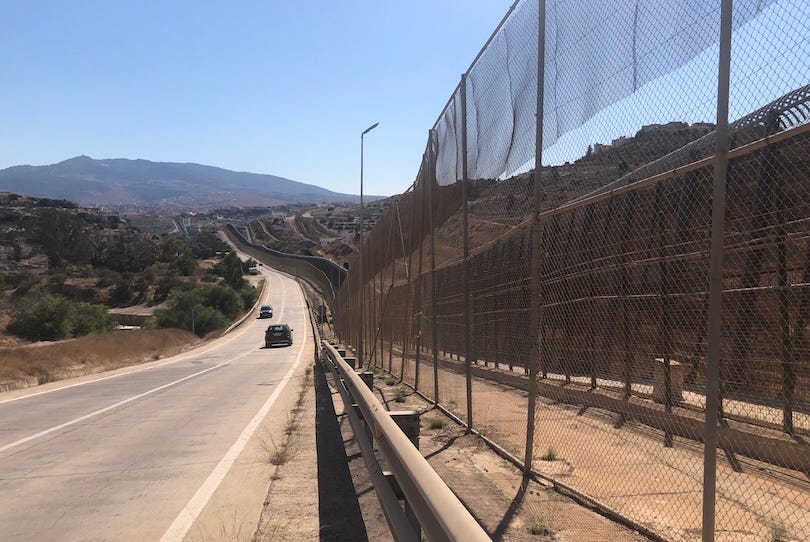
Walking along the border and passing through it was very insightful. As one might imagine there are stark differences between Melilla and Morocco, although some are more subtle and unexpected. The border fence is high, with two, sometimes three rows of fencing, and regular look out points. In some areas there are deep trenches between the individual fencing structures. There are also parallel roads on each side – with the imposing fence dividing them like an exaggerated crash barrier.
Interestingly, on the Moroccan side, day-to-day life is conducted very close to the fence – giving a sense that it should not be seen to interfere. Arguably, that despite the fence’s imposing stature it should be ignored both in practice and in concept. In contrast on the Spanish side, development is much sparser giving the impression that the fence is a more significant imposition; although the airport is close to the border, so too the migrant detention centre.
The fact that Melilla is an external border of the EU is of course one factor that makes it sometimes difficult to manage. But the disparities between Melilla and Morocco are also important to understand. There are significant differences that become almost immediately apparent when crossing the border. Commercial activity, transport systems, and urban development are of a lower level, whilst the extent of state security is noticeably higher. Although Melilla’s GDP is one of the lowest in Spain and only half of Madrid’s, economic and social conditions are still better than in Morocco, and of course that creates a significant pull factor for potential migrants from Morocco and neighbouring countries.
Nonetheless, it is worth reflecting on Melilla’s economic position, which as noted above has a relatively low GDP per capita. It has little local industry and agriculture, there is a heavy dependence on the public service for employment, and a clear difference between the better off and maintained areas near the historic centre and the outer areas, which are somewhat rundown. This is despite Spain’s best efforts to improve the economy through direct funding and initiatives to encourage more tourists to visit. However, this relative economic struggle is not untypical for territories that lie on the outermost fringes of the metropole.
In terms of Melilla’s social makeup, it appears that the Christian, Muslim, Jewish and Hindu populations coexist relatively peacefully, although they often live in different neighbourhoods. It was interesting to see, for example, that in the old Jewish areas, with street names such as Jerusalén and Haifa, they are now occupied by Muslim populations. There were also signs here of radical Islamic sentiment, though that should not necessarily be overstated. Nevertheless, the Muslim influence is strong, and this could be seen in some of the social mores of Melilla, for instance, the small number of bars serving alcohol, although there was a strong café culture more generally. But there was little indication of Muslim, and within that context Moroccan, agitation for Spanish sovereignty to end. In conversation with several Moroccan residents they highlighted the benefits of living in Melilla, emphasising education in particular.
One of the most significant changes affecting Melilla in recent years has been a hardening of the border with Morocco, and not necessarily on the instigation of Spain. For many years even after the fences began to be built in the 1990s, there were large cross-border flows of people and goods. However, the crossings were closed due to Covid-19 and only one, Beni Ansar, has since re-opened.
While Spain would not be against the other border posts reopening and the amount of traffic returning close to pre-Covid levels, the Moroccan government is keen to improve domestic economic opportunities and not rely on Melilla (and Ceuta) as release valves. Yet, the Moroccan economy is not performing well, and indeed growing discontent may well have been one of the factors explaining the recent surge of migrants to Ceuta.
The visit to Melilla complemented earlier visits to Gibraltar and the SBAs, and to conclude the article we would like to make brief comparative observations between them. State-to-state cooperation is a common theme, but the outcomes of that cooperation can be quite different.
Gibraltar’s model is based around the desire to keep the border open; a view shared by both the UK and Spain, despite Brexit and Spain’s sovereignty claim. The recently agreed post-Brexit arrangements preserve mobility on the actual border and move border controls to Gibraltar’s airport and port. The agreement was widely supported, although some politicians on the right in both Spain and UK raised concerns about the loss of sovereignty. However, this kind of opening is not without its risk as shown recently in regards to the smuggling of people and goods.
The SBAs illustrate a different approach. There is a long-standing open border with Cyprus, which allows UK sovereignty to continue, whilst giving Cyprus significant day-to-day operational control over many aspects of the lives of the resident Cypriot population, including the management of migration. However, these arrangements do create unsatisfactory outcomes, for example, when several migrant families spent more than 20 years on RAF Dhekelia before being allowed to settle in the UK.
Melilla is an interesting case. At the time of the visit the frontier was calm and operating as it should, and life, particularly on the Moroccan near-side of the border was being conducted with as little recognition of the fence as possible. But seeing what was happening in Ceuta it was clear that it would not take much for the frontier to be significantly compromised as was the case in 2022. There is clear fragility to the border and a standard operating procedure that arguably hopes for the best. The stresses and strains in the Spanish-Moroccan relationship illustrates this well: cooperation, avoiding blame, diplomatic recognition of the Western Sahara, and other issues all come into play. In many ways it is not surprising that the Spain-Melilla-Ceuta-Morocco nexus is so delicate and can easily be dislocated.
The contrast with Gibraltar and the SBAs is thus striking, although complications certainly remain, plus a degree of fragility. In Gibraltar, post-Brexit arrangements have been put in place (after much negotiation) to maintain an open border with Spain for the economic benefit of all parties. In the SBAs, an even more unusual set of arrangements are in place, with UK sovereignty and Cypriot agency, but again for mutual benefit.
Although there are caveats, these different outcomes suggest that difficult and contested borders do not necessarily produce restrictions and unrest. Gibraltar and the SBAs benefit from the legacy of the UK’s membership of the EU. They also operate across frontiers where levels of economic development are similar and where governments are democratic with comparable regulatory standards. Regrettably for the peoples of Melilla, Ceuta and those in the neighbouring areas in Morocco these mitigations are not on offer.
Dr Peter Clegg is a Professor of Politics, and Dean and Head of the School of Social Sciences at the University of the West of England, Bristol. He has been a Visiting Fellow at the Institute of Commonwealth Studies in London, and a Visiting Research Fellow at the Sir Arthur Lewis Institute of Social and Economic Studies (SALISES) at the University of the West Indies in Jamaica.
Dr Rosa Maryon is a Senior Lecturer in Politics & International Relations at UWE Bristol. She specialises in post colonial and critical approaches to security studies and IPE with an empirical focus on the Middle East and North Africa.
Tom Goodwin is a research assistant for the project on migration comparing and contrasting the experiences of Gibraltar, Ceuta, Melilla, and the UK Sovereign Base Areas of Akrotiri and Dhekelia in Cyprus. He is a Politics and International Relations graduate with First-class honours and the recipient of the Politics and IR Award for academic achievement from the University of the West of England, Bristol.