

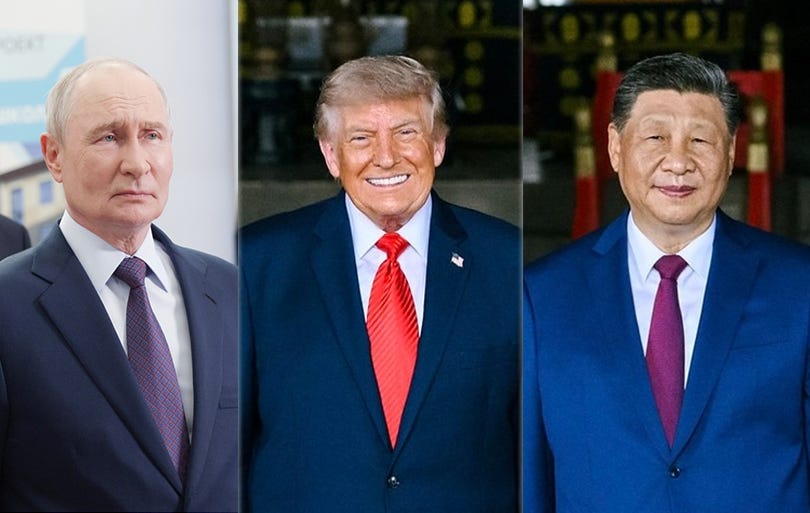
The November 2026 Asia-Pacific Economic Cooperation (APEC) meeting in Shenzhen, which US President Donald Trump has indicated he will attend, marks a critical juncture in the ongoing restructuring of the global system. Given the timing and context, and the exclusion of Ukrainian President Volodymyr Zelenskyy, the prospect of an agreement coming from a trilateral summit between Trump, Xi Jinping, and Vladimir Putin may represent a temporary, tactical stabilisation of an increasingly fractured interstate system. But, it may also sideline important alliance structures in Europe and Asia, mark the revival of traditional balance of power logic and great power diplomacy, and present a stark reality for peripheral states like Ukraine.
Get E-International Relations delivered to your inbox, free. As you sign up, consider becoming a paid subscriber, or make a donation, to support our work.
The fractures emerging within NATO over this impending Sino-American-Russian dialogue underscore an already existing structural decoupling between Washington’s geopolitical calculations and the deeply entrenched security anxieties within Europe. The UK has opposed unilateral bilateralism under the Trump administration, most notably the recent US-Russia diesel procurement accord. Characterising this transaction as a fundamental transgression of collective security frameworks, British Defence Secretary Wes Streeting argued that the transatlantic alliance must use its economic levers against the Russian Federation to fortify Ukrainian sovereignty rather than dilute the existing sanctions regime. Similarly, European allies interpret the proposed summit as a meeting that could sideline Europe and embolden Russia’s war strategy. Some commentary even draws comparisons to the 1945 Yalta Conference where great powers negotiated the fate of smaller nations.
Media discourse surrounding Ukraine still remains trapped within a reductive, binary, paradigm that positions diplomatic concessions of territory against absolute military victory. This fails to grasp the structural material realities of contemporary geopolitics and the shifting correlation of forces within the global system. From a systemic perspective, it is evident that achieving a total military defeat of the Russian Federation on the battlefield is implausible without unprecedented, long-term escalation of Euro-Atlantic material support. While so-called red lines set by the Kremlin have been continually crossed by Western military aid and weapons systems, the ever-present structural risk of escalation (nuclear or conventional) imposes a deliberate, systemic brake on Western tactical velocity. Consequently, the primary Euro-Atlantic objective is the containment of Moscow’s revisionist capabilities, managed carefully to avoid driving the Kremlin into a regional nuclear option born of systemic desperation. Concurrently, the conflict acts as a powerful material drain on Moscow, severely limiting its capacity to project power across other critical global fault-lines.
Despite the volume of Euro-Atlantic military assistance to Ukraine, the structural probability of a decisive Russian defeat remains unlikely. Russian casualties are rising, but the regime still commands a large reserve of fighting-age men. At the same time, the war’s protracted attrition yields incremental geographic consolidation for the regime around Putin. While Western-led economic sanctions initially strained Russia’s financial architecture, they have failed to alter the Kremlin’s strategic plans. After a multi-year adjustment period, Russia’s productive forces remain operational, hydrocarbon exports remain robust despite sanctions, and the domestic labour force has adapted. Consequently, despite the fact that economic stress is high, and there are increasing discrepancies between official military, economic and social narratives and observable realities, Putin’s authority over the state apparatus still remains firmly in place.
Stripped of its ideological framing, the mainstream discourse surrounding a potential land swap mechanism is irrelevant because Ukraine doesn’t control significant Russian territory. Ukraine’s attempt to take Russia’s Kursk Oblast in August 2024 proved ineffective and exposed the severe asymmetric attrition inherent in this proxy conflict, inflicting unsustainable casualty rates on Ukrainian forces and ultimately forcing a strategic withdrawal. The main goal of the Ukrainian offensive, to distract the Russian troops from their Donetsk advance, failed as Russia’s offensive in the east accelerated instead. While drone strikes on Russian energy infrastructure and military assets caused havoc and triggered localised panic, they have not yet produced decisive military results on the front lines. Ceding the eastern territories is structurally untenable for Kyiv as it would leave the remaining Ukrainian state and society vulnerable to external imperialist encroachments, economic strangulation and further internal divisions. For Ukraine, resisting territorial fragmentation is a material necessity to prevent it from being permanently relegated to a balkanised periphery.
Central to the geopolitical contestation prior to 2022, and even before Russian annexation of Crimea in 2015, were Moscow’s concerns regarding the structural disenfranchisement and ethno-linguistic marginalisation of the significant Russian-speaking populace residing within Ukraine’s eastern borderlands, and in Crimea. To address these deep-seated sub-national anxieties any negotiated settlement must look beyond zero-sum geopolitical realignments. A plausible avenue is an internationally monitored referendum – under the stewardship of external institutions such as the United Nations and the European Union – to asses local autonomy demands in contested peripheral zones. By preserving de jure state borders while legally codifying an asymmetric federal arrangement or autonomous constitutional status, this addresses some of the internal contradictions of Ukrainian state spatiality and could mitigate the historical West-East regional cleavage, offering a sustainable constitutional equilibrium that neutralises internal polarisation and shields local populations from the chaos of conflict – and secures Kiev’s control over the regions.
A comparable system can be applied to the Crimean peninsula, a region defined by its predominantly ethnic Russian demographic and long-standing role as a pivot of post-Soviet geopolitical tension. Under the 1997 Partition Treaty, Moscow secured maritime control by leasing Sevastopol’s strategic naval infrastructure – an arrangement later extended to 2042 – underlining its importance for Russia. While Ukraine’s recent tactical successes in compelling Russia’s Black Sea fleet to relocate mark a notable back down for Russia, the Russian military high command’s long-term interests remain bound to Sevastopol. Consequently, a diplomatic settlement based on a return to the pre-2014 status quo could defuse the existential flashpoint over Crimea’s status; it could therefore still stay as part of Ukrainian territory while at the same time be used by the Russian navy. Such an arrangement would naturally reproduce the structural contradictions and diplomatic frictions inherent to the pre-2014 era, yet it offers a pragmatic architecture for ceasefire and the start of negotiations.
Concurrently, Ukraine’s accession to NATO – which the Kremlin has persistently leveraged as a foundational casus belli to justify its military intervention – must also be considered through the lens of shifting Western strategies and internal fractures within the alliance. Key political figures within major NATO member states, most notably Donald Trump, have consistently rejected the viability of integrating Ukraine into the transatlantic military apparatus. Recent shifts in Washington’s rhetoric underscore this, favouring regional, multi-state security guarantees outside the formal Article 5 architecture and (at best) deferring Ukraine’s institutional integration into the broader Western security sphere to a later date. According to some reports, even Kyiv has indicated willingness to forego NATO membership in exchange for strong bilateral security guarantees.
Ukraine’s immediate strategic priority is to end hostilities and stabilise its deeply strained socio‑economic system by combining political reform, humanitarian support, and long‑term recovery planning. Achieving this level of stabilisation depends on substantial financial injections and macroeconomic support from Western states and international financial institutions, particularly the core elements of the Western-led coalition. At the same time, proposals for a United Nations-mandated multinational mission, backed by US air superiority and intelligence capabilities, are proposed as a deterrent against future Russian attacks. While Moscow has historically instrumentalised peacekeeping rhetoric to legitimise its asymmetric interventions, the evolving global security architecture, in particular combined interests of the US and Chinese leadership, may alter this calculus. If China and the US both insist on ending the war in Ukraine, and if a UN-supported peace keeping force is considered essential for this, Putin may not be able to object.
The bedrock of institutionalised Euro-Atlanticism, which has anchored Western hegemony for decades, is fast giving way to a naked great-power diplomacy. By bypassing multilateral structures and engaging in unmediated, direct negotiations with Moscow in the upcoming summit, the US is laying bare the profound geopolitical fault lines that have fractured the international system since the end of the Cold War. This structural destabilisation stems from the intersection of two massive historical forces: Firstly, China’s state-directed economic ascent – a formidable, non-Western systemic rival to the core hegemony of the Euro-American empire; and secondly, Russia’s aggressive military pushback against NATO expansion. Together, these two revisionist developments have forced a re-evaluation of American grand strategy. The unravelling of the transatlantic alliance, an ongoing process accelerated since the first Trump administration, is now a defining material reality of the current global power shift from the North and West to the East and South.
From a long-term geopolitical perspective, analysts widely agree that any sustainable framework for European security remains structurally unviable if it excludes the Russian state – either as a constrained actor or a future partner. Europe’s security environment has been historically and structurally shaped by Russia’s capabilities and geopolitical behaviour. Persisting in a dogmatically confrontational posture threatens an alliance between Moscow and Beijing that further accelerates the erosion of Euro-Atlantic alliance. At this critical juncture, the Trump administration’s strategic prioritisation of an arbitrated end to the Russo-Ukrainian war can therefore be understood as a calculated geopolitical manoeuvre to arrest, or at least slow down, the disintegration of Western hegemony by de-escalating tensions with Moscow and enabling Washington to redirect its remaining hegemonic capacity toward countering China’s economic and technological ascendance.
Bulent Gokay is a professor of International Political Economy at the University of East London.