

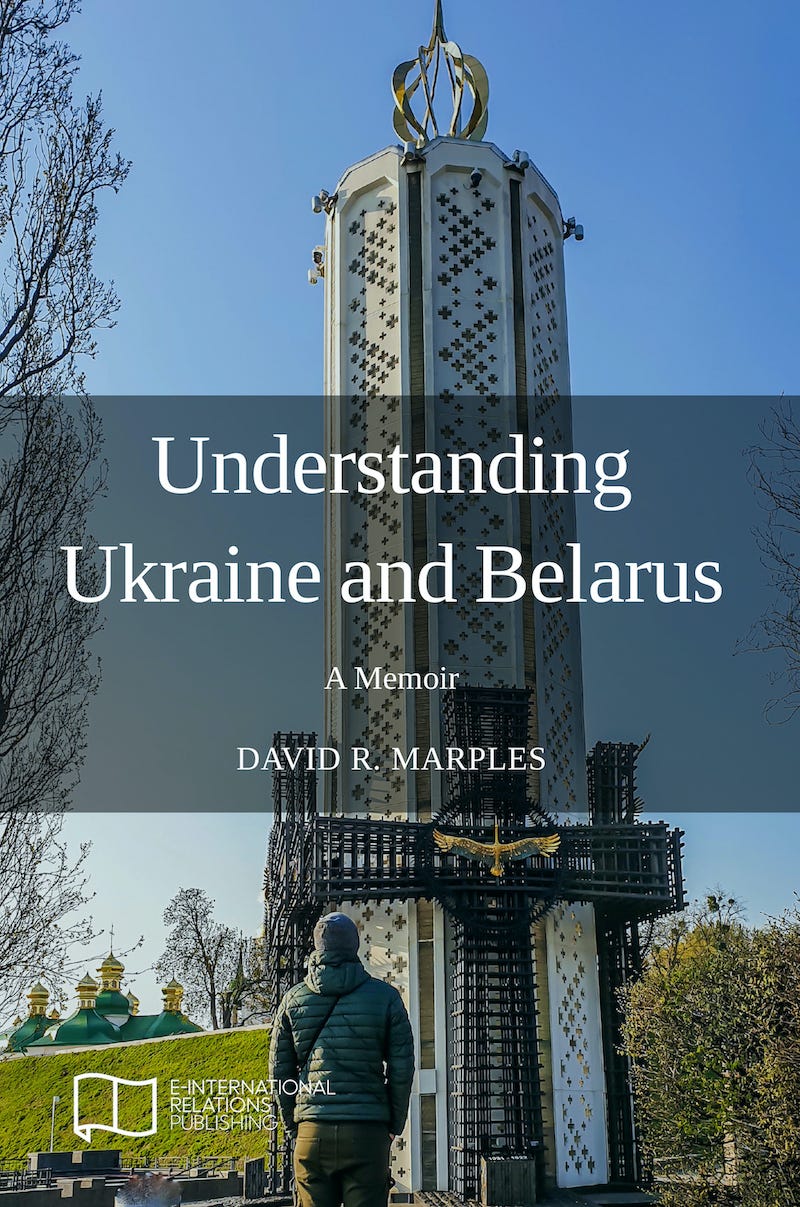
Download the book free of charge (below) or buy a paperback version on Amazon and in all good book stores.

This book describes the author’s academic journey from an undergraduate in London to his current research on Ukraine and Belarus as a History professor in Alberta, Canada. It highlights the dramatic changes of the late Soviet and post-Soviet periods, his travel stories, experiences, and the Stalinist legacy in both countries. It includes focus on his visits to Chernobyl and the contaminated zone, as well as a summer working with indigenous groups in eastern Siberia. Visiting Belarus more than 25 times since the 1990s, he was banned for seven years before the visa rules were relaxed in 2017. In the case of Ukraine, it chronicles a transition from a total outsider to one of the best-known scholars in Ukrainian studies, commenting on aspects of the coalescence of scholarship and politics, and the increasing role of social media and the Diaspora in the analysis of crucial events such as the Maidan uprising and its aftermath.
David R. Marples is a Distinguished University Professor of Russian and East European History at the Department of History and Classics, University of Alberta, Canada. He is the author of sixteen single-authored books, including Our Glorious Past: Lukashenka’s Belarus and the Great Patriotic War (2014), and Heroes and Villains: Creating National History in Contemporary Ukraine (2008). He has published over 100 articles in peer-reviewed journals. He has also co-edited four books on nuclear power and security in the former Soviet Union, contemporary Belarus, and most recently, Hiroshima-75: Nuclear issues in Global Contexts [with Aya Fujiwara] (Stuttgart: ibidem Verlag, 2020).
Reviews
This is a remarkable memoir that highlights the permeability of the Iron Curtain near the end of the Cold War – most notably through a personal account of visiting Chernobyl following the nuclear disaster – and is a testament to the continued importance of historical work that challenges the legacy of tyrants of the past, and of the present.
— Rylan Kafara, Killam Doctoral Fellow, University of Alberta, Canada
This very readable book offers thoughtful personal insights into academic life and perceptive strategic analysis of the complexities of contemporary politics in Ukraine, Belarus and Russia.
— Terry Mackey, Former Director of International Projects, Alberta International, University of Alberta, Canada
History is made and written by humans, and this book is the best proof of it. David R. Marples has written an honest and enlightening memoir revealing the human side of professional history writing and academic study of Belarusian and Ukrainian societies.
— Mikhail Minakov, Senior Advisor on Ukraine, Kennan Institute / Editor-in-Chief of Focus Ukraine Blog
Highly recommended reading as an inside account of the development of Ukrainian studies (and more) in Canada, a factor that I think will go some way to explain the support Ukraine received in its time of greatest need, when somebody in the future writes the history of our times. I took my first course in Soviet history from David R. Marples and for me this book is a real trip!
— Mark Opgenorth, Former Deputy Director, NATO Liaison Office in Kyiv, Ukraine
The theme of this engrossing memoir that impressed me the most is how close ties with an immigrant community, representing a part of a culturally divided country, shaped the author’s perspective on that country in its entirety and how this perspective subsequently evolved to become more meaningful, comprehensive, and even-handed. A punishment for even-handedness meted out by that community is instructive, too, as it stems from herd mentality and its inherently abusive relationship with social science.
— Grigory Ioffe, Professor of Geospatial Science, Radford University, Virginia
This memoir is entertaining and relevant. It gives an intimate window into the challenges of doing research on authoritarian regimes in the former Soviet Union over the last forty years, and reinforces the importance of protecting academic freedom during an age when identity politics increasingly threatens academic historical research. It also acts as excellent brief introduction to the history contemporary Belursian politics.
— Tolly Bradford, Associate Professor of History, Concordia University of Edmonton
A great book, especially considering its relevance to what’s happening in Belarus today. A good reminder that folks have been working on this topic for a long time.
— John Vsetecka, Founder and Co-Editor of H-Ukraine