

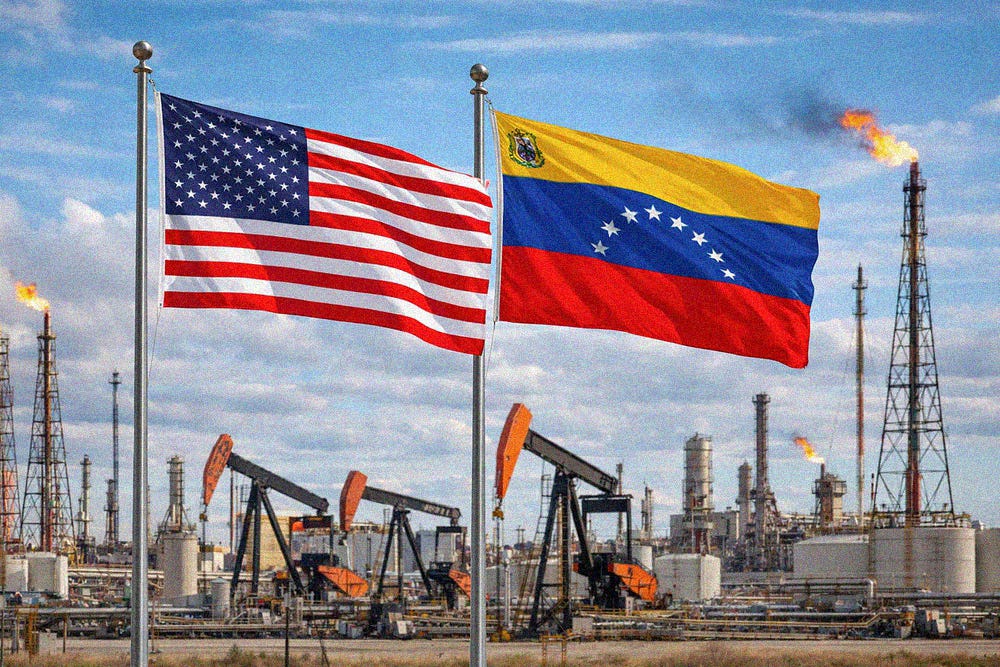
The Trump Administration’s landmark oil deal with the government of Venezuela appears to sit uneasily with its commitment to support a democratic transition in the country. The deal will give the United States unprecedented leverage over oil production and distribution in a country with a tradition of resource nationalism. Since the deal was announced, many commentators and elements of the Venezuelan opposition have argued that the oil agreement and democratisation are contradictory imperatives. In this reading, the Administration has chosen to prioritise access to Venezuela’s resources over democratic reform. Yet, the Trump Administration appears to see them as complementary. There is a political transition taking place – although it is gradual – and its purpose is to legitimate the oil agreement while insulating it against changes of government and domestic contestation in Venezuela. Because democratisation in Venezuela is being shaped around the oil deal, the type of democracy which emerges is likely to be a form of “pacted democracy” - an elite-managed democratic order which aims to provide legitimacy and political stability while limiting challenges to the new resource order.
Get E-International Relations delivered to your inbox, free. As you sign up, consider becoming a paid subscriber, or make a donation, to support our work.
The Oil Agreement
The Trump administration’s primary interest in Venezuela is in integrating its oil into a US-led resource bloc to compete with China. The deal announced by the administration at the end of August and beginning of September 2026 institutionalises this objective through embedding the US government directly into Venezuela’s resource governance.
The US government will take a 35% ownership stake in North American Blue Energy Partners (NABEP), which will control around 20% of Venezuela’s proven oil reserves. The United States will be guaranteed 20% of oil output at production cost and also first refusal of the remaining 80% of NABEP’s production, with the deal set to last 100 years. Although NABEP is a Venezuelan company, a majority of its board will be American citizens and the 35% stake will be held by the Pentagon’s Office of Strategic Capital. This gives the US government a direct role in the governance of a significant slice of Venezuela’s energy sector for the foreseeable future. The Trump administration has also encouraged US and Western oil majors to return to the country to significantly expand oil production. In January 2026, the President held a meeting with oil company CEOs to push them to invest $100 billion into the country’s oil industry.
This deal is not motivated by short-term or domestic political considerations linked to the mid-terms, the impact of the Iran War on oil flows, or gas prices: in fact, Trump was already considering securing a US ownership stake in Venezuela’s oilfields before authorising the removal of Maduro in January. Instead, the aim is to integrate Venezuela’s oil reserves into a US-led geopolitical bloc, while denying access to these strategic Western Hemisphere resources to China. The issue for Washington is that the deal currently lacks political legitimacy in Venezuela, opening it up to contestation from political forces outside the regime.
The Emerging Political Settlement
The imperatives of generating political legitimacy for the oil agreement and insulating it from political contestation in Venezuela are shaping the political transition process that is now in train. A continuation of the Chavista regime could provide immediate political stability. However, the regime’s lack of legitimacy could provide wider political upheaval in the future. It could also deter the investment from oil majors needed to increase the country’s oil production, due to their fears that under Chavismo contracts could be unenforceable and that their assets could be expropriated. Alternatively, the United States could back a transition to a wide liberal democratic system, as it did in a number of states from the 1980s to the 2010s such as Poland, Nicaragua, Chile, Serbia, and Ukraine. Typically, these transitions involved US support for a wide coalition of pro-democratic civil society organisations who helped to shape the new democratic system. Beyond elections, a vibrant and pro-democratic civil society embedded consent for democracy in daily life and provided citizens with channels to impact policy. This option would increase the legitimacy of any successor regime. However, it would also empower actors who might challenge the new resource framework on distributional, social, and economic grounds.
Neither of these options will achieve the Trump Administration’s objectives. The first offers political continuity that could underpin the oil agreement, but weak legitimacy. The second offers stronger legitimacy but introduces actors who may challenge the agreement. Between these two forms of political regime there is another, hybrid, alternative: “pacted democracy”. Here, the new political system and the rules of the political game emerge from negotiations between regime and opposition elites, rather than with wider participation from civil society. Elections occur and governments can change, but key elements of the political order are excluded from democratic contestation, and key centres of power linked to the old regime maintain strong political influence.
“Pacted Democracy” in Venezuela
The transition process now taking place in Venezuela points toward the emergence of “pacted democracy”. Negotiations between the regime and the opposition, backed by the United States, did occur in August 2026, and these did produce an agreement on greater independence for the courts and the Supreme Tribunal of Justice – the Supreme Court which ratified Nicolas Maduro’s fraudulent election victory in 2024. While there was no agreement on elections, this concession, plus the expectation that further negotiations will occur, shows that a political transition is in train. However, these negotiations proceeded within a narrow circle of actors. Maria Corina Machado, the leader of the largest bloc within the Venezuelan opposition, has been excluded from them, along with Venezuelan civil society actors, whose participation was called for by Machado in the Panama Manifesto in May 2026. The effect of this exclusion has been to focus the transition negotiations on institutional bargaining among elites while limiting the influence of civil society.
This points toward a “pacted transition” toward democracy agreed between elites. This does not mean that such a transition could not broaden after these initial agreements to include civil society actors – historically, many have. In contrast, a “pacted democracy” limits this broadening process due to the continued influence of key institutions from the old order which can exercise veto power over such changes. These conditions are also being met in Venezuela. The January 2026 US intervention removed Maduro but the centres of Chavista power, such as the army and SEBIN, were not disrupted and remain operational and capable of exercising political influence.
A wider elite consensus which accepts the oil deal and underpins a system of “pacted democracy” may also be taking shape. While elements of Chavismo and the opposition have condemned the agreement, some opposition leaders have been more circumspect. Most significantly, Maria Corina Machado has condemned US negotiations with the regime but characterised the US as Venezuela’s key partner for its development. These are objections to the process of negotiating the deal, not to its substance. The Venezuelan Armed Forces could benefit from greater oil investment by acting as the gatekeepers for security and access to oilfields and oil infrastructure, extracting higher levels of rents from a growing sector. Therefore, there is space for a bargain in which some regime and opposition factions converge with the military over the oil agreement. This convergence is being shaped by the reality of overwhelming US influence. Access to political office, reconstruction funds, and oil rents for these actors all depend on acceptance of the US’ favoured resource regime.
Historical Precedents
The combination of democratic legitimacy and control of strategic resources by an outside power is not unprecedented. The “pacted democracy” element of the system emerging in Venezuela might resemble the outcome of the US-backed political transitions in El Salvador and Guatemala in the mid-1980s, when elections took place and civilian politicians gained the presidency but key actors from the old regime, such as the army and the security forces, maintained strong political influence and were able to constrain the policymaking power of elected leaders. These systems broadened in the 1990s, as the military failed to fully defeat leftist guerilla movements in the ongoing civil wars in these states, while the collapse of the Soviet Union removed the Cold War dimension of the conflict that had incentivised the US to provide strong backing to the military to exclude leftist actors from the political system. However, the US-China competition, which is the fundamental motor of Washington’s new Venezuela policy is unlikely to change soon.
US policy in the Dominican Republic in the early years of the 20th century shows a precedent for the governance of a state’s key source of revenue generation by an outside power. In 1906, the US took over administration of the Republic’s customs houses, its main source of revenue. The aim was to direct this revenue to the US-friendly government to keep it in power, and to allow it to pay down debts to its foreign creditors. This would reduce the chance of external powers infringing on what policymakers saw as the US’ sphere of influence by using pressure or force to compel repayment.
British policy in Iraq after formal independence in 1932 shows an example of foreign control of strategic resources alongside a limited democracy. Democratic elections and representative institutions existed, under a constitutional monarchy. However, this system contained safeguards to protect Britain’s substantial oil concessions. The monarchy had the power to ban political parties, while elections were heavily influenced by the local elites which supported it. The system often produced coalition governments with weak legitimacy due to the imperative of keeping more nationalist parties who might contest these oil concessions out of power.
None of these provide an exact blueprint for a system of “pacted democracy” in Venezuela. However, they show that systems which provide a limited degree of democracy have been instituted by external powers to achieve geopolitical objectives, and that these can coexist with substantial foreign influence or control over key resource sectors.
Conclusion
The contradiction between the Trump Administration’s oil agreement with Venezuela’s current regime and its stated commitment to democratisation does not exist. However, the transition now being backed by Washington will not terminate in a broad-based democratic order rooted in civil society, as was the aspiration – and sometimes partially the reality – of US-backed democratic transitions in the final phase of the Cold War and during the Post-Cold War era. Current American policy toward Caracas is being led by the oil agreement, which aims to secure Venezuela’s oil resources for a US-led geopolitical bloc while excluding America’s Great Power competitors. The country’s democratic transition is being designed to provide political legitimacy and stability to insulate this new resource regime from challenge.
The result is likely to be a form of “pacted democracy”. This will provide sufficient legitimacy and rule of law to attract the foreign investors who are needed to increase oil production and to be acceptable to some Venezuelans. Under this process, the coalition necessary to produce and sustain democracy changes from being opposition parties, along with civil society, and potentially defectors or reformers from the old regime to rest on one composed of regime elites, opposition elites, and the military. The resulting form of democracy contains elections and some measure of change but limits the ability of Venezuelan social and political actors to overturn the oil agreement. The parameters of this system will be shaped primarily by US pressure and secondarily by domestic political dynamics. What emerges will be unique to the country, but history shows that the more general combination of some level of democracy with external power over a country’s strategic resources has precedents.
If the trajectory toward “pacted democracy” continues and measures are taken to implement the oil agreement, the dividing line in Venezuelan politics may shift from being support for or opposition to Chavismo, to support for or opposition to the oil agreement. The factions on either side of this new dividing line may incorporate current elements of Chavismo and the current opposition. Elections and political debates, among those actors allowed to participate, will take place within a framework in which the oil agreement is accepted as a settled reality. While future governments may seek to renegotiate parts of the deal, such as levels of royalty payments, the essential features which give the US direct governance over a proportion of the country’s resources will remain. If successful, this process could shape how the US integrates democracy, access to strategic resources, and geopolitics in its foreign policy in the age of Great Power Competition.
Robert Pee gained his PhD from the University of Birmingham in 2013 and has taught on the history and politics of US foreign policy at the University of Birmingham, University of Leicester, Royal Holloway University of London, and the University of Reading. His research focuses on democracy promotion and US strategy. He has published a monograph and a coedited collection on democracy promotion under the Reagan Administration, articles on Cold War history and US policy in the Middle East, and has written for TIME. He currently writes on geopolitics, populism, and the strategy of the Trump administration.