

*Originally published in 2025 and preserved as part of our archive project.
Get E-International Relations delivered directly to your inbox, free of charge. As you sign up, consider becoming a paid subscriber to support our work.
In August 2021 the world watched as thousands of people, both Americans and Afghans, crowded onto airplanes at the Kabul airport to escape the return of the Taliban. By the end of August 2021, the United States had evacuated over 200,000 people. On August 15, 2021, Afghan president Ashraf Ghani fled the country, and the Taliban seized control of Kabul calling themselves the Islamic Emirate of Afghanistan. The collapse of the Islamic Republic was predicated on the United States-Taliban deal that was signed in February of 2020. Most people assumed the Taliban would be unable to govern Afghanistan and that their government would not last. After all they were rural tribal people with a fundamental belief in a primitive version of Islam, and their control of Afghanistan from 1996 to 2001 was in many ways a disaster. But, the Taliban have now led the country for four years, with no end in sight.
Arguing that they are following basic Islamic law regarding the proper place for women in society, the Taliban have severely restricted the rights of women, restrictions more severe than in any other Islamic country. The treatment of women is the major reason the Taliban has not been recognized as the legitimate government of Afghanistan by many nations (Drury, 2025). The Taliban have also been denied a seat in the United Nations, again largely because of their treatment of women (Lederer, 2025). Recently the International Criminal Court has issued arrest warrants for two Taliban leaders, Haibatullah Akhundzada, the supreme leader of Afghanistan, and Abdul Hakim Haqqani, the chief Justice in the Afghan supreme court, for their treatment of women and girls in Afghanistan (Ayre, 2025).
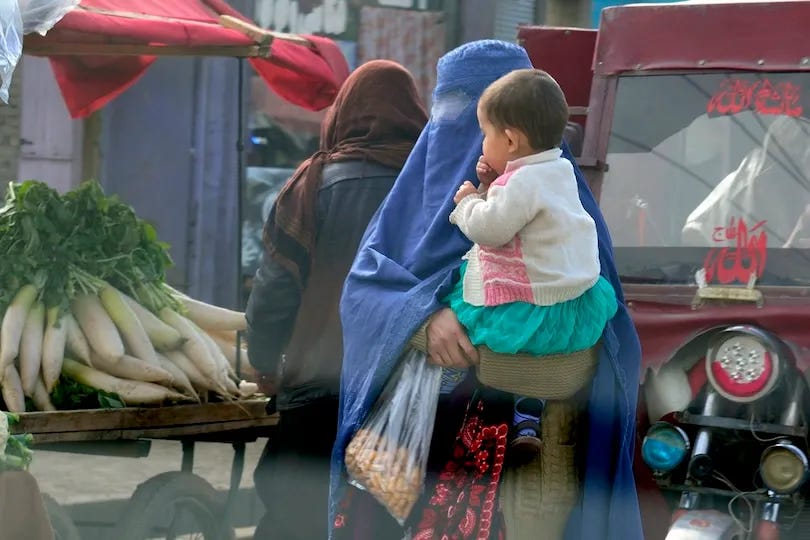
Not only are women not allowed to attend school beyond six grade, but they are not allowed to travel outside of their homes without a male companion. Women traveling outside the home must wear a veil that covers their full body. The Gender Inequality Index, a metric developed by the United Nations Development Program as a composite measure of a women’s place in society, is based on three dimensions: reproductive health, empowerment, and labor market participation. It ranks Afghanistan one of the lowest the world in terms of the treatment of women in government, education, health and political participation (UNDP, Gender Inequality Index, 2025).
Gender based violence has also increased. Afghan women experience a high rate of harassment when they leave their homes. Incidents of stoning and verbal harassment have been widely reported. This harassment and abuse is condoned by the Taliban’s Ministry for the Propagation of Virtue and the Prevention of Vice, a Taliban government agency that, among other things, dictates where women can go or not go, what women must wear, and how they must behave. Women who do not follow the rules of this Ministry are chastised, harassed, and often beaten. When women are arrested, they often face verbal abuse and torture (Ahmadi, 2023). Afghan women also often have no say in who they marry and many of these forced marriages are a result of poverty which drives fathers to marry off their daughters, often at a young age (Nariman, 2025).
There are very few female doctors or nurses in Afghanistan. Because men are prohibited from treating women, let alone seeing them without their veil, women are often unable to access basic medical services. Maternal mortality rates are high compared to other countries. With poor medical help available for pregnant women, it is estimated that approximately 24 women die each day in Afghanistan due to pregnancy related causes. Most of these deaths are the results of complications during childbirth (Gluck, 2023). Because of the lack of medical support, the infant mortality rate for Afghanistan is 62 deaths per 100,000 live births, one of the highest in the world (CIA, 2024).
Afghanistan has always been a poor country with high levels of poverty. Since the Taliban takeover poverty has drastically increased, particularly in the rural areas. It is estimated that over 90 percent of the population of Afghanistan is facing poverty and food insecurity (Programme W. F., 2024). The United Nations Development Project estimates that approximately 85 percent of the Afghan population live on less than one dollar per day (UNDP, 2024). The increase in poverty is in part because donors who had previously supported Afghanistan have halted their support. By 2025, Afghanistan had lost about 26 percent of its gross domestic product as many of these international development projects closed, pushing many Afghans out of work and into poverty (Smith, 2024). With the return of President Trump in 2025, the United States stopped all aid to Afghanistan, worsening the situation. Food scarcity falls most heavily on girls, as poor families make the hard choice of feeding boys before the girls. The mortality rate among girls is 90 percent higher than among boys (Bank, 2023).
The increasing level of poverty is exacerbated by the large number of Afghan refugees who are being forcefully repatriated from the countries where they had sought exile, mostly from Pakistan and Iran, but also in some cases from European countries and other countries where they sought refuge. The United Nations High Commission for Refugees estimates that over 96,000 Afghans were forcefully deported back to Afghanistan in April of this year alone, and that over 3.4 million Afghan refugees have been deported from Iran and Pakistan since 2023 (UNHCR, 2025). Most of these returning refugees have no home or job to return to. Although the UNHCR sometimes gives returning refugees a small amount of money as they return, most return to poverty and in many cases without homes. These returning refugees most often settle in areas around major cities, especially Kabul, Kandahar, and Herat, creating a large population of unemployed and impoverished families.
The returning refugee problem has been exacerbated by the decision by Iran to expel all Afghans. This is apparently a result of the growing Iranian conflict with Israel (Haqiqatyar, 2025). It is not clear why Iran is expelling Afghans, many of whom had been in Iran for decades. It has been suggested that Iran felt that the Afghan’s were sympathetic to Israel and/or the United States and were acting as spies, although there is no evidence of this. It is estimated that over 6 million Afghans had been living in Iran. The United Nations High Commission of Refugees reports that this year over 1.4 million Afghans have returned from Iran (UNHCR, 2025).
Many former Afghan government officials have fled Afghanistan or have been killed as political dissent is not allowed and political parties or ideologies that do not support the Taliban are forbidden. Those who have stayed have largely been quiet. The media is controlled by the Ministry of Information and Culture. This includes the control of newspapers, radio, and television. Most reporters and journalists have fled and female journalists are not allowed (Mercier, 2025). Although there is some opposition to the Taliban government, especially by the National Resistance Front, they have accomplished little and do not pose a serious threat to the Taliban (Bowes, 2024). Other groups such as al-Qaeda and the Islamic State, while present in Afghanistan do not pose a serious threat to the Taliban. These shifts have resulted in a marked drop in fighting, which has brought a form of security to the country.
Even though the US travel advisory for Afghanistan remains at ‘level four: do not travel’, in fact tourism, although limited, is beginning. The Taliban government encourages tourism because it brings in much needed foreign currency. The Afghan Ministry of Information and Culture, which oversees tourism, reports that there are at least 350 tourism companies operating in Afghanistan (Lateef, 2025). Humanitarian agencies working in rural areas report that it is now possible to travel into remote areas of Afghanistan, areas that were previously either too dangerous to travel to or too remote. This is in part because the Taliban have embraced the Afghan rural population, and while there still areas that may be dangerous to travel to, much of the anti-government sentiment in the rural area is gone (Smith, 2024). Travel outside of Kabul has also improved as roadblocks have been dismantled, bridges repaired, and roads repaved.
While there have been reports of petty corruption at the local level in Afghanistan, corruption under Taliban rule has dramatically reduced. Pre 2021, numerous Afghan government officials, as well as American contractors, made fortunes by funnelling off billions of dollars earmarked for public projects. The corruption took place at all levels so that anything one wanted to do involved a bribe. Corruption was especially found in customs and border checkpoints. It is estimated that during the Republic over 1.4 billion dollars were illegally collected at border checkpoints annually (SIGAR, 2016). Much of this corruption has been eliminated under Taliban rule.
Finally, before the Taliban takeover, Afghanistan was the world’s top producer of opium which is used to make Heroin. The Taliban imposed a ban on growing opium in the spring of 2022, with the exception that farmers were allowed to harvest their standing crop. It is estimated that in 2024 about 12,800 hectares of poppies were grown, down from before the ban when farmers planted over 233,000 hectares (Mishra, 2024). However, largely because of economic difficulties, farmers are beginning to grow opium again, even if it is forbidden by the government in Kabul (Mishra, 2024).
In sum, despite dire predictions of many the Tailban have managed to stay in power for four years and now seem to exercise firm control of Afghanistan. As explored in this article, they have apparently done some things well and some things poorly – and the international community should expect to see Taliban rule as a fixture in Afghanistan’s near term future.
Works Cited
Ahmadi, B. (2023, December 7). How the Taliban Enable Violence Against women. Retrieved from United States Institute of Peace: https://www.usip.org/publications/2023/12/how-taliban-enables-violence-against-women
Ayre, M. (2025, July 8). France24. Retrieved from ICC issues arrest warrant for Taliban leaders over persecution of Afghan women: https://www.france24.com/en/asia-pacific/20250708-icc-issues-arrest-warrants-for-taliban-leaders-over-persecution-of-afghan-women
CIA. (2024). Infant Mortality Rate. Retrieved from World Factbook: https://www.cia.gov/the-world-factbook/field/infant-mortality-rate/
Committee, I. R. (2022, December 22). Afghanistan: An entire [opulation pushed into poverty. Retrieved from International Rescue Committee: https://www.rescue.org/article/afghanistan-entire-population-pushed-poverty#:~:text=Humanitarian%20risks%20in%202023,rationing%20and%20other%20coping%20strategies.
Committee, I. r. (2023, August 22). Afghanistan: An entire population pushed into Poverty. Retrieved from International Rescue Committee: https://www.rescue.org/article/afghanistan-entire-population-pushed-poverty
Drury, F. a. (2025, July 3). Russia becomes first state to recognize Afghanistan's Taliban government. Retrieved from BBC: https://www.bbc.com/news/articles/c78n4wely9do
Fact, W. (n.d.).
Glass, N. (2023, June 22). the Crisis of Maternal and Child Health in Afghanistan. Retrieved from Conflict and Health Biomedcentral: https://conflictandhealth.biomedcentral.com/articles/10.1186/s13031-023-00522-z
Gluck, C. (2023, October 25). Midwifery programme Takles Afghansitan's High Maternal and Infant Mortality Rates. Retrieved from UNHCR: https://www.unhcr.org/us/news/stories/midwifery-programme-tackles-afghanistan-s-high-maternal-and-infant-mortality-rates#:~:text=Afghanistan%20has%20one%20of%20the,day%20in%20childbirth%20or%20pregnancy.
Haqiqatyar, H. a. (2025, July 7). They threw us out like garbage. The Guardian.
Intelligence, C. (n.d.).
Lateef, S. (2025, July 8). Afghans invite US tourists to visit four years on the fall of Kabul. Retrieved from The Telegraph: https://www.yahoo.com/news/afghans-invite-us-tourists-visit-113907380.html
Lederer, E. (2025, July 7). UN Adopts resolution on Afghansistan's Taliban rule. Retrieved from ABC News: https://abcnews.go.com/US/wireStory/adopts-resolution-afghanistans-taliban-rule-us-objections-123552000
Mackintosh, T. (2024, May 17). Three Spanish tourists killedin central Afghanistan gun attack. Retrieved from BBC: https://www.bbc.com/news/articles/c9wzvlz40wpo
Mercier, C. (2025, Febuary 2). Afghanistan: the disturbing, escalating censorship suffocating the freee press. Retrieved from Reporters without Borders: https://rsf.org/en/country/afghanistan
Nariman, A. (2025, June). Taliban Bride. Retrieved from aeon: https://www.amnesty.org/en/location/asia-and-the-pacific/south-asia/afghanistan/report-afghanistan/
Program, U. N. (n.d.).
Programme, U. N. (2025). Gender Inequality Index. Retrieved from United Nations Development Programme.
Sleiman, K. (2023, March 16). Afghanistan: Journalist Hosein Naderi killed in bombing of press event. Retrieved from International Press Institute: https://ipi.media/afghanistan-journalist-hosein-naderi-killed-in-bombing-of-press-event/
Smith, G. (2024, August 14). Afghanistan Three Years after Taliban Takeover. Retrieved from International Crisis Group: https://www.crisisgroup.org/asia/south-asia/afghanistan/afghanistan-three-years-after-taliban-takeover
Smith, G. (2024, August 14). Afghanistan three Years after theTaliban takeover. Retrieved from International Crisis Group: https://www.crisisgroup.org/asia/south-asia/afghanistan/afghanistan-three-years-after-taliban-takeover
UNDP. (2024, January 10). Approximately 85 percent of Afghans live onless than one dollar a day. Retrieved from United Nations Development Project: https://www.undp.org/stories/approximately-85-percent-afghans-live-less-one-dollar-day#:~:text=Afghans%20are%20dealing%20with%20extreme,from%20education%20and%20most%20jobs
UNDP. (2025, May 6). Gender Inequality Index. Retrieved from Gender Inequality Index: https://hdr.undp.org/data-center/thematic-composite-indices/gender-inequality-index#/indicies/GII
UNHCR. (2025, June 28). UNHCR sees sharp increase in adverse circumstances from Iran to Afghanistan. Retrieved from UNHCR: https://www.unhcr.org/us/news/press-releases/unhcr-sees-sharp-increase-afghan-returns-adverse-circumstances-iran-afghanistan
Grant Farr is a Profesor Emeritus at Portland State University. He has lived and worked in Afghanistan, Pakistan, and Iran, and has published several articles and books on those countries.
This article raises an important question, but its most significant contribution is not simply the observation that the Taliban have survived four years in power. The deeper analytical question is why a movement that was widely expected to collapse after returning to Kabul has instead demonstrated considerable political and organizational resilience.
From a conflict-analysis perspective, the distinction between survival, control, legitimacy, and effective governance is essential. These concepts are related, but they are not interchangeable. The Taliban's continued control of Afghanistan demonstrates political and organizational resilience; it does not, by itself, establish broad-based legitimacy, institutional effectiveness, or social acceptance of all aspects of Taliban rule.
At the same time, analytical assessments of post-2021 Afghanistan should avoid another equally problematic assumption: that the absence of international recognition necessarily means the absence of domestic political consolidation. Afghanistan's recent history demonstrates that a government can possess limited external legitimacy while maintaining significant internal coercive, administrative, and organizational capacity.
This is one of the areas where Afghanistan's experience deserves greater attention in international relations and conflict studies.
The collapse of the Islamic Republic in August 2021 cannot be explained simply by the Taliban's military strength. The more important phenomenon was the rapid disintegration of the political and security architecture that had supported the Republic. Once that architecture lost cohesion, the Taliban did not need to conquer every part of Afghanistan through conventional warfare. They inherited a state whose central institutions had already lost much of their capacity to resist a coordinated political-military takeover.
This distinction is crucial because it changes how we understand the subsequent period.
The post-2021 reduction in large-scale armed conflict is a real strategic development. So are improvements in physical security, the removal of many checkpoints, greater freedom of movement across some previously contested areas, and reductions in certain forms of institutional corruption. These developments should be acknowledged rather than excluded from analysis simply because they occur under a government whose policies are deeply contested.
But security is not synonymous with freedom, and order is not synonymous with legitimacy.
This is perhaps the central analytical tension in contemporary Afghanistan.
The Taliban have achieved a degree of monopoly over organized political and military power that the Republic never fully achieved. Yet the same political order has imposed extraordinary restrictions on women, girls, political pluralism, media freedom, and civic participation. The result is a system that can be comparatively effective at maintaining territorial and coercive control while remaining deeply problematic in terms of inclusive governance and human rights.
That apparent contradiction should not be treated as an anomaly. It is a recurring phenomenon in post-conflict political orders.
There is another dimension that deserves greater emphasis: the relationship between rural legitimacy and state legitimacy.
For many years, international assessments of Afghanistan were heavily concentrated around Kabul and formal state institutions. Yet Afghanistan's political history repeatedly demonstrated that control over the capital was not equivalent to control over the country's political and social environment. The Taliban's ability to maintain influence among significant rural constituencies, exploit local networks, provide predictable forms of authority, and present themselves as an indigenous alternative to a heavily externally supported political system was strategically important.
This does not mean that rural Afghans uniformly support the Taliban. They clearly do not. Nor does it mean that the Taliban's ideological program enjoys universal acceptance. Rather, it demonstrates that political authority in Afghanistan cannot be adequately measured through Western institutional categories alone.
The Republic possessed ministries, parliament, elections, security forces, international funding, and formal diplomatic recognition. Yet the state ultimately proved extraordinarily vulnerable.
The Taliban entered Kabul with far fewer conventional resources, but with a more coherent organizational structure, a clearer political narrative, and a capacity to survive prolonged conflict.
That is a major lesson for international intervention.
Military superiority, financial investment, institutional construction, and international recognition can create powerful state structures, but they cannot automatically create political legitimacy or durable political loyalty. Institutions that depend excessively on external resources may appear stronger than they actually are. When external support disappears, the difference between institutional capacity and institutional dependency becomes visible very quickly.
My own field experience reinforces this distinction. In Afghanistan, the decisive question was often not who possessed the superior weapon, vehicle, or tactical capability. It was who could maintain organizational cohesion, adapt to changing conditions, sustain morale, understand the local environment, and remain politically relevant after the immediate tactical encounter had ended.
This is why the Taliban's return should be studied not simply as the failure of one government and the victory of another, but as a case study in political resilience after prolonged external intervention.
The article also correctly draws attention to the unintended consequences of economic isolation and the collapse of external assistance. However, responsibility for Afghanistan's humanitarian and economic condition should be analytically separated from the question of Taliban governance itself. External sanctions, donor withdrawal, regional refugee policies, internal economic restrictions, institutional weaknesses, demographic pressures, and Taliban policies all interact. Treating any one of these variables as the sole explanation produces an incomplete model.
The same principle applies to corruption and narcotics.
The reduction of certain forms of corruption and the dramatic decline in opium cultivation are significant developments. But they should be evaluated alongside the economic costs, institutional restrictions, enforcement mechanisms, and social consequences associated with those policies. A serious assessment should resist both romanticization and dismissal.
Ultimately, the most important lesson of the Taliban's four years in power is not that the Taliban have “succeeded” or “failed.” It is that they have demonstrated something many external actors underestimated: political survival can be achieved through a combination of organizational cohesion, coercive authority, ideological coherence, local networks, territorial control, and the exhaustion of alternative political structures.
The harder question is what comes next.
A regime can survive without becoming inclusive. It can control territory without generating broad legitimacy. It can reduce armed conflict without resolving the underlying political grievances of a society. And it can maintain order while simultaneously producing severe social and human costs.
Therefore, the future of Afghanistan should not be measured by a single indicator such as security, economic growth, international recognition, women's rights, corruption, or territorial control.
The real test is whether the current political order can eventually transform survival into sustainable governance—and whether Afghanistan can move from a politics of coercive stability toward a political settlement capable of accommodating the country's extraordinary social, ethnic, regional, generational, and ideological diversity.
That is where the long-term strategic question lies.
Afghanistan has already demonstrated that governments can collapse faster than expected.
The next lesson may be whether a regime can survive indefinitely without solving the political contradictions that made Afghanistan one of the most difficult state-building environments in the modern international system.
— Wahidullah Noorzai
Former Senior ANCOP/ANP Officer | Field Strategist & Regional Security Analyst
NOPGC — Noorzai Operational Police Generation Center
A much-appreciated and eye-opening article. Now I hope you show the same courage in writing about Palestinian women and children, slaughtered, orphaned, starved, and buried beneath Gaza’s rubble. The Western-backed Israeli Zionist regime has devastated an entire population while its powerful sponsors preach selectively about humanity and human rights. Silence in the face of Gaza’s destruction is not neutrality it is complicity.