

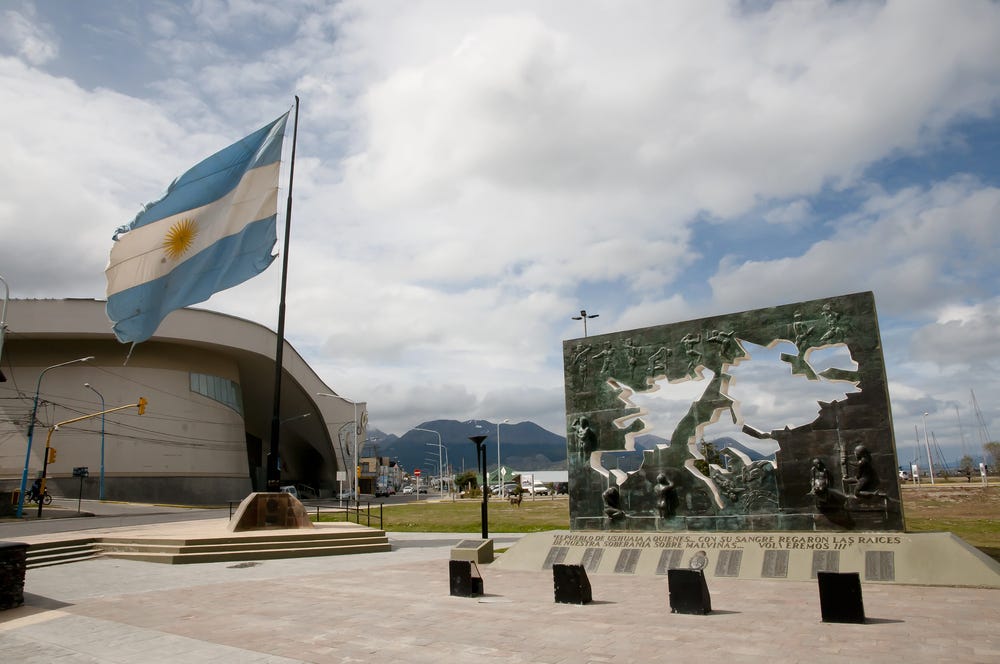
The University of Oregon political geographer Alex Murphy once wrote about territory’s continuing allure (Murphy 2013). In essence, Murphy posited that territorial understandings and practices that developed in lockstep with the modern state system continue to exert significant influence on how the world functions and how state-defined territory itself is conceptualised. In his memorable turn of phrase, there is unquestionably a structural “stickiness” and deep-rooted emotional power which is reproduced by several notable mechanisms. The first is spatial socialisation and how citizens and residents are educated and prompted to identify with a specific national territory (Paasi 1996). This remains an area of concern for popular geopolitics: the way in which seemingly abstract concepts such as political borders and territories (like a nation-state, region, or town) become deeply personal parts of our identity and sense of belonging. This might be inculcated through popular media sources and the celebration of cultural and geographical myths and legends. Paasi’s pioneering work examined the Finnish-Russian border and concluded that memories of territorial losses (such as ceding parts of Karelia to the Soviet Union after World War II) and collective sacrifice offered up a resilient socio-spatial consciousness amongst Finnish people.
Get E-International Relations delivered to your inbox, free. As you sign up, consider becoming a paid subscriber, or make a donation, to support our work.
The second is state-sponsored knowledge production, and that would include maps, school curricula in subjects such as geography and history, and government practices that reinforce the boundaries of that nation-state’s territory. In countries that have outstanding territorial disputes and borders that are not agreed upon, the production of maps remains a highly sensitive matter. In India, for example, all commercial and public maps depicting India’s external boundaries must strictly conform to official maps published by the Survey of India, depicting disputed territories like Aksai Chin and parts of Kashmir as integral parts of the country. Finally, there are regimes of territorial legitimation, the political and legal frameworks that constantly validate and agitate state authority over a particular territory and its borders. The preamble of the PRC Constitution states that “Taiwan is part of the sacred territory of the People’s Republic of China” and calls the achievement of reunification the “lofty” (or sometimes translated as sacred) duty of the Chinese people.
In his original article, Murphy’s “allure” framing used the example of Western Sahara, which has been long occupied by Morocco, to reinforce his thesis. Another example would be Argentina and its long-standing project to recover the disputed Falkland Islands/Islas Malvinas. As the late Argentine political scientist Carlos Escudé argued, Argentine territorial nationalism has reified the Islands as a “lost territory” that must according to the 1994 Constitution be thought of as integral to the Argentine Republic. Since the 1940s, Argentina has devoted considerable institutional and imaginative resources to projecting to its citizens, through various regimes of territorial legitimation and state-sponsored knowledge production, a catalogue of maps, charts, books, and popular cultural objects designed to reinforce the allure of lost territory—lost in the sense of being currently occupied by another power, the United Kingdom. In April 1982, the Argentine military regime invaded the Islands and then retreated from them after military defeat in June 1982. Henceforth, successive Argentine governments have faced a near-constant dilemma—how to recover those Islands without going to war again?
In 2011, we co-authored an article revisiting Carlos Escudé’s notion of Argentine territorial nationalism, in which we built on a coterie of work on banal (Billig 1995) and everyday nationalism (Jones and Merriman 2009), to argue that territorial nationalism needs to be understood as a diverse phenomenon. In a country as large and complex as federal Argentina, the scale, scope, and intensity of territorial nationalism vary across the country and depend on wider political events and agendas in the southwest Atlantic and Latin American region. Interviews and in-field observations, some of which involved young people in Buenos Aires, suggested to us that geographical location, personal/familial connections with Argentina’s southern provinces and the Islands played a part in that identification with territorial nationalism, as did generational differences. Whether there was lived memory of (or direct familial connections with) the 1982 conflict over the Islands was another key factor for many interviewees.
The fieldwork revealed that when asked directly about the Islands, young interviewees would readily acknowledge their importance within the Argentine geographical and political imagination. When asked about their significance relative to other priorities facing the Republic, the Islands were less likely to be described as a national priority. But what Escudé recognised in the 1980s and 1990s was that political elites in Argentina could draw upon state-directed educational indoctrination and circulation of historic “myths” to forge a public fixation on “lost geography” over and above pragmatic national development (Escudé 2008). In his view, Argentina helped to create the grounds for this indoctrination by using state education, public culture, and international posturing to highlight the importance of recovery of the Islands from the UK. Despite successfully expanding outwards in every direction in the 19th century, the country was smarting, albeit with varying degrees of intensity and political-diplomatic focus, from the UK’s occupation and annexation of the Islands in 1833—the Peronist era of the 1940s and 1950s was arguably one of those periods when the recovery of the Malvinas assumed extraordinary importance. Escudé was perhaps the most persistent well-placed Argentine critic of what could be framed as an obsessive territoriality because Argentina’s quest for territorial recovery and spatial control was never completed, and in his eyes, even a compulsive project. During the Menem years of the 1990s, Escudé was a Foreign Ministry adviser to Guido di Tella and notoriously went into the Foreign Ministry building wearing a badge suggesting the Falkland Islands were British.
Geography textbooks, postage stamps, weather forecasts, murals, and formal legislation regarding official maps of the Argentine Republic reinforce the notion that there are three elements of the country—continental Argentina, the South Atlantic islands and Argentine Antarctic Territory (Dodds 2002, Vidal 2023). Anyone visiting Argentina will notice the nation-state’s territorial extent depicted through the “bi-continental map”. The bi-continental map itself is widely distributed to schools and what it depicts is the demarcation of the “complete” nation, including its continental shelf (Benwell 2014). Law 26,651, passed in 2010, mandates the use of the bi-continental map in all educational institutions, national public agencies, and provincial offices. Much of this mapping impulse actually dates to the 1940s and the Peronist era. The Instituto Geográfico Militar (now known as the Instituto Geográfico Nacional) began including parts of Antarctica on official Argentine maps from around 1940 onwards. This was important because by 1946 the formal longitudinal boundaries of an Argentine Antarctic Territory were set—and that in turn meant that the AAT substantially overlapped with the Falkland Islands Dependencies (now British Antarctic Territory).
In recent months, the current Argentine president Javier Milei has elevated the profile of the Islands in Argentina and beyond. Elected in December 2023, Javier Milei is an unconventional radical right-wing president who has framed himself as someone comfortable with shattering shibboleths and breaking the mould of Argentine politics. His team engaged lobbying firms in the US such as Tactic Global and Corcoran Partners with the expressed intention of cultivating closer relations with the Trump administration and has championed a strong relationship with Israel. In 2024, Trump described Milei as a “MAGA person”. The Argentine president’s administration has had more than a few challenges to navigate, including austerity and a cost of living crisis for ordinary Argentinians, corruption scandals and concerns that the global uber-wealthy are purchasing property in Buenos Aires and rural land outside the federal province.
Paradoxically, perhaps, Milei was not considered to be a president who was particularly interested in the Malvinas compared to Cristina Fernández de Kirchner (2007–2015). At the start of his presidential term, there were signs that he would support a warmer relationship with the UK including on the Falklands/Malvinas sovereignty dispute. That altered in the first half of 2026 when President Trump’s officials indicated that the historic position of the United States might shift from neutrality on the disputed ownership of the Islands into one that was arguably more favourable to Argentina. For the last 40-plus years, the UK has been the net beneficiary of this policy stance because it meant that the UK was able to develop military deterrence on the Islands and support the Falkland Islands Government in building and sustaining its highly lucrative fishing-licensing economy.
Milei’s decision to harden his stance towards the Islands is an indicator that Argentina’s reported fixation has not been a constant. Between 1982 and 2026, multiple presidents have addressed it either in a co-operative frame or a more direct and confrontational manner. The most co-operative period was arguably in and around the signing of the 14th July 1999 Joint Statement, which came in the direct aftermath of a period of considerable instability, following the detention of former President Pinochet of Chile in London in late 1998. Pinochet’s detention set off a series of consequences including the regional isolation of the Islands as air links between Chile and the Falklands were suspended for up to 6 months. The Joint Statement addressed non-living resources and created a framework for joint oil exploration, but this was rescinded later in 2007. Oil has, in the past, been a “hot” issue for Argentine nationalists because it rekindles the firm belief that the UK’s decision to send the task force to the Islands in 1982 was a resource calculation rather than for community defence.
Milei’s recent decision to very publicly and loudly voice opposition to the Sea Lion project in the waters to the north of the Islands needs to be seen in this context. To allow extraction of resources to go unchallenged would be unthinkable. The Sea Lion field is estimated to hold up to 1.7 billion barrels of total oil (with around 313 million barrels in proven/probable Phase 1 reserves), and a joint venture between British firm Rockhopper Exploration (35%) and Israeli-backed Navitas Petroleum (65%) expects to start exploiting the field in 2028. The Argentine administration denounced the drilling as an “illegal plundering of our resources” on the Argentine continental shelf. London and the Falkland Islands Government maintain that the companies hold valid, lawfully issued local licenses. An Argentine federal court in Tierra del Fuego issued a preliminary suspension order blocking drilling and infrastructure work pending an environmental review, and the country has pledged to sanction any companies/individuals involved in the project and will pursue the matter via the International Tribunal for the Law of the Sea. In addition, the fishing licensing regime around the Islands—central to the Falklands’ economy—has also come under scrutiny in Milei’s draft national sovereignty bill, which looks set to target affiliates of companies involved in exploiting this mobile resource in a shared southwest Atlantic.
Each time an Argentine president shifted to a less cooperative stance on the sovereignty dispute, it has provoked accusations from some British and Falklands-based commentators that Argentina is being unreasonable and even irrational. This reveals a fundamental schism—the UK considers the matter of sovereignty settled once and for all in 1982, whereas Argentina considers the matter outstanding and does not accept the British title to the territory. The net result is that Argentina has come to appreciate that the longer the post-1982 status quo prevails, the harder it becomes to galvanise support for change. Under Trump, Argentina has its greatest opportunity to alter the political balance in its favour because he has been so critical of the UK’s unwillingness to support the US in its campaign against Iran. Trump has also championed an ambition for the US to secure Western Hemispheric dominance and pressured Denmark to enter into a new defence agreement with Greenland, which has facilitated further military base development.
President Milei, then, could be construed as capitalising on a tactical opportunity presented to him by President Trump. He might also think that Trump’s obsession with Western Hemispheric dominance is an opportunity to recast, yet again, Argentina as a reliable security partner. This could help the US secure the Drake Passage as a chokepoint, in the process deterring China, and enable Argentina to capitalise on Trump’s misgivings about the UK as a reliable security partner. Milei has placed greater store on accelerating plans to develop the joint integrated naval base in Ushuaia, which further signals the closeness of the relationship between Argentina and the US. Notably, in a speech at the UNGA in September 2026, Milei was dismissive of the body, denouncing it as “looking the other way” and failing to enforce its own resolutions, referring to the Falklands as an illustrative example of what he called the UN’s “incapacity.” The President invoked UN Resolution 3149, from 1976, which calls on both countries to refrain from unilateral changes to the Islands’ status while the sovereignty dispute remains open, including the exploitation of natural resources. He argued that:
What good is a resolution if for decades the other party can act in the opposite direction and that resolution remains intact in the archives, but powerless against reality?
The International Tribunal does lack direct enforcement powers, but, mindful of the example of the British Indian Ocean Territory and the Chagos Islanders, Argentina might well think (however wishfully) that an affirmative emergency order from the Tribunal would be consequential. An initial deal (now under review by the Labour government) to hand over the BIOT to Mauritius came directly after an advisory ruling from the ICJ in 2019 that the UK’s separation of the Chagos Archipelago from Mauritius in 1965 was unlawful.
In the aftermath of the semi-final with England at the 2026 FIFA World Cup, the “Las Malvinas son Argentinas Malvinas” banner held by members of the Argentine football team resurrected a well-known trope about the country and its peoples. It was commonplace to read, as far back as the 1950s in the UK’s Foreign Office papers, of Argentina being prone to hysteria and paranoia, especially during the Peronist era (Dodds 1994). Argentina (and its players/staff) were once again the out-of-control, unreasonable rule-breakers. Another way of thinking about it is that, whatever the subsequent FIFA sanctions (which were limited to individual player suspensions and fines), this purportedly spontaneous action had several advantageous consequences for the exposure of Argentina’s territorial claim. High-profile Argentine veteran and author Edgardo Esteban pointed out “[t]he World Cup is now over, and yet people are still talking about the Malvinas because the Malvinas somehow became part of the World Cup… Kids in schools are asking me, ‘What’s this Malvinas thing?’ Now there’s a passing of the torch.” This spike in interest among younger generations at home was matched internationally as “[g]lobal Google searches for the Malvinas surged by 2,400%... marking the largest increase in search interest since the platform began tracking data.” Then, in September 2026, President Javier Milei delivered a 15-minute televised speech to the nation. The speech focused on the Falkland Islands (Islas Malvinas), reiterating their status as an integral part of Argentine national territory, and announced the measures Milei’s government would take to defend their claim.
While there is no doubt that Argentine territorial nationalism is shaped by a geographical and cartographic consciousness, Argentina and the UK both share a highly developed geo-strategic view of the South Atlantic and Antarctica. Both countries understand that their territorial disputes are interlinked—the Falklands, South Georgia, and the Antarctic Peninsula region. The UK has a tethered approach that uses air and sea links between its overseas territories (airbases in the Falklands and Ascension Island are critical here) via the connective power of the British Antarctic Survey (BAS), the Royal Air Force and Royal Navy. To further reinforce these linkages, the Falkland Islands governor serves as the ex officio Commissioner for South Georgia and the South Sandwich Islands, and BAS uses the Falklands as a logistical gateway and staging hub to support operations further south.
The logistical complexities of maintaining these long-distance connections mean that UK emergency planning for the Islands in the future will need to quickly pivot to two things: First, ensuring that Uruguay is able and willing to remain a support hub for the air-bridge run between Brize Norton-Ascension-Mount Pleasant (Falklands). Montevideo is the primary medical evacuation and tertiary care hub for the Falkland Islands. Chile is the other vital link—and that airlink depends on being able to cross in and out of Argentine airspace. Access could be shut again as it was briefly in 1999. A maritime link between Punta Arenas in the south of Chile and the Falklands has also been mooted but is sure to be geopolitically sensitive in Argentina. Second, the air service from the UK via Ascension to the Falklands used to be operated by the RAF, but various third parties have taken over in recent years, from Air Tanker to Hi Fly. Ascension Island is a UK overseas territory, but the Wideawake Airfield is run jointly by the RAF and US Space Force. The airfield is controlled by the UK’s British Forces South Atlantic Islands, but the facilities are run by US contractors, making its operation more vulnerable to changes in US foreign policy.
Argentina, on the other hand, continues to emphasise its geographical and geological connections to its southwest Atlantic and Antarctic territories. One of the interesting geopolitical oddities dating back to the 1970s was the role of anti-communist and strategic alliances between Argentina, South Africa, and Israel. President Milei’s cultivation of the strategic relationship with Israel is not predicated on the resurrection of that alliance per se, but it does recognise the importance of Israel as an exporter of advanced military technology and a long-term ally of the US. The great Argentine miscalculation of 1982 was to misjudge not only the capacity and willingness of the UK to respond but what Buenos Aires hoped would be the ambivalent role of the US. Milei is arguably choosing this moment in the hope of capitalising on the perceived ambivalence of another US administration. President Milei hopes that there is sufficient common strategic ground between Argentina and the US such that it might deliver a series of tactical advantages that impose higher costs on the UK and directly on Falkland islanders. Every Argentine President assumes the constitutional responsibility to “recover” the territories in the southwest Atlantic, but how they do it is of course subject to choice. President Trump has offered an opportunity to his self-described “favourite president” in this regard.
Can Milei’s recent actions simply be explained as those of an incumbent Argentine president playing the Malvinas card, summoning Argentine territorial nationalism in the southwest Atlantic and beyond, ahead of forthcoming presidential elections in 2027? This is one popular reading that many British-based commentators have propagated, and one that is especially seductive given the historical precedents. And yet, Argentines do not perceive and respond to territorial nationalism in uniform ways, as we have previously argued. Indeed, the electoral gains for Milei will likely be negligible given many have expressed scepticism at his sudden awakening on the sovereignty question in the southwest Atlantic. Another framing might simply be that this is clear-eyed geopolitical opportunism. Milei’s diplomatic approach aligns with Trumpist geopolitics which centres on dominating strategic chokepoints—the US currently has a strong relationship with Argentina, and recognises the strategic importance of countering China and having a military footprint in the southwest Atlantic including the Drake Passage. Meanwhile, the UK has overseas territories in the Americas, including Bermuda and the Falkland Islands, which could come on the radar of a US administration unapologetically keen on pursuing a “Greater North America” and “western hemispheric dominance”.
In an era of great power geopolitics where “special relationships” appear to be especially fragile, and as the influence of multilateral institutions is diminishing, Milei’s Falklands/Malvinas strategy could arguably be construed as a case of head over heart.
Dr Matthew C. Benwell is Reader in Human Geography in the School of Geography, Politics and Sociology at Newcastle University. He has broad interests in different aspects of political geography, including the geopolitics of the UK Overseas Territories with a particular focus on those subject to sovereignty disputes.
Professor Klaus Dodds is Professor of Geopolitics and Dean of the Faculty of Science and Technology at Middlesex University and a Fellow of the Academy of Social Sciences. He has published many books and articles concerned with the geopolitics and governance of the Polar Regions, as well as the cultural politics of ice.