

This is an excerpt from Critical Terrorism Studies: A Dictionary by Lee Jarvis and Alice Martini. Available in all good book stores, and via free download from E-International Relations.
Get E-International Relations delivered to your inbox, free. As you sign up, consider becoming a paid subscriber, or make a donation, to support our work.
Antonio Gramsci
Antonio Gramsci (1891–1937) was an Italian Marxist journalist and theorist famous for his concept of hegemony, which he developed while imprisoned by the Mussolini regime. Unlike traditional Marxist perspectives with their emphasis on economic structures as the primary force of domination, Gramsci argued that power is maintained through consent as well as coercion. He introduced the idea of hegemony, in which a ruling class secures its dominance by shaping societal values, norms, and beliefs in ways that make its rule appear natural, inevitable, or even desirable. Power, approached thus, is reproduced via cultural narratives and practices that are circulated through influential and authoritative social institutions such as education systems, the media, and religion. The worldviews that these institutions reproduce – and the class privilege they maintain – help to reinforce ruling-class ideology, and prevent alternative ideas from gaining traction. Gramsci’s work has had a powerful impact on a wide range of fields including International Relations and International Political Economy.
For Critical Terrorism Studies, Gramsci’s theory of hegemony highlights how dominant security discourses are constructed, normalised, and legitimised. Counterterrorism policies, for example, often reflect hegemonic understandings of security, where state violence is framed as necessary and legitimate and non-state violence is criminalised and delegitimised. Similarly, hegemonic views on terrorism reproduce racialised and gendered interpretations of political violence, while sidelining others, such as the interpretation of far-right violence as terrorism. CTS has been criticised for not engaging more deeply with Gramscian theories of hegemony. Nonetheless, some significant contributions have used Gramsci’s work to study counterterrorism and the functioning of P/CVE programmes (e.g. Kaleem 2021).
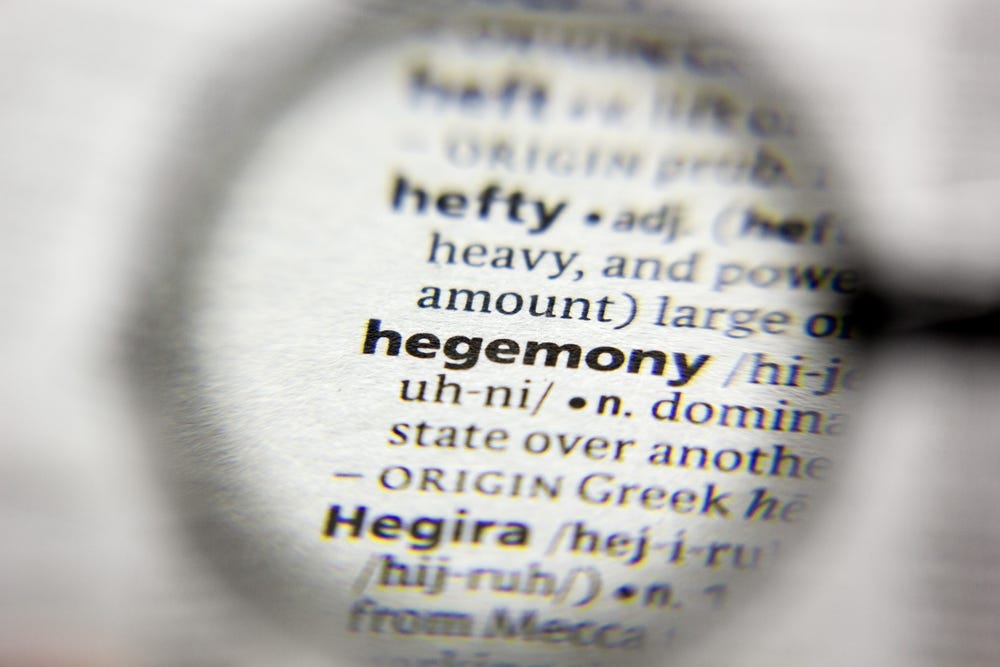
Hegemony
Hegemony is a widely-used concept within the social and political sciences. In International Relations, it achieved prominence through the framework of ‘hegemonic stability theory’: a conceptual argument that one particularly powerful state actor could create a less divisive international order by offering economic, military or other incentives to smaller powers making them less inclined to disrupt the system. These incentives might include international institutions or ‘norms’ – accepted ways of behaving – that benefit weaker states as well as their powerful counterparts. The post-World War II period is often described as an era of hegemonic stability, with the United States – a superpower – active in the creation of new global organisations such as the UN and World Bank.
In Marxian scholarship, hegemony is widely associated with the writings of Antonio Gramsci – who put similar emphasis on the importance of governing through consensus. Particularly important for Gramsci was the power of ideas to create consensus, whereby ruling elites were successful in shaping the interests of others. Where Gramsci’s writings focused on the creation of hegemony – and therefore order – within particular states, authors such as Robert W. Cox – a key exponent of critical theory – were key in applying these ideas to the international system in disciplines such as International Relations and International Political Economy. A related approach to hegemony is found in the post-Marxist writings of Ernesto Laclau and Chantal Mouffe. Drawing also on Gramsci, they approach hegemony as the successful, but always partial, stabilisation of meaning by a particular political entity. One example of this might be the widespread acceptance gained by the war on terror as the necessary and inevitable response to the 9/11 attacks.
Critical terrorism scholarship engages with the concept of hegemony in a couple of different ways. For some authors, such as Amna Kaleem (2022), it offers a useful way of understanding the normalisation of particular forms of counterterrorism such as found within the expansion of counter- radicalisation initiatives aimed at pre-emptively stopping the terrorist threat. When initiatives become hegemonic, they are much more difficult to challenge or critique, becoming the normal way of countering terrorism. Other authors use the term to explore how particular actors have contributed to a commonsensical or taken-for-granted understanding of terrorism (e.g. Herschinger 2012; McGowan 2016). Related work, finally, looks at constructions of terrorism through the lens of ‘hegemonic masculinity’ – particularly privileged ideas of what it means to be male within specific contexts such as in the context of the far-right (Frenguielli 2024) or the Kurdish Workers’ Party (PKK) (Türk 2020).
Further Reading
Gramsci, Antonio. 2012. Selections from the Prison Notebooks of Antonio Gramsci. London: Lawrence & Wishart.
Herschinger, Eva. 2013. “A Battlefield of Meanings: The Struggle for Identity in the UN Debates on a Definition of International Terrorism”. Terrorism and Political Violence 25 (2): 183–201.
Kaleem, Amna. 2022. “The Hegemony of Prevent: Turning Counter-Terrorism Policing into Common Sense”. Critical Studies on Terrorism 15 (2): 267–289.
Martini, Alice. 2021. The UN and Counter-Terrorism. Global Hegemonies, Power and Identities. Abingdon: Routledge.
Lee Jarvis is a Professor of Security and Society at Adelaide University, and holds honorary professorships at the Loughborough University and the University of East Anglia. He is author or editor of 17 books and over 60 articles on the politics of terrorism and security. He is co-editor of Critical Studies on Terrorism, and his research has been funded by the ESRC, the AHRC, the Australian Research Council and NATO among others.
Alice Martini is a Lecturer of International Relations at the Complutense University of Madrid, Spain, and holds an honorary professorship at the Queen Mary, University of London. She is the author of The UN and Counter- Terrorism: Global Hegemonies, Power, and Identities (Routledge 2021), and co-editor of Encountering Extremism: Theoretical Issues and Local Challenges (Manchester University Press 2020) and Contemporary Reflections on Critical Terrorism Studies (Routledge 2023). Her work has been published in journals including Security Dialogue and Third World Quarterly.
This is an important contribution because it reminds us that before we analyze a phenomenon, we first have to define what we are actually looking at.
From a field perspective, definition is not a purely academic exercise. It shapes observation, influences analysis, and can ultimately affect the response.
Terrorism is a particularly difficult example because the same act can be interpreted differently depending on the actor, context, time, and political framework surrounding it.
That is why I find the critical approach valuable: it forces us to examine not only the phenomenon itself, but also the framework through which we are observing it.
In the field, the first question is often not “What should we do?”
It is: “What exactly are we looking at?”
If the definition is wrong, the analysis can begin on the wrong ground — and everything that follows may be affected.
— Wahidullah Noorzai
Former Senior Military Officer | Field Strategist | Regional Security Analyst