

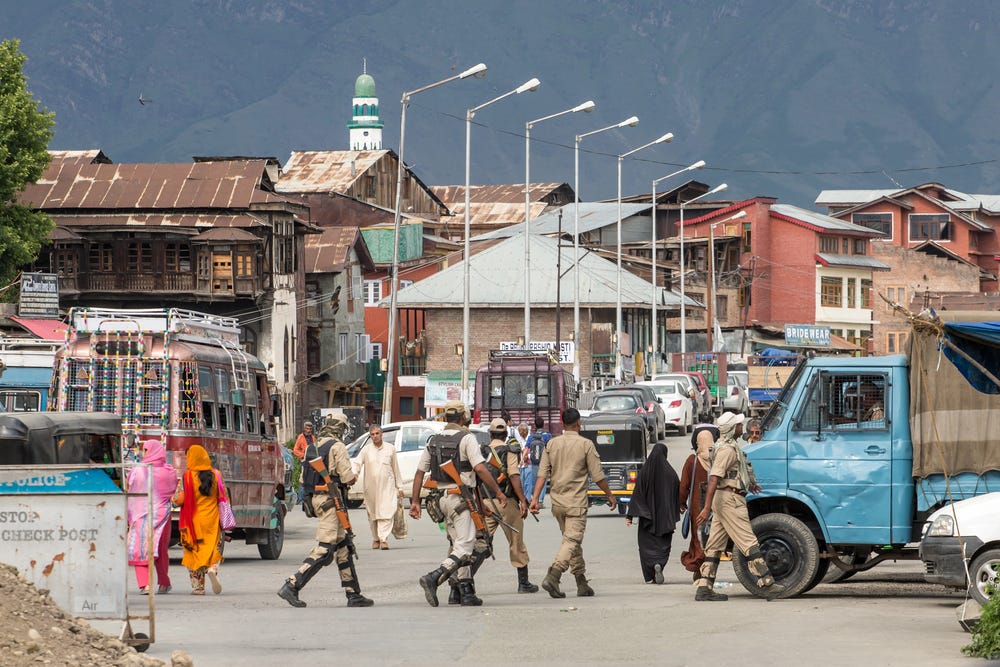
Since 1947, the Kashmir issue remains the most obstinate between nuclear rivals Pakistan and India. Pakistan controls around 30% of the disputed land while India controls around 55% of it (Pakistan ceded the remaining 15% of the territory to China). Both countries have fought three wars over Kashmir and the area is infamous for being the world’s most militarized zone and the oldest unresolved international conflict. Following the 1947 war over Kashmir between Pakistan and India, UN resolution 47 was passed on 21 April 1948, asserting that the issue must be resolved through a free and fair plebiscite. The Indian government under Nehru promised that a plebiscite would be conducted per the will of the Kashmiri people, but this never transpired. In fact, since 1947 India has ruled Kashmir with either a sham democracy or an iron fist. The insurgency and freedom movement can be categorized broadly into 3 cycles: (1) 1989–2004, (2) 2008–2019 and (3) 2019–present.
Get E-International Relations delivered to your inbox, free. As you sign up, consider becoming a paid subscriber, or make a donation, to support our work.
The 1989–2004 Militancy
Since 1948, Delhi maneuvered around the “plebiscite” question and instead relied on co-opting Kashmiri politicians to dissuade the Kashmiri freedom movement. Due to rigged elections, Delhi-controlled prime ministers, and nepotism throughout the decades since 1947, Kashmir was simply a mock democracy. Indian machinations to subdue Kashmiri desires for an independent homeland, however, backfired and Kashmiri frustrations with Delhi steadily increased until it reached the proverbial point of no return. The 1987 sham legislative elections were the straw that broke the camel’s back. The Congress-backed Farooq Abdullah, son of Sheikh Abdullah, became the chief minister and formed a coalition government – however, his government lacked legitimacy among Kashmiris and the Kashmiri freedom movement turned militant. The insurgency is believed to have been a product of the massive electoral rigging sponsored by Delhi, in addition to Pakistan fanning the flames by giving largesse and equipment to the insurgents. In 1991, the Kashmir Valley resonated with the sounds of gunfire and explosions as young men wielding AK47s roamed the streets of Srinagar and other major towns.
Initially, the Yasin Malik-led JKLF (Jammu and Kashmir Liberation Front) rose to prominence in the insurrection. The JKLF demanded a separate and secular Kashmir, independent from both India and Pakistan. Bandhs (shut-downs) and Hartals (strikes) became commonplace – and so did JKLF-sponsored bomb blasts, attacks on government buildings, and assassinations. The response from Delhi was equally brutal. Indian security forces, from the police to the army, on many occasions, used indiscriminate means to combat the insurgency – killing insurgents but many civilians as well. The use of draconian laws (that are still present in Kashmir today), such as the Armed Forces Special Powers Act (AFSPA), was extended to J&K in 1990, which bestowed upon soldiers “a free pass to kill.” In areas determined as “disturbed”, the act permits shoot-to-kill, arrest, and search without a warrant. If this was not abhorrent enough, the Act also immorally shelters security forces personnel as it grants them impunity from civil prosecution. Human Rights Watch, Amnesty International, and other groups have repeatedly called for its repeal until today.
Notable Indian forces’ human rights violations during this time include the Gawkadal massacre, which saw Indian paramilitary forces killing 50 Kashmiri protesters (but survivors state the number could be close to 300); the Sopore massacre, where 57 Kashmiris were killed by India’s Border Security Force; and the Bijbehara massacre, where 51 civilians were killed by Indian forces.
Human rights violations also occurred on the other side of the camp. The JKLF and other militant groups targeted the native Kashmiri Pandits (Kashmiri Hindus), and the violence forced a mass exodus of the Pandits. Islamist groups identified Pandit homes so the latter could be killed or converted. Due to the continued persecution of the Pandits and their killing at the hands of the JKLF and others, around 100,000 out of the total 140,000 Pandits left the valley in the 1990s (according to conservative estimates).
Eventually, however, the JKLF slowly eroded due to Indian counterinsurgency operations and took a back-burner position in the movement. This vacuum was filled by the pro-Pakistan Hizbul Mujahideen (HM). Pakistan desired to support an insurgent group that was loyal to it and bellowed “Kashmir banega Pakistan” (Kashmir will become Pakistan) rather than the JKLF’s “Kashmir banega khudmukhtar” (Kashmir will become independent). In 1991, Pakistan focused its aid on the HM while engineering defections and schisms in the JKLF. The HM cadre, mostly comprised of Kashmiris, would cross the LoC (Line of Control) to get weapons and training from Pakistan-administered Kashmir. After the Soviet defeat by the Afghan mujahedeen in 1989, many non-Kashmiri “jihadis” also became part of the Kashmir insurgency and, in essence, hijacked the movement. This means that during this period, many madrassa-educated mujahedeen from Afghanistan had infiltrated J&K to fight against India. Therefore, the movement started acquiring a different shape due to, in part, the Pakistan factor and also due to the Islamist influence of the mujahedeen who defeated the Soviets.
The aforementioned factors eventually proved detrimental to the Kashmiri movement, as many Kashmiris saw this iteration of the movement as exported or foreign and discerned the meteoric inflow of guns and violence as unfavorable. These factors, coupled with effective Indian counterinsurgency efforts, albeit regularly indiscriminate and violent, saw the movement dwindle. In the mid-1990s, many insurgents either dropped their weapons or chose to collaborate with Indian security agencies. The JKLF, once the leader of the movement, promised to continue their struggle peacefully. The HM, although still active today, lost its zeal in the mid-1990s due to a war of attrition with the Indian security forces.
In 1993, the All Parties Hurriyat Conference was formed, which consisted of 26 parties seeking Kashmiri separation from India. Later on, the Hurriyat split into two factions – one that actively seeks a merger with Pakistan, while the other is pro-independence. Both, however, want to rid Kashmir of Indian occupation and remain an integral player in the Kashmiri socio-political landscape.
After the movement lost its intensity, there were a few “fidayeen” attacks (around 50) that took place from mid-1999 to the end of 2002, conducted by insurgents on both security and civilian targets. These attacks were conducted by groups like Lashkar-e-Taiba (LeT), which allegedly had Pakistan’s support. These attacks were mostly conducted by non-Kashmiris, however. Although the violence paled in comparison to a few years ago, the psychological impact of the fidayeen attacks should not be scoffed at.
The aftermath of the September 11 attacks changed not only the Kashmiri freedom movement but also the world. Pakistan was heavily pressured by the US to withdraw support to proxy groups – and the country was practically forced to side with America. In 2004, Pakistan under President Musharraf began to end its support for the insurgency. Although Pakistan was rewarded handsomely for its support to America in the war on terror, soon after the country became embroiled in its own insurgency as many anti-American militant groups turned anti-Pakistan. This further diminished the militancy aspect of the Kashmiri freedom movement, as Pakistan began fighting a war against militants within its own borders.
Stone Pelting & The Burhan Wani Period (2008–2019)
Kashmiri animosity against Indian authority never perished but lay dormant for some time. In 2008, the valley witnessed its largest anti-India demonstration since 1994. Hundreds of thousands of men, women, and children made their voices heard in the streets of Srinagar against Indian authority and crimes. Indian security forces were, as always, heavy-handed in responding to the protests and killed many innocent people. In this phase of the freedom movement, the Kashmiri people’s weapon of choice became the stone rather than the gun. The Kashmiris made stone-pelting their own as much as the Palestinians have against Israel in their quest for freedom.
Pakistan’s involvement was partial during this period. Pakistani rhetoric was the same as in the past, i.e., “Kashmir is the jugular vein of Pakistan”, but not much was being done on the diplomatic front or even surreptitiously. The Economist stated how the Kashmiri freedom movement had evolved: where in the past innocent Kashmiris died because of the war between Indian security forces and Pakistan-assisted insurgents, now stone-pelting Kashmiri civilians were being killed by Indian paramilitary forces and police.
The militancy aspect during this phase remained muted, but despite this, India increased its military presence in the valley instead of trying to peacefully integrate Kashmir with the rest of India. Arundhati Roy, the Indian Booker Prize-winning author, stated that the huge number of soldiers that have been stationed in the Kashmir Valley were there solely to keep the rebellious civilian population at bay and not to fight a few poorly-equipped militants.
Even though militancy remained low in the valley, Kashmiri civilians showed their support to the limited number of armed Kashmiris fighting Indian authorities. In fact, since 2014, India was rattled by the fact that Kashmiri civilians came in between insurgents and security forces during gunfights to aid the escape of the outgunned and outnumbered insurgents. Some commentators stated that if it were not for the support of the local Kashmiris – around 6 million in the valley – the Indian security forces could easily “round up and wipe out the 200-odd armed insurgents” in half a day. In 2015, 2016, and 2017, over 300 Kashmiri civilians were killed by Indian security forces across various operations.
In 2016, a watershed moment transpired that changed the Kashmiri landscape. It resonated loudly within the hearts of many Kashmiris and defined this phase against India. Indian security forces killed a beloved youth insurgent commander named Burhan Wani. Burhan Wani was a Hizbul Mujahideen leader who had leveraged social media to become popular amongst the Kashmiri youth. His death plunged the valley into chaos with mass civilian unrest. Police stations were attacked by mobs and buildings were set ablaze. The Indian crackdown on the civilians was brutal: hundreds of people were killed and many more blinded. The security forces relied on the use of pellet shotguns to disperse civilian protests. According to an Indian newspaper, at the end of August 2016, nearly 6,000 civilians had been injured – of them, 927 had suffered eye-related injuries. Counterproductive to Indian interests, the killing of Burhan Wani and this crackdown made hopeless Kashmiris turn to militancy (which was previously low before his death). Therefore, stone pelters and a new wave of militants had become the focal point of the insurgency. Unlike the 1989 insurgency, which was hijacked by Islamist non-Kashmiris, this time even educated Kashmiri youth turned to militancy. According to an Indian army official, 191 young Kashmiris joined armed groups in 2018 – the number of recruits in 2013 (before the BJP came to power) was only 16.
The killings and mass blinding of Kashmiris, sustained curfews, augmented Indian security presence, as well as other human rights violations by security forces, have risen since the BJP’s re-arrival in 2014. In fact, 2018 was Kashmir’s deadliest year since 2008, with 160 civilians being killed. Furthermore, commentators, Indian and otherwise, alleged that since Modi became prime minister in 2014 and his re-election in 2019, India was withering as a secular democracy and instead was becoming a Hindu Rashtra (nation) – the end goal of the BJP.
In mid-December 2018, Indian security forces killed seven innocent Kashmiri protesters, marking it as one of the bloodiest days for Kashmiris in recent memory. Modi also placed a curfew and media blackout in the valley so that atrocities could not be broadcast to the world. In the previous cycle, while India was to blame, it had a reasonable excuse and a culpable party in Pakistan; this time, however, the anti-India hatred was primarily due to its own wrongdoings. As aptly stated by Indian historian and professor, Mridu Rai: “the oft-asserted contention that Pakistan has created the turmoil in Kashmir ab nihilo is unconvincing.” The Pulitzer Prize-winning journalist Jeffrey Gettleman wrote that where once Pakistan supported militancy in J&K, “Now, the resistance is overwhelmingly homegrown.” He asserted that the Kashmiri conflict today is shaped less by geopolitics than by “internal Indian politics, which have increasingly taken an anti-Muslim direction.” India, however, refused to accept this as the case even though scholars, from India and abroad, stated otherwise.
The most infamous militancy-related incident in this phase was the 2019 Pulwama attack, where 40 security personnel were killed via a suicide bomb by Adil Dar, a local Kashmiri youth. A seismic shock, this attack initially led to mudslinging between Pakistan and India and eventually climaxed in the 2019 Pakistan-India military standoff. The standoff ended when an Indian MiG-21 was downed by Pakistan, and its pilot Abhinandan, was captured.
Hybrid Militancy: 2019–Present
After the Burhan Wani incident and the Pulwama attack, India made a seismic policy shift that enraged Kashmiris. To fulfil its Hindutva (far-right Hindu ideology) objectives and keep its campaign promises, the BJP revoked J&K’s Article 370 and 35A from the Indian Constitution. The former allowed J&K to make its own laws for most subjects, while the latter forbade outsiders from, inter alia, permanently settling, buying land, and holding local government jobs in the region. India removed J&K’s state status and divided the region into two union territories – Ladakh and J&K; a move that angered Pakistan and China. This was a landmark decision that eventually ushered in a new phase of militancy.
The BJP presaged that the abrogation of the articles would lead to ensuing chaos in the valley and so imposed a curfew for months – including an internet shutdown for 558 days, which is considered the longest for a democracy. During the protests, India arrested hundreds of activists and political leaders. Severe media and internet restrictions were placed to curb militancy, but this failed in the long run. The BJP government buttressed its 500,000-strong troop presence in the region by adding tens of thousands of additional troops. Due to the curfew and the spread of COVID-19, things became extremely bleak for Kashmiris. In the first half of 2020, 229 killings took place, including the “extrajudicial executions of at least 32 civilians,” according to the Jammu and Kashmir Coalition of Civil Society (JKCCS).
Due to Modi’s hardline stance against J&K, militancy did reduce; however, a new Frankenstein’s monster arose. The new iteration of militancy is not as consistently active and in-your-face as the first wave. It hides in the shadows and attacks when the opportunity is right. This is because of several reasons, such as increased Indian troop presence, curfews and media blackouts, limited support from Pakistan, aggressive and draconian Indian laws to protect security personnel, etc. This is also exemplified in statistics. In 2001, 2,864 terrorist related incidents took place, while in 2025, 67 took place. This sounds good on paper, but the attacks that do take place were deadly, viewed globally, and proved that anti-Indian hatred has not dissipated as the BJP constantly proselytizes.
Due to the evolving political and security environment in Jammu & Kashmir, the militants too evolved. The current iteration of militants is called hybrid militants due to them living dual lives, which can include them studying or working until they conduct an attack and go back to their normal lives. They are also not known like the militants in the Burhan Wani era as these militants many a time do not have police records and keep low public profile so they are not easily tracked.
New militant groups sprang up during this period who have adopted a secular face rather than wearing a religious mask in order to appeal to the masses and avoid international scrutiny. Groups like The Resistance Front (TRF), Kashmiri Tigers, People’s Anti-Fascist Front (PAFF) and United Liberation Front (ULF) have taken centre stage – they use terms like “settler colonialism”, “occupation”, and “fascism” in reaction to the revocation of Article 370. However, the Indian government sees these groups as offshoots of the traditional religious militant groups such as LeT.
Another facet of this cycle is that the violence has shifted from the Kashmir valley to Jammu, which has a majority of Hindus. Due to the changing demographics (Hindu Pandits and other non-Muslims returning/entering) in Jammu and Kashmir allowed by the revocation of Article 370, the militants have added Hindu, Sikh, and even Muslim civilians as targets. According to the Indian government, 118 civilians, including 5 Kashmiri Pandits and 21 Hindus were killed from August 2019 to July 2022. There have been many instances of civilians being targeted in this phase – for example, PAFF claimed responsibility for killing a BJP municipal councillor in 2021. This is not to say that the militants stopped attacking the Indian military (details ahead), but have enlarged their target scope to scare off civilians from their “homeland” to avoid any future Kashmir plebiscite that would favour the BJP/Indian government.
Militants attacking Hindus and others on religious lines is also ironic when touting a secular badge. The first cycle saw violence against Hindus as well but from a Jihadi and non-secular point of view. In Oct 2021, Makhan Lal Bindroo, a Kashmiri Pandit and famous pharmacist was shot to death – in that same month a total of 11 civilians were murdered including Sikhs, Hindus, and Muslims. The tactic seems to be working as an exodus of Hindu Pandits and others has begun.
This wave of hybrid militancy also heavily relies on social media to get their message across. The Kashmiri Tigers, for example, are active in sharing videos and images of successful ambushes to demoralise the Indian military. The BJP-controlled Indian media, on the contrary, has dissimulated the Indian wrath against Kashmiris and chooses to show ordinary Kashmiris as inherently contumacious. Modi and his government have tried to justify their revocation of the articles by citing that militancy has decreased and Kashmir’s integration has become inevitable; however, this is an affectation at best.
The Indian military too has been hit hard by the militants. In 2022, a fidayeen attack took the lives of four Indian soldiers at Pargal in Rajouri. In 2023, PAFF claimed responsibility for killing 5 army soldiers in an ambush in Poonch. The militants rely on jungle warfare in Jammu to ambush the Indian military and then retreat into the jungles, making it difficult to track them. In 2022, J&K witnessed 253 militancy-related deaths, out of which 30 were security personnel; this number decreased to 134 in 2023, but the proportion of security personnel killed doubled.
The most infamous of the attacks in this cycle was the 2025 Pahalgam attack, where militants killed 24 Hindu tourists. This subsequently brought Pakistan and India to yet another limited and short conflict. Pakistan denied any wrongdoing, and its role remains murky. Obviously, Pakistan cannot outright support outlawed militant groups as it once did due to FATF, international sanctions, and scrutiny post-9/11, as well as domestic issues of its own. However, it is true that cross-border infiltration across the Line of Control does take place. While Pakistan has acted against certain anti-Indian militants on its soil in the past, it perhaps turns a blind eye in certain situations or cannot act against these militants due to them being popular amongst certain quarters domestically.
Conclusion
The Indian government has not given Kashmiris their rights, has denied them their plebiscite, and has provided them no convalescence for decades. Kashmiri resistance is a reaction to this, where at times it has become so belligerent that it takes the lives of innocent Hindu civilians, and at times it is merely the stone thrown by a young Kashmiri boy towards his occupiers. As long as India provides the oxygen to the Kashmiri insurgency, there will always be a Kashmiri resistance movement – either in the shape of a gun or a stone.
Sarmad Ishfaq is the CEO of the think tank, Paradigm Shift. His work has been published by Harvard Kennedy School Review, The Diplomat, OpenDemocracy, Mondoweiss, and Eurasia Review. He has also been published by several international peer-reviewed journals such as Social Identities. Before becoming an independent writer, he worked as a research fellow for the Lahore Center for Peace Research. He has a master’s degree in International Relations from the University of Wollongong in Dubai.