

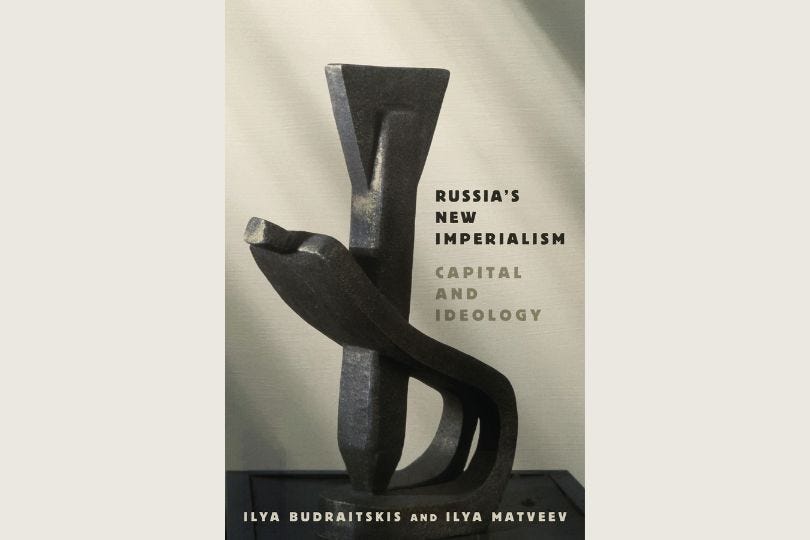
Russia’s New Imperialism: Capital and Ideology
By Ilya Budraitskis and Ilya Matveev
Stanford University Press, 2026
The origins of contemporary Russia’s foreign policy are often attributed to the personal predilections of Vladimir Putin. The aetiology of its violent imperialism is more complicated. Ilya Budraitskis and Ilya Matveev discuss the wider circumference of modern Russia’s dilemma. Less a direct creation of Putin’s imagination, aggressive actions in Ukraine, and elsewhere, are more an expression of Russian society’s nostalgia for a dwindling empire. Facing a pre-eminent China, an economy kaputt, pensions inflated into worthlessness, and foreign exile incredulous, perhaps the only game left is imperialism? Once a guarantee of success, this option cannot hope to generate genuine return on its economic or human investment. Indirectly, this is the conclusion of Budraitskis and Matveev (pp. 167–71). However, imperialism, like any brand of chauvinistic nationalism, is a powerful distraction. Putin manages to repurpose this imagination.
Get E-International Relations delivered to your inbox, free. As you sign up, consider becoming a paid subscriber, or make a donation, to support our work.
Six substantial chapters interrogate the contradictions in Russia’s “imperial syndrome”. Nearly five years after Russia’s Ukraine invasion, Moscow has conquered only modest territory. Over half a million Russian soldiers have died, the economy is trashed, the Kremlin’s relationship with its enemies has rarely been worse, and ambiguity towards its arch-rival, China, only grows. Why does Putin not end what he envisaged as a hopeful special military operation? As part of the answer, Budraitskis and Matveev show the power of immersion politics and societal stalemate (pp. 15–37). They are suggesting a stronger answer may lie in distraction politics, more than the collective neo-imperialism of Putin’s obsession with Russia’s world-historical mission.
However, Budraitskis and Matveev have a still more novel (additional) explanation. It is that Kremlinophobes are torn between two opposing views. One side interprets Russia as a mafia racket of political entrepreneurs, tied to the Kremlin’s goals and accumulating wealth. These Russian entrepreneurs are not ideologues, espousing grand ideas, but see the Kremlin as a casino table at which they must keep playing. Conversely, Russia’s real ideologues suggest they remain an imperialist and nationalist country. So, its proud military culture necessitates subjugation of opponents in a style less of past Kremlin-bosses than of aggrandising Tsars. Both views have had a negative (and ultimately immiserating) impact on the financial disaster and moral stasis that Russia contemplates (pp. 58–79).
Thus, for that second group of thinkers (not the entrepreneurs, but the opportunists), Russia’s unprovoked invasion of Ukraine in 2022 actually manifests a genuine post-Soviet imperialism. Budraitskis and Matveev offer a theoretically well-informed analysis of Russian adventurism, showing the convergence of money and ideology, force and hegemony, desperation and opportunity (pp. 1–13). However, while money partially explains Russia’s current imperialist impulses, the full explanation does not lie in funds alone. Money hardly explains the annexation of Crimea or the instigation of the Donbas separatist insurgency.
Geopolitical developments, like the US and NATO military deployments, offer a more persuasive explanation for Putin’s actions. Indeed, Budraitskis and Matveev argue Putin’s reaction to the Maidan revolution reflected the growth of a self-sustaining, “total ideology” (pp. 1–14). Seen from this perspective, the West returned as Russia’s eternal enemy and Ukraine as a geopolitical pawn in the nostalgic expression of that bitterness. Thus Budraitskis and Matveev explore Putin’s foreign policy as something more ambitious: nothing less than the Kremlin’s project to remake the Russian people to realize an imperialist agenda.
In 1842, Nikolai Gogol portrayed Russia as “a rushing troika hurtling uncontrollably into an unknown future” (pp. 143–44). In his final sentences, all nations and states “stand aside” for the Russia-troika. Almost two hundred years later we found a massive convoy of Russian tanks invading the neighbouring Ukraine, animated by a political imagination that expects history to yield to Russia’s civilizational mission. Budraitskis and Matveev, both “left-wing political scientists”, offer an econometric reading of Russia’s imperialist tendencies (pp. 11–14). They reject the commonly held “misconception” that the invasion of Ukraine is explained purely by security concerns, such as NATO’s expansion, or economic fears. Instead, they identify an increasingly authoritarian “Kremlin mindset” (pp. 10–14). It arose in the wake of a brief 1990s period of dashed post-Soviet liberalism. In this political order, ideology had ceased to be merely a tool of the state and had become a way of perceiving reality itself. Over the last two decades, “Putin-ism” has progressively hijacked all aspects of Russian life—even historical interpretation (pp. 114–16). As its tanks crossed the Ukrainian border, Kremlin ideology was no longer simply justifying the war; it made the war intellectually feasible.
Understanding how this degeneration occurred requires a dissection of current “Kremlin-esque” ideology itself. The year 2012 was critical. Until this point, as Budraitskis and Matveev argue, Putin’s regime had been defined by a “capitalist imperialism” that relied on “economic methods and pursued economic goals”. The former-Soviet space was its primary target for expansion, since the infrastructure established under the USSR survived in the newly independent states. There were protests against Putin’s re-election for a third term. Russia also feared the wave of political revolutions across the Middle East and the Maghreb (the “Arab Spring”), which suggested to Putin that America had a “regime-change agenda” (82–82). This antagonistic-paranoia “blend” is crucial for understanding the Kremlin’s ideological puzzle.
The writers distinguish between “first-level” and “second-level” (or “total”) ideology (56-57). The former resembles workaday political belief—partial, contingent, and capable of recognizing competing perspectives. It emerges from and reflects the collective experiences of a particular social group. Total ideology, in juxtaposition, offers an explanatory universe in which contradictory evidence is not a challenge but actually proof of a conspiracy seeking to destroy it. This ideological “blowback” (pp. 119–121) guided the Russian society and ultimately consumed its creators too, thus making Putin’s persistence credible. Large numbers – particularly the most nostalgic and, conversely, enough of the young and angry – shared his imagination. As Budraitskis and Matveev suggest, the Kremlin gradually ceased treating ideas as useful fictions and increasingly came to act as though they described reality itself (pp. 114–116). The regime and sufficient followers (young and old) have bought Putin’s dream. Ironically, they were persuaded by their own “naked Emperor.”
History occupies the centrepiece of this ideological framework—more precisely, Putin’s own perception of a mythologized version of history. A strong political boss like Putin serves both as history’s teacher and its author. His KGB background, in the mind of the Russian Securitate, bespoke safety and state oversight. Putin’s “Historical Russia” imagines the nation not as a modern state but as a transhistorical civilization, whose existence transcends contemporary borders (pp. 114–122). Russian nationalism, in this sense, is fundamentally civilizational rather than ethnic. The doctrine of the Russkii mir (the “Russian world”) extends a vision of a controlling political community beyond the state’s borders, to encompass all those who allegedly speak or identify as Russian (pp. 66–67).
From this political mentality, sovereignty is fetishised, justifying Russia’s retreat into autarky and effectively insulating the state from external criticism. By this persuasive model, a deviant “sovereignty” bolsters the elite’s claim to independence from external or internal constraint. That absolves them from international law or civil rights at home. This helps explain why Russian economic rationality is repeatedly superseded by ideological commitment. Economic and diplomatic sanctions are not seen as losses, but necessities for affirming Russia’s historical destiny (pp. 54–55). Seen from this angle, as oftentimes said, Putin, like Stalin, understands only the “hard-currency of territoriality”.
Budraitskis and Matveev are loath to speculate on Russia’s future and see it as either fixed or predetermined. In Gogol’s Dead Souls Russia’s past sinfulness was a vital precondition for its moral renewal. Providential destiny and a sense of historical mission certainly animates the Ukraine campaign. It may even underlie the ideologies of historical tradition that Russia’s “new imperialism” anatomizes. Gogol famously burnt large fragments of his book, thereby effectively ceasing to imagine Russia’s redemption. History, unfortunately, seldom grants people the luxury of discarding their inherited “origin stories”. Thereafter it is up to the common people, invariably persuaded by articulate politicians, as to whether enough of the populace continue to believe them. Reading Budraitskis and Matveev, it would seem that Putin still commands a precarious majority of “believers” (pp. 167–172).
For many (but not all) Russians, big is (still) beautiful, so there remains vocal pro-Putin support, despite mounting casualties, conflict-fatigue, and widespread social deprivation (pp. 132–34). Ironically, war created a potent new class of bereaved war “compensees”, psychologically anxious to justify painful family sacrifice. Grief can also provoke entrenchment. While they remain mobilized, there is still backing for the Ukraine operation.
Thus Budraitskis and Matveev suggest that Putin is bolstered by a toxic combination of post-Soviet “adventurist capitalism” and the persuasive myths of “Historical Russia” fused into an ideology of ruthless survival (pp. 167–172). This masterclass of political synthesis perceives the invasion of Ukraine as the finale of a decades-long ideological remaking of Putinism. The authors go beyond realist geopolitics and simplistic Marxist models, to reveal how post-Soviet capitalism, state power, and imperial ideology fuse to nurture an irrational and destructive imperial project (pp. 11–13, 167–172). This is one of the most interesting books of the year about the post-Soviet space. The writers are not hide-bound by their leftist political thinking, and the IR reader will find much of interest about this most seismic of 21st-century political imbroglios.
Martin Duffy has participated in more than two hundred international election and human rights assignments since beginning his career in Africa and Asia in the 1980s. He has served with a wide range of international organizations and has frequently been decorated for field service, among them UN (United Nations) Peacekeeping Citations and the Badge of Honour of the International Red Cross Movement. He has also held several academic positions in Ireland, UK, USA and elsewhere. He is a proponent of experiential learning and holds awards from Dublin, Oxford, Harvard, and several other institutions including the Diploma in International Relations at the University of Cambridge.