

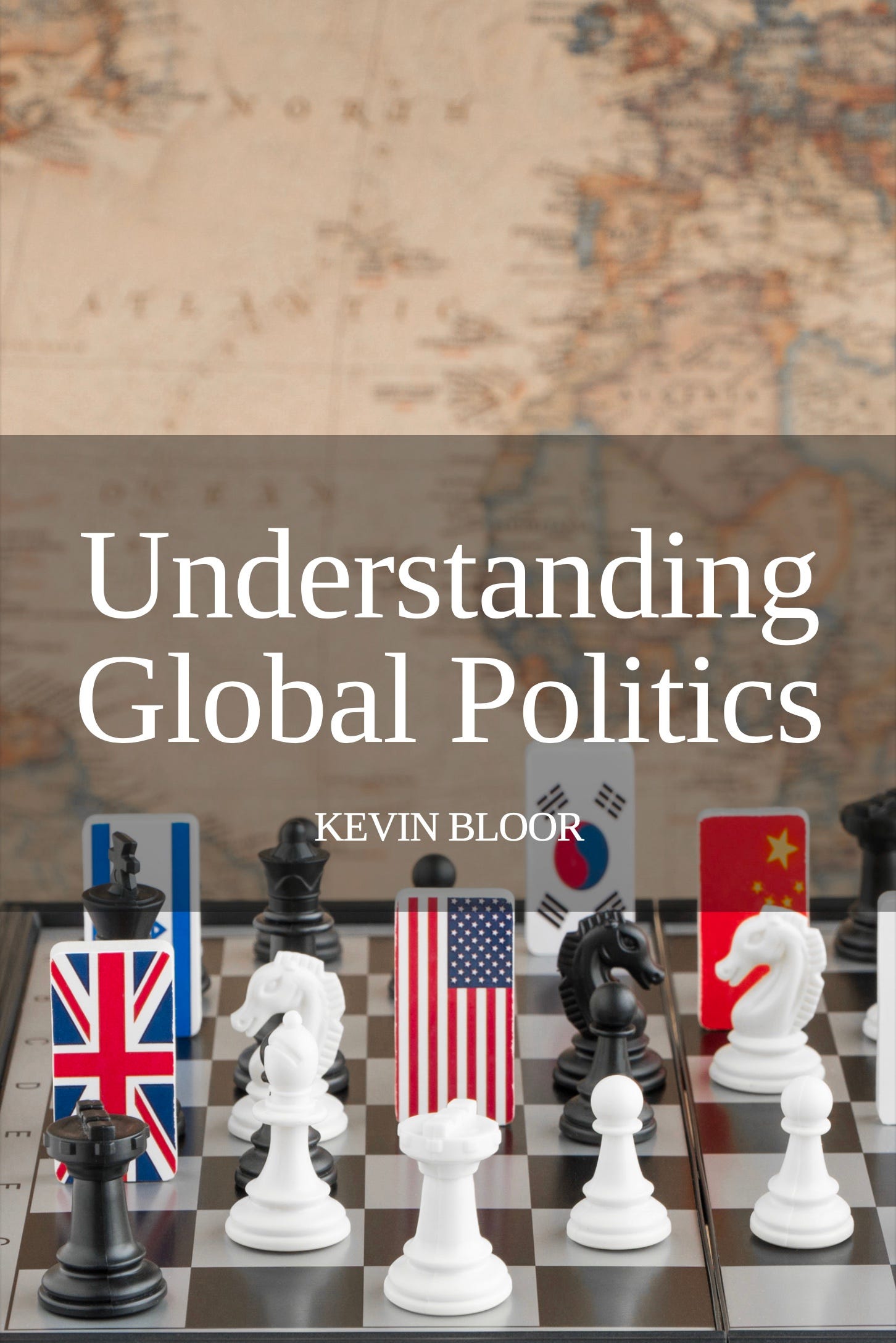
Download the book free of charge (below) or buy a paperback version on Amazon and in all good book stores.

This book is aimed at those with an interest in cultivating a clearer understanding of global politics. It will hopefully bring together those who are interested in the changing dynamics of the international system with those who seek to comprehend the often-bewildering pace of change in the world around them. Above all, it is aimed at those who recognise that in global politics the last page is never truly written. We therefore need a theoretical and conceptual framework in order to ground us in stormy waters. It is only through a better awareness that we can hope to offer any lasting improvement to the world we inhabit. The book is based on a popular A-Level Politics course, taken by students typically aged 16–18 in the UK’s national curriculum system and presents both as a guide to an A-Level student and/or a starting point for any reader looking to get to grips with the fundamentals of how the world works – including as preparation for embarking on an International Relations degree at university.
Accompanying the book is an online Glossary of Key International Relations Terms.
Get E-International Relations delivered to your inbox, free. As you sign up, consider becoming a paid subscriber, or make a donation, to support our work.
Kevin Bloor is an author, Principal Examiner and teacher. He has over twenty years of experience in the social sciences and is the author of several texts and educational resources such as Understanding Global Politics, The Definitive Guide to Political Ideologies, Understanding Political Theory and Sociology: Theories, Theorists and Concepts. He holds a BA in Politics and International Relations and an MA in International Relations, both from Staffordshire University, and an MPhil in Government from Manchester University.
A valuable contribution to the study and teaching of International Relations, particularly because it begins with a question that is often underestimated: how do we actually learn to understand a constantly changing international system?
The idea that “the final page is never truly written” is especially important. International politics is not a static structure that can be understood once and then permanently explained. Power shifts, alliances evolve, institutions adapt, conflicts transform, and actors continuously reinterpret their interests according to changing circumstances. For this reason, theoretical and conceptual frameworks are necessary—but they must remain open to revision when reality challenges their assumptions.
From a field-informed perspective, I would add that understanding global politics requires more than learning concepts such as sovereignty, power, security, conflict, cooperation, institutions, and international order. It also requires understanding how these concepts behave when they reach the ground.
The distance between a policy document and its implementation in a conflict environment can be enormous. Decisions made at the level of governments, international organizations, and strategic headquarters eventually encounter geography, local political structures, institutional capacity, human behavior, operational limitations, incomplete information, and rapidly changing conditions. It is often at this level that the real meaning of international policy becomes visible.
Afghanistan is an especially important example. The country has been at the intersection of international intervention, regional competition, counterinsurgency, state-building, alliance politics, terrorism, humanitarian policy, and great-power strategy. Yet understanding Afghanistan cannot be achieved solely through external strategic frameworks. The interaction between international decisions and field realities must also be studied.
This is why I believe that the future of International Relations education should connect three forms of knowledge more systematically: theoretical knowledge, empirical research, and lived operational experience.
Theory gives us conceptual tools. Research tests and refines those tools. Field experience reveals where reality confirms, modifies, or contradicts them.
The strongest understanding of global politics emerges when these three are brought into dialogue.
A book such as this is therefore valuable not simply as an introduction for students, but as an invitation to develop the intellectual habit of asking how global structures actually operate in the real world—and why the same international policy can produce very different outcomes in different societies.
For the next generation of students and practitioners of International Relations, the challenge is not merely to memorize how the international system has been explained. It is to develop the analytical capacity to recognize when the world is changing faster than our existing explanations.
That is where genuine learning begins.
— Wahidullah Noorzai
Former Senior ANCOP/ANP Officer | Field Strategist & Regional Security Analyst
NOPGC — Noorzai Operational Police Generation Center