


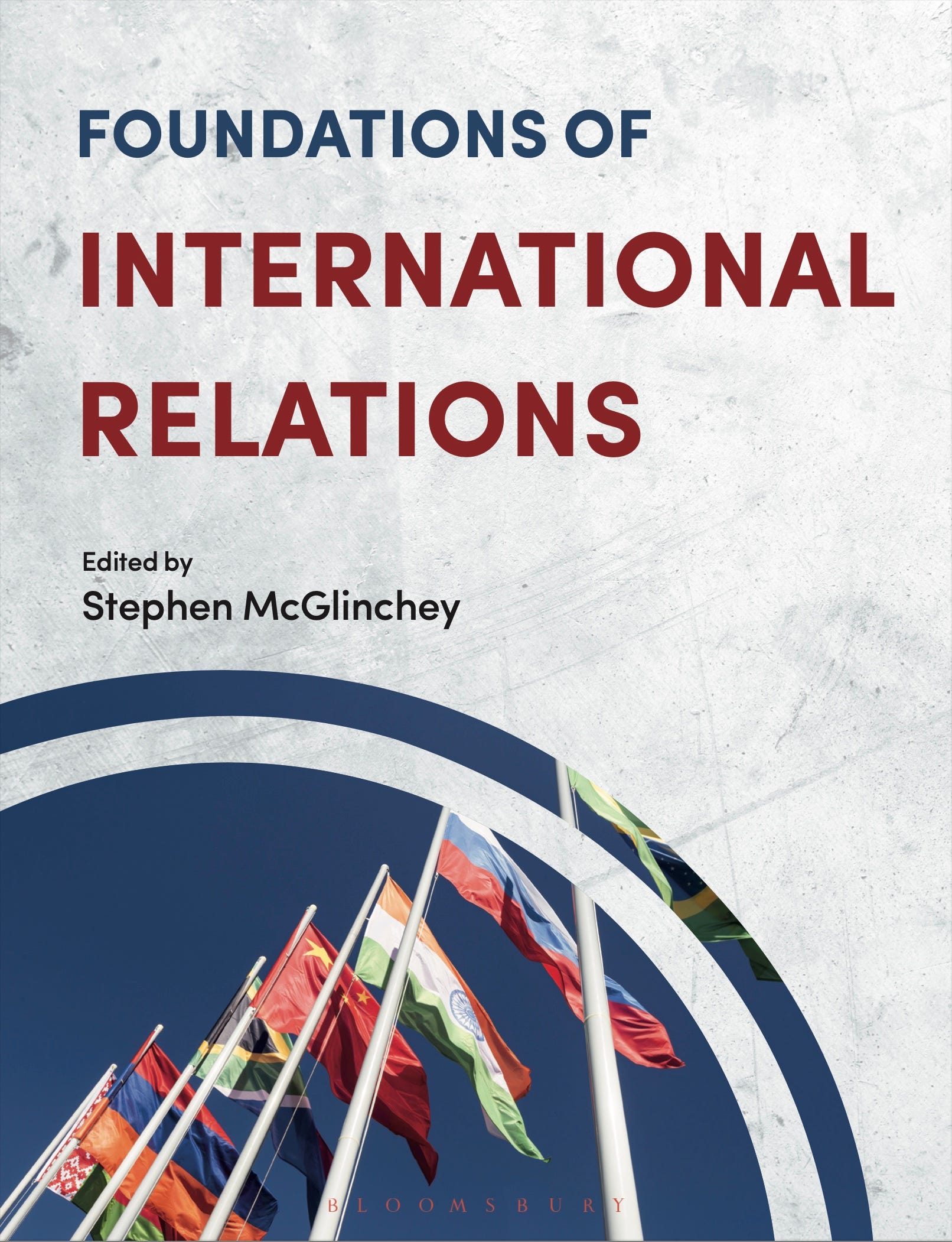
Download a full chapter preview below and find out more about the book on the publisher’s website.

E-International Relations has partnered with Bloomsbury to produce a fully featured textbook for beginners. With a diverse set of authors and chapters covering topics including race, colonialism, gender, sexuality, digital globalization, the environment and security studies, this textbook takes into account the historical development of International Relations and the web of dynamics that forms the subject, resulting in a clear analysis of the field from a variety of perspectives.
As this book is published by Bloomsbury – who have invested a substantial sum in producing the book to such a high quality we are unable to offer a free-to-download version of the book. However an earlier edition of this book from 2017 is available free on E-International Relations.
Get E-International Relations delivered to your inbox, free. As you sign up, consider becoming a paid subscriber, or make a donation, to support our work.
About the author
Stephen McGlinchey is a Senior Lecturer in International Relations at the University of the West of England, Bristol (UWE Bristol). He is Editor-in-Chief and Publisher of E-International Relations.
Table of contents
GETTING STARTED
1. Introduction to International Relations – Stephen McGlinchey
PART ONE: HISTORY AND THEORY
2. International Relations and the Global System (read online) – Stephen McGlinchey
3. Discovery, Conquest and Colonialism – Robbie Shilliam
4. Towards Global International Relations – Sahil Mathur and Amitav Acharya
5. Levels of Analysis – Carmen Gebhard
6. Traditional and Middle Ground Theories (read online) – Stephen McGlinchey and Dana Gold
7. Critical Theories (read online) – Stephen McGlinchey, Rosie Walters and Dana Gold
PART TWO: GLOBAL STRUCTURES
8. International Organisations – Shazelina Z. Abidin
9. Global Civil Society – Raffaele Marchetti
10. International Political Economy – Günter Walzenbach
11. International Law – Knut Traisbach
12. Religion and Culture – John A. Rees
13. Gender and Sexuality – Rosie Walters
PART THREE: GLOBAL ISSUES
14. International Security – Natalie Jester
15. Transnational Terrorism – Katherine E. Brown
16. Migration – Anitta Kynsilehto
17. Poverty and Wealth – James Arvanitakis and David J. Hornsby
18. Global Health – Mukesh Kapila
19. Environment and Climate (read online) – Raul Pacheco-Vega
20. Connectivity and Exploitation in the Digital Age – Clare Stevens and Andreas Haggman
REFLECTING ON INTERNATIONAL RELATIONS
21. Crossings and Candles – Peter Vale
Reviews
An immensely user-friendly introduction to International Relations, replete with diagrams, maps, illustrations and helpful summaries of the material covered. Such care for a student text has not been taken for a very long time.
— Stephen Chan OBE, Professor of World Politics, SOAS University of London, UK
Foundations of International Relations delivers a comprehensive explanation of International Relations that includes a thorough introduction to critical theories and non-western viewpoints alongside established IR theories and narratives. The approachability of the text and relevant case studies will leave students with the tools needed to understand and analyse international events.
— Jessica Neafie, Assistant Professor of International Relations, Nazarbayev University, Kazakhstan
The core strength of this textbook is the clarity it brings to explaining the many concepts and theories that make up International Relations – it introduces students to the nuance and complexity of the field in an exciting and accessible way. An excellent educational resource.
— Zoë Jay, Lecturer in Politics and International Relations, University of Tasmania, Australia
This introduction to International Relations is one of the most original and interesting to come to the market in a long while. Moving away from a purely European perspective, students will gain an understanding of traditional ideas about international organisation, whilst also appreciating how issues such as COVID and food security are truly international in scope.
— Anthony F Lang, Professor of International Political Theory, University of St Andrews, UK
Stephen McGlinchey has brought together a fantastic collection of authors who together present a wide-ranging, critical and accessible introduction to International Relations. Supported by helpful case studies, key insights and key term features, the book will enable its readers to navigate the complexities of global politics.
— Peter Sutch, Professor of Political and International Theory, Cardiff University, UK
Foundations of International Relations is a wonderfully rich, yet highly accessible, introduction to International Relations, both as a subject and as a discipline. Students are brought on an engaging intellectual journey through a range of contending perspectives and issues, whilst being encouraged to think critically throughout. They will find it challenging and rewarding in equal measure.
— Stephen Hill, Lecturer in Politics and International Relations, University of Edinburgh, UK
This innovative and well-written textbook takes students on an exciting historical, theoretical, geographical and thematic journey of International Relations. It is truly attentive to the multiplicity of (state and non-state) actors in global politics, as well as non-Western approaches. The book presents an impressive and well-thought pedagogical outline leaving students critically engaged and encouraged to apply their new knowledge of IR to specific, concrete cases. I highly recommend this unique book to both beginner and more advanced students.
— Andréas Litsegård, Senior Lecturer in Peace and Development Research, University of Gothenburg, Sweden
What makes an introduction to International Relations genuinely valuable is not simply the number of theories or global issues it presents, but whether it teaches the reader how to move from concepts to reality.
International Relations is ultimately tested in the field. States, institutions, armed groups, societies, economies and individuals do not always behave according to the assumptions of a theoretical model. They adapt to pressure, learn from outcomes, preserve options, and change their calculations as circumstances change.
This is why the relationship between theory and practice should not be one-directional. Theory helps us interpret reality, but reality must also be allowed to challenge, refine, or even correct our assumptions.
From a field-informed perspective, the analytical process begins with observation and experience, moves toward analysis and principles, and then returns to practice and outcomes. The outcome becomes feedback.
For me, one of the most important questions in International Relations is therefore not only “Which theory explains this event?” but also:
What did reality reveal that our existing assumptions failed to capture—and what should we change in our understanding after observing the outcome?
That is where International Relations becomes more than the study of international events. It becomes a continuing process of learning from reality.
Wahidullah Noorzai (NIDA)
Field Strategist | Military & Security Analyst | Field-Informed Strategic Reasoning